Author Archives: Admin

Announcing the release of THE REVENANT!

MP900384729Welcome to the party!


The wait is finally over! The Revenant is now available for purchase in hard copy on the Black Rose Writing (BRW)page, and online and in bookstores by the end of the month. I want to thank Reagan Rothe at BRW for helping to make my dream of being published a reality. Also thank you to Dave King, Design Lead at BRW for his amazing cover design and endless patience through the revision process.


Even though we’re taught not to judge a book by its cover, most readers will tell you cover art is key. I’ve had my front cover posted on my page for The Revenant for about a week now, but here is the complete cover:

Click to enlarge

Click to enlarge

Thank you to Dave King for his work on the cover art.

On with the festivities…

Here’s what the party agenda looks like so far. Keep checking back as more activities are added over the next two months!

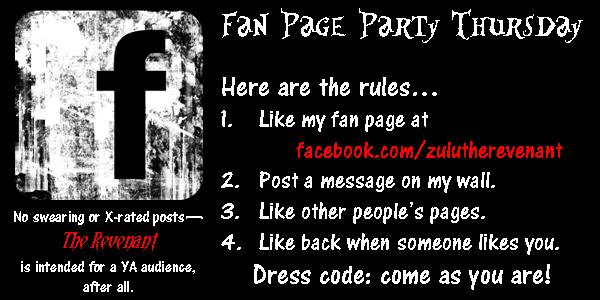
fan page party thursday


Join me on Facebook for a Fan Party meet and greet on my release date, this Thursday, July 10, 2014. Like people’s pages and get your page(s) liked as well.

new follow back friday


Join the party-hop as we move from Facebook to Twitter. I pledge to follow back everyone who follows me on Twitter on Friday, July 11, 2014 @eliseabram

going on tour


A number of really amazing bloggers and reviewers have opened up their blog sites so I can take The Revenant on tour in the month of August. Check back on my itinerary page for stops and updates as the tour takes shape.

giveaway


Use the form on my itinerary page to enter into a Rafflecopter draw for a chance to win one (1) of three (3) eCopies of The Revenant. The giveaway will run for the entire month of August. All you have to do for your chance to win is follow me on Twitter via the Rafflecopter form.

Also available as a giveaway, PDFs of The Revenant bookmarks and a study guide. Please request these via email at info @ eliseabram . com

Dear Mr. Alan Ball – An open letter to the writers of “True Blood”

Dear Mr. Alan Ball,

WTF dude? Seriously!

First you killed off Tara, whom, along with Lafayette and Jason provided much valued comic relief. It was bad enough you made her into a vampire. Then, just when we were getting used to the idea you kill her again, for real. Tara had it all: a strong female character who was smart, tough, beautiful, black and gay! We didn’t believe it at first. We thought that maybe it was a hallucination, or a dream, that the scene would change and Tara would still be engaging in hand-to-hand combat with a rabid vamp, but no. Tara had finally met her true death.

Maxine Fortenberry had to die, I get that. Since Hoyt left, she really didn’t have much of a role. Now Mrs. Fortenberry is free to take up permanent residence at her country home in Chester’s Mill. Good for her. But why Alcide?

You lulled us into a false sense of security. Sookie was in danger in spite of Vampire Bill’s protection, then came Sam, Alcide, Andy, Jason and the cavalry. Who could predict that when the smoke cleared there would be one random hillbilly (Joe Manganiello’s word, not mine) left to shoot Alcide. And in the head of all places!

I’m sorry, Mr. Ball, but when you killed off my beloved Alcide, you crossed a line. Why Alcide? Why not some of the more annoying characters, like Sookie or Bill?  My friends and I draw another line at Lafayette and Sam. Most of them draw the thickest line you could ever imagine at Eric.

I understand that the show began with Sookie alone until she met Bill and that it would be a neat full circle if it ended the same way, and that the show had to end at some point, but why must it end in letting the blood of our most cherished characters?

I don’t know what you have planned for the rest of the season, but you must stop the insanity! I don’t care what you have to do–re-write, re-film, re-contract–but whatever you do, no more killing off the main characters!

Thank you.

Elise and her “True Blood” buddies

A. Terry’s How-to Book for Blog Tours is a Recipe for Success!

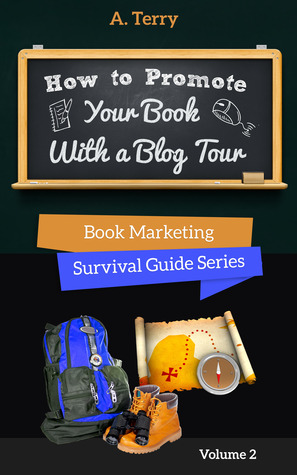
promote-book-blog-tour 

Just when I think I’m learning what it means to promote and publicize a book I’ve published, I’m thrown for a loop. I hadn’t heard about blog tours until recently. I’d always assumed that when the time came I’d find an affordable company to do it for me. Then I read How to Promote Your Book With A Blog Tour by A. Terry and I wondered why I shouldn’t be trying to do this on my own.

Terry’s How to Promote Your Book With A Blog Tour is an easy to follow step-by-step guide to planning, booking, tracking and wrapping up your blog tour. The book suggests materials you might collect prior to this endeavour, how to contact prospective bloggers, and alternatives to simple requests for reviews. Terry provides links to important sites and online exemplars. There is even a template for querying prospective blog tour hopefuls that I’ve used and find it works quite well, with a little modification.

I’m still in the process of organizing my tour.  At present, after approximately a week of sending out queries, I have four stops on my tour booked. Whether or not it works out will not be for lack of trying on my part.

Bottom line? A. Terry’s How to Promote Your Book With A Blog Tour is a recipe for success, sure to help ambitious, resourceful and persistent authors rise to the occasion of going it alone when it comes to planning and executing their book blog tours.

[Tweet “A. Terry’s “How to Promote Your Book with a Blog Tour” is a recipe for success.”]

My Writing Process: Catch as catch can!

Hello everyone! Welcome to my stop on the Writing Process Blog Hop! I was introduced to this blog hop by Lori L. Schafer:

Lori Schafer is a writer of serious prose and humorous erotica and romance. More than thirty of her short stories, flash fiction, and essays have appeared in a variety of print and online publications, and her first novel, a work of women’s fiction entitled My Life with Michael: A Story of Sex and Beer for the Middle-Aged, will be released in 2015. Also forthcoming in 2015 is her second novel Just the Three of Us: An Erotic Romantic Comedy for the Commitment-Challenged. On the more serious side, her memoir, On Hearing of My Mother’s Death Six Years After It Happened: A Daughter’s Memoir of Mental Illness, will be published in October 2014. When she isn’t writing (which isn’t often), Lori enjoys playing hockey, attending beer festivals, and spending long afternoons reading at the beach.

Website: http://lorilschafer.com/

Like my colleagues also participating in this blog hop, I’ve been asked to answer four questions about my writing and my writing process. Don’t forget to spend some time getting acquainted with authors Rosemary Whittaker, Val Conrad and Jolee Wilson whose bios and links are at the end of this post. Rosemary, Val and Jolee will be hosting the next stop on the blog hop next week.

1. What am I working on?

About a year ago I read a Writer’s Digest featured agent who said she’d be interested in reading a YA Time Traveler’s Wife. I loved that novel, and took it as a personal challenge. What I wound up with was I Am, Was, Will Be Alice something part YA Time Traveler’s Wife, part Alice in Wonderland, part YA romance (yuck!), and all adventure. I am participating in July’s Camp Nanowrimo to give me the kick in the pants to finally get Alice’s story told.

My first YA novel, The Revenant,  is to be released on 10 July 14 and so a good part of my summer will be spent on publicizing and selling that.

I am also working on an adult time travel love triangle novel called Chicken or Egg: A Love Story, not to mention the next instalment in the Molly McBride series, entitled The Next Coming Race, involving evidence of aliens having visited Earth in antiquity in the historic record.

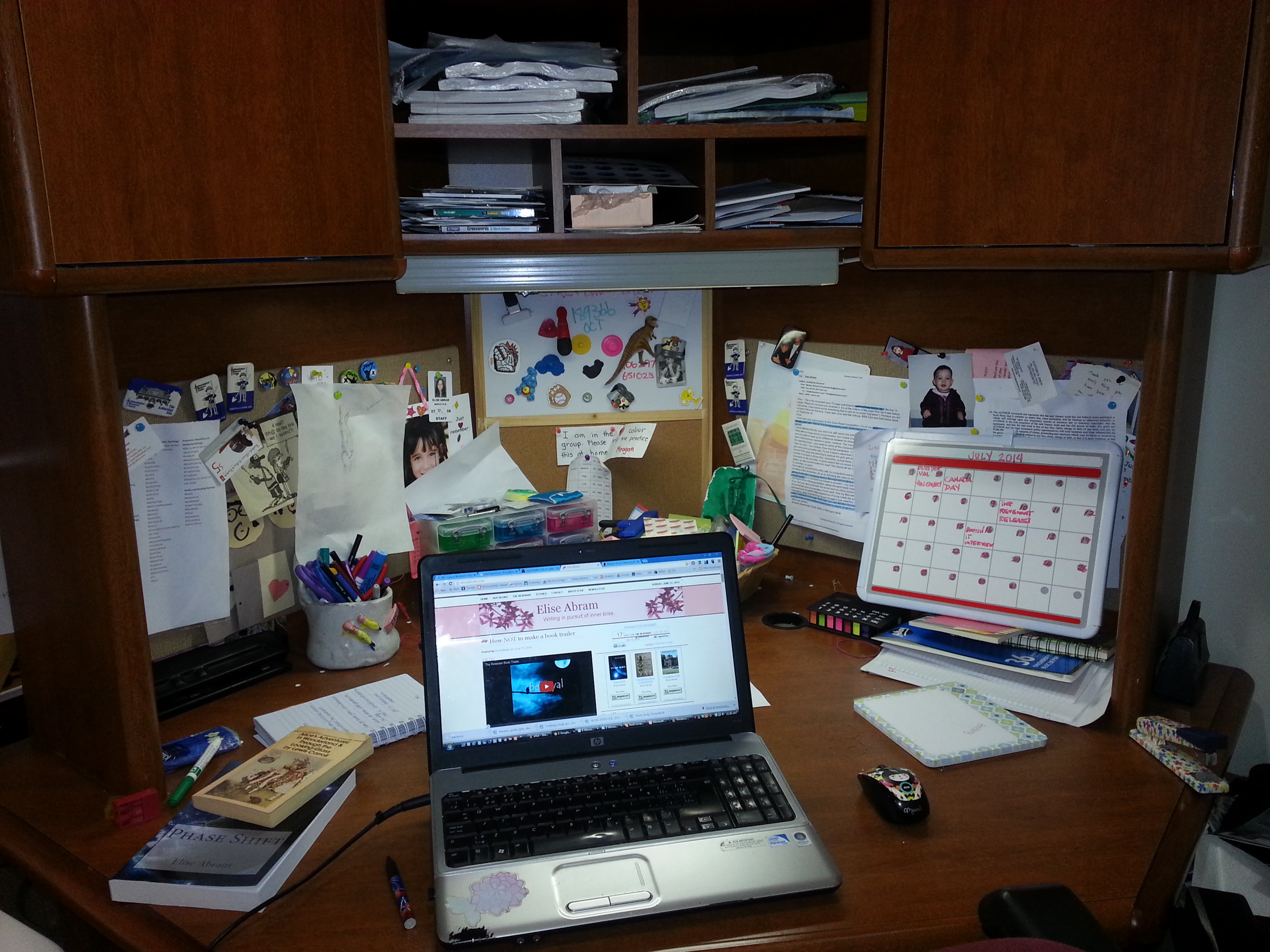
This is where I usually work:

My Writing Space

My writing space.

2. How does my work differ from others of its genre?

I suppose you could call my primary genre science fiction, but when I think of sci-fi I think of alien race wars, lots of tech, space ships, and robots. I call my brand of sci-fi feminine speculative fiction, a made up genre composed of a sort of light-sci-fi, no war (which is stereotypically masculine), modern day tech (also stereotypically masculine), but maybe with a few tweaks. If there is time travel involved, it is in the near future, less than 100 years and not that far removed from the society of today.

[Tweet “I call my brand of sci-fi feminine speculative fiction. That does not mean it only appeals to women.”]

Calling my brand of sci-fi “feminine” does not mean it is chick-lit or only appeals to women. Rather, it is sci-fi of the mind. It takes the world of today, proposes one change, and runs with it to see the effect it may have on society. Phase Shift explores what might happen if the ability to travel to alternate worlds were discovered. The Revenant (not unlike “X-Men” or “Heroes”) supposes there are people among us who have special abilities which some might use for good and others evil. Alice proposes a similar scenario – that people might one day evolve the ability to travel through time. Ditto Cat and Mouse, only this time, the ability for time travel is via technology and not genetic. 

I make small tweaks to people, beliefs and tech and sit back and watch what happens.

3. Why do I write what I do?

I consume popular culture like candy. I also question everything I consume. Star Trek was my first introduction into the world of sci-fi, introduced to me by my father at a young age and the ideas stuck. I grew up telling myself stories before bedtime between lights out and falling asleep. At some point I started writing them down. 

[Tweet “I consume popular culture like candy. I also question everything I consume.”]

It seems like I don’t choose what I write, but rather, it chooses me. Case in point is The Revenant, which grew from a desire to write the penultimate vampire story. The storyline wasn’t gelling so I decided to do some research and found a link on Wikipedia for revenants. The idea blossomed from there. You could almost say Zulu found me and started telling me his story. I really had no choice but to write it down.

4. How does your writing process work?

My first novel, The Guardian, took almost ten years to imagine and another ten years to write. This is partly because I was bogged down with the responsibility of being a new teacher, but also because I didn’t like the way I wrote and struggled over every word. When I took a page from Nanowrimo and just wrote to make up the word count and worry about the editing later, writing became more of a pleasure than a chore. The agony was still there in the revisions and re-writes, but at least the story had already been told.

[Tweet “Accepting you aren’t a real writer if you don’t write every day builds barriers to success.”]

Many sources you read will tell you that writers write every day. I’m here to tell you that’s not necessarily the case. Whole months go by where I don’t add to my current work in progress at all as far as word count goes, but I am always thinking about my work in progress and adding to the story. Taking frequent breaks like that helps the thoughts to percolate so that when I do finally sit to write, I know exactly what I want to say. Accepting that you aren’t a real writer if you don’t write every day is a good way to build barriers to your success. Life happens, especially if you are a student, or are juggling a full-time job with a family. Work on your story every day; write whenever you can.

[Tweet “Work on your story every day; write whenever you can.”]

Don’t forget to spend some time getting acquainted with authors Rosemary Whittaker and Val Conrad whose bios and links are at the end of this post. Rosemary and Val will be hosting the next stop on the blog hop next week.

[Tweet “Writing process blog hop! Get acquainted with authors @LoriLSchafer, @DanzaCRose, Val Conrad and @JoleeWilson!”]

Rosemary Whittaker:

Rosemary is a British born author. She is an English teacher by profession. Since leaving university she has lived and worked in the United States, New Zealand, Australia and twice in Denmark. Her husband works in biodiversity informatics (cataloguing all living species on earth) and this has entailed many moves. They have five children so the moves have been extra challenging.

Her real love has always been writing and she has written several novels, variously set in the countries in which she has lived. She also writes for children. All her novels are available on http://amzn.to/UXJUJp and http://amzn.to/1iUadT. Her recent novels, a set of four, all take the theme of British women who move, by choice or circumstance, to one of the four countries mentioned above. The Cinnamon Snail is set in Denmark, where Rosemary currently lives. [http://bit.ly/1puSPwJ]

Website: rosemarywhittaker.wordpress.com

Val Conrad:

Val Conrad’s life is upside-down to most – her nights are spent working as a nurse in intensive care, leaving her days and more often her nights off to writing.  Her series – Blood of Like Souls, Tears of Like Souls, Promises of Like Souls, and Secrets of Like Souls (Black Rose Writing) is available at Amazon in both paperback and e-book formats.  Much of the skeleton of these stories comes from living in the geographical settings and a career in medicine spanning decades.  She steals moments to write any time, but odd places and crowds of people don’t deter her.  She’s currently working on a new book about how cellular phones are being used to catch criminals.

Website: www.valconrad.com

Jolee Wilson:

Jolee Wilson lives in West Texas with her husband and three children. She has been writing as a hobby since age seven and decided to turn it into a career after the completion of her first novel, Seven Days Normal. With a passion to help hurting relationships, Jolee uses fiction to impart her own lessons in love.

Website: http://www.the-nkwell.blogspot.ca/

How NOT to make a book trailer

For years I thought that if I were ever in a position to need a book trailer I’d be independently wealthy and could hire a professional to do it for me.

Barring that, I’d use Flash. I have a basic working knowledge of Flash. I’ve had to teach it to Travel and Tourism students for use in their end of semester presentations, and I’ve had occasion to teach entire semesters of Flash Action Script through eLearning courses. I never considered that when the time finally came, the proliferation of operating systems and browsers that do not support Flash would make that option all but obsolete.

The only other software I had was Windows Movie Maker. My kid made a movie with it while still in grade school–how hard could it be? Little did I know, the software would be the least of my worries.

Here are my three pearls of wisdom of what NOT to do, should you ever consider to go it alone when making a book trailer.

[Tweet “3 pearls of wisdom about what NOT to do when making a book trailer.”]

Pearl #1 – use royalty-free but not for commercial use graphics

I never considered that what I was embarking on was a commercial endeavour. All I wanted to do was get the word out about my book release; I wasn’t ready to start selling books yet. Nevertheless, all of those people I alerted to the release of my book were potential buyers which ultimately made my project a commercial one.

Back to the drawing board.

I eventually stumbled upon Flickr.com (make sure you click “Commercial use allowed” on the licence tab) and foter.com (make sure you click “Commercial Use” at the top of the page after doing a search).  Keep in mind you must still check the licence to ensure you have fulfilled your end of the use agreement. Most of the pictures will say to link back to the Creative Commons agreement as well as give the photographer credit, which you can do in the rolling credits at the end of your trailer.

For music, try FreeMusicArchive.org.

Pearl #2 – forget to record your titles, artists and URLs as you go

As someone who just wrote a post entitled “Just Cite the Damn Cite!” I don’t know what I was thinking. Too absorbed with ensuring I wasn’t breaking copyright to realize that if I didn’t have the credits right I was breaking copyright anyway.

Open a NotePad file (or create a file on similar software or go old school and do it on paper) and record the title of each photo, the artist, and the URL (Flickr and foter seem to want a link to the author on their site and not directly to the author) as well as a description so you’re sure you attribute the correct photo to the correct photographer. List your photos in order of appearance in the credits (and say you are doing this in your credits).

Pearl #3 – use Windows Movie Maker

I’m not sure if this should be a “pearl” or not, but like all Windows products, Movie Maker has its ups and downs.

On the up side is its ease of use. Movie Maker has the same drag and drop functionality of any other Windows product making it sort of intuitive to learn.

On the down side is just about everything else. Though the learning curve for any new app is steep, it seemed insurmountable at times for Movie Maker. Problems included how to coordinate the video with the title overlay (video should come first but since mine was a book, I started with the text), getting “slides” close enough to eliminate pauses between them (which made bang-on coordination with the audio file near impossible) and having to convert my MP3 file to a WAV file before I could even import it (I used Zamzar.com). I also could not holistically change the font, but had to do it piecemeal, one “slide” at a time, which was aggravating because it was super time consuming. Also, Movie Maker only creates WMV files, which meant I needed to do yet another conversion to the less proprietary MP4. And I couldn’t change the background of the file so my  background graphic is a different colour than the surrounding “stage” (which continues to miff me to no end).

In the end I have a passable book trailer for my new release (on 10 July 14), The Revenant, that I can display with pride. I pass this on to you now because forewarned is forearmed. You  can create a sort of professional-looking book trailer on the cheap (FREE!) with a bit of time invested (weekends for a month) and a lot of patience.

[Tweet “Making a book trailer? You’ve gotta read this!”]

Did you find this article useful? Still have questions about creating a book trailer?  Let me know in the comments below.


Become an online review-collecting sensation

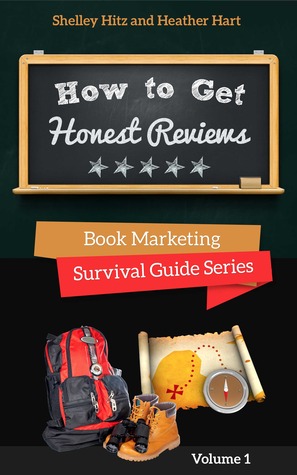
Book Cover

How to Get Honest Reviews

As an author, I can tell you that one of the hardest things is to get reviews for your work. When soliciting friends, relatives and social media followers, comes up nil, what does one do? How to Get Honest Reviews by Shelley Hiltz and Heather Hart is a detailed and precise guide that might help answer that question for authors in their pursuit of reviews for their work.

In their book, Hiltz and Hart leave no digital stone unturned for their readers. How to Get Honest Reviews is a catalogue of places and practical strategies anyone can immediately set into action in their search for reviewers. Of particular interest is the section on how to set up a book review program. Here, the authors include step-by-step instructions for everything from establishing a mailing list to templates to use and adapt to communicate with program participants.

Hiltz and Hart’s writing style is user-friendly and informative which makes for easy reading (if you ignore the awkward “I (author’s name)”  syntax used to introduce which of the two has written the current section). How to Get Honest Reviews makes readers feel as if, with a little elbow grease, they can become an online review-collecting sensations.

Please note that I was provided this book free by the authors in exchange for my honest review.

Just cite the damn site!

file0001149448379

To use someone else’s words without citing the person who wrote them, is illegal and subject to prosecution.

What does citing references mean?

According to Dictionary.com, to cite means to quote a passage from an authority, or to recall something. When we write, we recall who owns the copyright of the information we are quoting.

We live in a world where everything we create is copyrighted the moment it is saved to a device. According to Google, anything that is a work or invention of creativity, including a manuscript, is considered intellectual property, that which may be copyrighted, patented or trademarked. To use someone else’s words without giving him or her credit for positioning those exact same words in that exact order is theft of intellectual property, also known as plagiarism. In other words, to use someone else’s words without citing the person who wrote them, is illegal and subject to prosecution.

[Tweet “to use someone else’s words without citing the person who wrote them is illegal.”]

How do I protect myself from plagiarizing?

The answer is simple: cite, cite, cite!

How do I cite my references?

Citing references is a two-step process.

For step one, a note must be made at the exact place where you use someone else’s words. This is usually called an “in-text” citation, as it places the author’s name and other information (depending on whether you are using APA or MLA notation) in parenthesis (brackets) inside your text.

Step two is to include the complete reference for the original source material in a works cited list. Although the exact information and formatting will vary depending on the style you use, the basic information will include the author’s name, year and place of publication, and URL or publisher, depending on whether the source is print or digital in nature. Works cited are listed in alphabetical order, preferably by author’s last name.

Do I really need to use in-text citations if I have a works cited page?

The answer to this question is an emphatic yes!

Imagine a report card with a list of marks and no reference to teacher or course. This is kind of like a works cited list without in-text citations. Without indicating which information came from which source, a works cited list is useless. The idea is that you, as the author, uses in-text citations to show where a quotation comes from. If I’m interested in reading further, I know to go to the works cited list to find more information about the publication so I can find the same article and do more research. Without the in-text citation, I am left with a list of sources and no indication of which information came from where.

How often do I need to include in-text citations?

Any time you paraphrase, summarize, or directly quote anything that you didn’t write, you must cite it using in-text citations. This could mean having 1 or more citations for every sentence in your composition, depending on the type and requirements of the manuscript.

[Tweet “Any time you paraphrase, summarize,or directly quote anything that you didn’t write, you must cite!”]

It is always better to over-cite than to under-cite and be accused of plagiarism. I don’t know of any teacher who has ever complained because there were too many in-text citations in a term paper.

A final word

When it comes to citing sources, it is best to subscribe to the CYA school of thought–cover your ass! Cite everything you learn as a result of your research. Even if you think you might already know about the topic, cite one of your sources.

Give credit where credit is due; don’t forget to cite your sites.

“Orphan Black” is Mind Blowingly, Jaw Droppingly Satisfying

Kerplow!

That’s the sound of my mind being blown.

“Orphan Black” does it again with this week’s episode, “Knowledge of Causes, and Secret Motion of Things.”

[Tweet “”Orphan Black” is mind blowingly, jaw droppingly satisfying.”]

If you aren’t watching “Orphan Black”, you should be, so let me catch you up. Street thug Sarah Manning discovers she’s a clone after watching her “identical twin” commit suicide by train. She joins forces with her clone-mates, suburban housewife and mother, Alison Hendrix, scientist Cosima Niehaus, and her actual twin, the wild Helena, to figure out the story behind the clones’ origin.

This week, sick Cosima can be cured using Sarah’s daughter Kira’s stem cells; both Sarah and Kira are on board with sharing a little of Kira’s DNA. Dr. Aldous Leekie (love that name) is given a chance to live by evil clone Rachel provided he run and never look back. And Alison blabs about her role in her neighbour’s death to Vic (Sarah’s ex) who is selling her out to cop Angela Deangelis (Angel the angel – another great, if not redundant, name).

On to the mind blowing. Fuse Number One: the reunion of Sarah, Felix, Vic and Alison in a clever moment of comic relief.

The last time these four got together Vic lost a finger. Since then, he’s enrolled in rehab where he meets Alison. The two strike up an unlikely friendship which is understandable once we realize Vic plans to sell Alison out to Deangelis. This week was Family Day. Vic won’t send Alison up the creek if she arranges a meeting with Sarah so he can atone for his sins. Sarah and Felix arrive at the facility. Sarah is confused for Alison and forced to role play with Alison’s husband, Donny, with laugh out loud results. Poor Vic is drugged by Felix and everyone in the facility thinks he’s relapsed.

Donny is the key to Fuse Number Two.

Alison has always suspected Donny was her watcher. This week we learned he thought he was involved in a sociology experiment, like they did in university. Turns out he had no idea who he was actually working for or that Alison was a clone. When Alison accuses him of ruining their marriage, Donny seeks out Leekie, forces him into his car at gunpoint and Leekie confesses. Donny accuses Leekie of ruining his marriage. Leekie berates him. Donny gets angry and bangs his hand–and the gun–against the steering wheel. The gun goes off. Leekie’s brains are splattered all over the inside of the car.

My jaw dropped and stayed unhinged for several moments thereafter.

[Tweet “”Orphan Black” made my jaw drop and stay unhinged for several moments thereafter.”]

Then I laughed.

Then I cursed. How dare “Orphan Black” keep me hanging as to what comes next for an entire week?

I don’t know about you, but I can’t wait to see what happens next!


What is a Story Cartel?

dinghy

…when it’s done, we’d connect our dinghies in an everlasting virtual cartel…

I’ve just entered Joe Bunting’s contest to win one of three memberships in his next Story Cartel group.

Here is my entry:

The writer’s group I belonged to disbanded a number of years ago. Since then, I’ve been afloat without a paddle in a small rubber dinghy with room enough for one. There is a teeny tiny hole in the bottom of the boat. Most of the time I am able to plug it with my finger and forge on with my writing. Sometimes the waters of self-doubt seep in and no matter how quickly I paddle, I cannot stave the flow. Belonging to a writer’s cartel would help connect me to a group of passionate, like-minded individuals. We would listen to each other’s tales and offer support, advice, and encouragement, patching each others’ dinghies. We would teach each other what we’ve learned about the world of publishing, make connections with fellow cartelistas, and build our readership. Then, when it’s done, we’d connect our dinghies in an everlasting virtual cartel and sail off to apply what we’ve learned, posting the occasional tweet about a fellow cartelista that reads “I knew him or her when.”

Wish me luck!

Overcoming Writer’s Doubt

This blog post represents my entry in the “Overcoming Writer’s Doubt” Writing Contest held by The Positive Writer.

[Tweet “Read Elise Abram’s entry in the “Overcoming Writer’s Doubt” #Writing #Contest.”]

“I wish I could write like that,” I said to my husband. We were in the car heading home from the theatre having just seen “The Mummy Returns.”

“You can,” he told me, and for the first time, I shared the story that had been tumbling around in my head for the twenty or so years prior.

The rest of that summer was spent in the eye of a perfect storm of creative fury, spurred on by my love for science fiction, the abundant resources of the Internet, and the fact that I had been tasked to teach Writer’s Craft that coming September. As I researched the finer points of structuring plot, character, imagery and theme while preparing my lessons, the trickle of words I’d only ever been able to muster soon became a deluge. In my dreams I saw my novel on the shelves of bookstores and on bestsellers’ lists worldwide.

Nearly ten years passed before my masterpiece was complete and I was ready to shop for the perfect venue for my book. Back then, few publishers and agents were accepting submissions via email. Printing out my novel and mailing it was cumbersome, not to mention expensive. I soon succumbed to doubt and gave up on my writing career before it had even begun.

Then the next idea took root.

I ignored it at first, reluctant to take another ride on the writing roller coaster. Before long, the incessant chatter of the characters could not be silenced by anything other than my transcribing their story.

[Tweet “I ignored the idea, reluctant to take another ride on the #writing roller coaster.”]

Five years later Phase Shift was finished. A few more publishers and agents were accepting unsolicited manuscripts than before, but not many. After a year of fighting the good fight, and another twenty or so rejections added to my pile, I realized my submissions had amounted to nothing more than expensive lottery tickets. Actually, I’d convinced myself, I probably had a better chance of winning the lottery than getting published.

I took time to lick my wounds, wallow in writer’s doubt and decide if the writing life truly was for me.

I was teaching grade ten English at the time. Over a period of about three years, I’d listened to near a thousand student presentations on young adult novels. Every semester my awe at the torture YA novelists foisted on their characters grew; global apocalypse, false accusation, abuse, addiction, pregnancy, murder–no topic was sacred.

In my discussions with them, the librarians at my school encouraged me to write YA. At first, I had no clue where to begin. I’d always wanted to write a vampire story, I thought, so I began where I’d begun almost every project I’d ever tackled–doing research. It was during the  research phase I discovered revenants, kissing cousins to vampires in traditional lore. I soon realized I’d stumbled upon an untilled field of possibility. As little was known about revenants, I could shape them into almost anything I wanted.

Coincidentally, Nanowrimo was not far off that year. If I could force myself to stick to the regimen the contest demanded, I could bang out most if not all of my first draft in as little as thirty days. In spite of the demands of my job and my family, I “won” Nanowrimo and spent most of the next six months finishing and polishing my manuscript.

I felt good. I’d written my best work yet. I was going to be published by a traditional publishing house, but not before a knock-down drag-out bidding war between publishing bigwigs for the rights to my book. I was going to be the next Stephanie Meyer! The next J.K. Rowling! Bigger!

And then I began to send out queries.

When the responses started to roll in, elation was replaced with the first buds of writer’s doubt.

[Tweet “When the responses started to roll in, elation was replaced with the first buds of #writer’s doubt.”]

“Your book doesn’t seem right for us.” I could deal with this kind of rejection;  the problem wasn’t me, it was them. I soldiered on, but with each successive rejection I started to realize maybe the problem was me. What if It was worse than me? What if it was my writing? I could always change a plot or write a new story, but if my writing was the problem…?

With each new rejection it became harder to navigate the waters of the river of writer’s doubt without slipping under.

I decided to focus on my next novel (which I tentatively titled I Am, Was, Will Be Alice), allowing The Revenant to stew on the back burner for a while. I liked my Alice novel. I liked The Revenant, too, but if it wasn’t meant to be then I’d have to write another magnum opus and try again. I believed in The Revenant, even if no one else did. I took a course on how to market a book, resolving to self-publish and run with it myself if no one had picked it up by the summer.

Then the gloriously unthinkable happened: one of the publishers I’d contacted was interested in publishing my book. A week after I’d heard the news I’d signed the contract. The stormy waters of self-doubt settled, the clouds parted, the sun came out. I might have heard harp music and choral angels sing.

I was going to be published!

I’m not going to lie and say I’ve managed to permanently banish writer’s doubt from my life. As long as my success hinges on how well others receive my work those thin tendrils of writer’s doubt, the ones that threaten to take root and sprout buds will always be there.

Let’s just say I’ve managed to prune back the branches for the time being.

The Revenant, a YA paranormal adventure novel by Elise Abram is set for a 10 July 14 release by Black Rose Writing.

[Tweet “Watch for The Revenant by Elise Abram, released on July 10 by Black Rose Writing.”]