Tag Archives: writing

How to write a book review in 3 easy steps

In today’s uber-wired society, most of us are bloggers. Think about it…you’ve probably already posted something on Twitter (microblogging) or Facebook (slightly longer microblogging). Or maybe you’ve used Tumblr (graphic blogging), Snapchat (also graphic blogging) or even YouTube (video blogging–or vlogging). Most of us have something to say about…well… something.

Most of us are also consumers of some kind of  popular culture, be it books, magazines, games, television or the movies. We watch voraciously. Some of us read that way, too. Most eBook sites invite users to review the books they read in order to generate sales. For us consumers, the people who pay the producers of popular culture, what better way is there than to voice an opinion on our satisfaction with the products we’ve purchased with our hard earned money than to write a review?

It’s not all that hard, really. Just three easy steps to reviewing success.

But if you’re going to review and post your review, you have to do it responsibly. Think of it this way–if you don’t understand a painting you see in the museum you wouldn’t stand in front of the museum with a sign saying “Don’t See This Painting!” Okay, so maybe some of you would. But that doesn’t make it okay. Authors put most of their blood, sweat and tears over the course of months or years into everything they write. That kind of devotion must be respected, no matter what you think about the end product. Just remember that at the receiving end of every review is a flesh and blood person with feelings and you should be okay.

Now, as promised, 3 steps to writing a good book review…

Step 1 – The Retell

Your first paragraph should retell some of the important plot points that lead up to but do not reveal the climax. Introduce main characters and their relationships and why they’re important to the story.

Step 2 – The Analysis

Every novel is written with a social conscience. This is the injustice the author sees in society that he thinks he can draw attention to by writing about it. Academics call this “theme”.

Discuss the theme in your analysis. Think about the voice and tone of the narrator; what about this is unique? Were there any recurring symbols or images and if so, how did they affect your understanding of the theme?

Step 3 – The Reflect

This is where you make connections with your understanding of the world around you. How does the novel relate to anything else you’ve ever heard or seen or read?

Lastly, discuss what you thought of the book, but before you do, try to figure out why you really liked or disliked the piece. Rather than say “The point of view is awful,” try to find a reason why you hated it so much. Maybe you didn’t like the idea of a male protagonist. Maybe  you are used to first person narratives and you just don’t get the second person viewpoint. Try to remember that this is your interpretation based on your life and reading experience and not about a major flaw in the author’s storytelling ability.

End your post with a call to action. Ask what others think in general or about a specific aspect of the work and invite them to leave a message with their opinion. Don’t forget to answer everyone kind enough to post.

What did you think?

Was this article helpful? Drop me a line letting me know why or why not. Feel free to post your book review here for feedback.

Guest Blog Post Announcement!

20 May 2013


I am proud to announce the publication of a guest blog post on TheWritePractice.com website.

Showing, not telling, is the mantra I use with my students in the first months of teaching Writer’s Craft. I tell them they must paint a word picture, using sensory information from all five senses. The trick is in finding balance between when to show and when to tell.

The post’s direct link is http://thewritepractice.com/word-pictures Please feel free to visit the site and post in the comments. I will make every effort to get back to you after posting.

2 May 2013

I am proud to announce the publication of my first guest blog post on the WriteToDone.com website.

Modelling expert text is something I learned about in teachers’ college and have used many times over the years, both as a tool with which to develop my own writing voice (as I discuss in the article) as well as with my students as a writing exercise.

The post’s direct link is http://writetodone.com/2013/05/02/develo-your-narrative-voice-by-stealing-from-bestselling-authors/. Please feel free to visit the site and post in the comments. I will make every effort to get back to you within 24 hours of posting.

Guest Blog Post Announcement – 20 May 2013

I am proud to announce the publication of a guest blog post on TheWritePractice.com website.

Showing, not telling, is the mantra I use with my students in the first months of teaching Writer’s Craft. I tell them they must paint a word picture, using sensory information from all five senses. The trick is in finding balance between when to show and when to tell.

The post’s direct link is http://thewritepractice.com/word-pictures/. Please feel free to visit the site and post in the comments. I will make every effort to get back to you within 24 hours of posting.

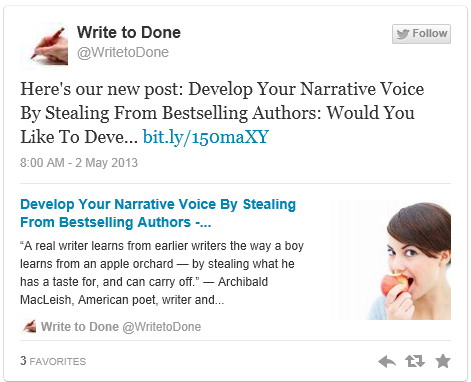
I am proud to announce the publication of my first guest blog post on the WriteToDone.com website.

Modelling expert text is something I learned about in teachers’ college and have used many times over the years, both as a tool with which to develop my own writing voice (as I discuss in the article) as well as with my students as a writing exercise.

The post’s direct link is http://writetodone.com/2013/05/02/develo-your-narrative-voice-by-stealing-from-bestselling-authors/. Please feel free to visit the site and post in the comments. I will make every effort to get back to you within 24 hours of posting.

Above is the Twitter announcement for the post:

If a tree falls in the forest…?

image

If a tree falls in the forest does it make a sound? Does anyone care that it’s fallen? More precisely, if I complete a manuscript, publish it, and no one reads it, can I still call myself a published author? 

That sounds weird: me; a published author. It took a lot for me to admit I aspired to be an author, as I thought it would be viewed as a frivolous pursuit. I think it was because I was pushed hard growing up to do the right thing to become independent and successful. I pursued archaeology as a career instead, something I loved and which my mother supported, my father didn’t understand and my grandfather ridiculed. Yes, ridiculed. “Find any gold, yet?” he used to joke every time he saw me. I wish I could chalk it  up to old world mentality, that archaeology, the search by those in the present seeking to understand those in the past is lost on those who have lived through it, but my grandfather was second generation Canadian and probably younger than my mother is now (i.e., not that old). My father, an avid reader of the newspaper, cover to cover, each and every night, with his grade 9 education and demeanor too weak to tell my grandfather that he should demonstrate pride in lieu of derision for his granddaughter’s accomplishments, ironically would have understood.  Though not a fan if fiction, he would have supported my endeavour, recognized it as a noble pursuit (much in the same way I marvel at my son’s artistic ability, as something I could never, no matter how many lessons or how much effort, could duplicate). With the eye for detail he’d groomed over years spent in the printing industry, he’d have made me excellent proofreader.

It turns out, people actually believe writing, publishing, is a noble pursuit. I had an interesting discussion with my cousin, just last week that demonstrated this for me. He’d asked how my book was selling. I told him I was selling copies at the rate of about one a month. He’d picked up on my disappointment and told me that, nevertheless, I had sold copies and I could call myself a published author which was more than most could say. I reminded him that I’d self-published and anyone could do that. He reminded me that few people did and he pointed out I was the only one he knew who did. I also think about my mother and how she practically begged me to get her a print copy. I reminded her that she would be better suited to an e-book with which she could adjust the text size until so she could actually read it. I don’t think she was happy about my suggestion, but she agreed. Tell people you’ve published an e-book and they congratulate you; show them the physical book and they’re impressed. Show to make an impression; don’t tell—what author hasn’t heard that old saw?

As for me, I continue to write for the same reason I continue to teach, for the same reason I cling to my lottery fantasy of leaving it all to run an archaeology camp in the backyard of an old Victorian  somewhere in the city—because it’s my passion. Always has been, for as long as I can remember (except for the lottery fantasy which has only been around for 20 years or so). I continue to cling to the “if you build it, they will come” school of thought—if I continue to write,  publish,  and publicize,  like Shoeless Joe and his teammates and fans, the readers will eventually come.

In droves.

About the Author
Elise Abram, English teacher and former archaeologist, has been writing for as long as she can remember, but it wasn’t until she was asked to teach Writer’s Craft in 2001 that she began to write seriously. Her first novel, THE GUARDIAN was partially published as a Twitter novel a few summers back (and may be accessed at @RKLOGYprof). Nearly ten years after its inception Abram decided it was time to stop shopping around with traditional publication houses and publish PHASE SHIFT on her own.

Download PHASE SHIFT for the price of a tweet. Visit http://www.eliseabram.com, click on the button, tweet or Facebook about my novel and download it for FREE!


Graphic taken from http://writers-write-creative-blog.posterous.com/quotable-donna-tartt

THE PURCHASE and Point of View

Whether consciously aware of it or not, the point of view from which a story is told can make or break the story. The most popular points of view are first person—in which the reader sees the events unfold through the eyes of a single character, including their thoughts and feelings—and third person. There are typically three types of third person narrative. The first is limited, essentially another take on the first person narrative. In third person limited, the reader can only know, see and feel what the point of view character knows, sees and feels. In third person omniscient, the reader experiences the narrative from a variety of people’s points of view. In third person objective, the narrator tells the plot as if the reader were viewing a movie, taking in all of the characters’ expressions and actions, but with none of the characters’ thoughts and feelings expressed in the narrative, other than those responses which can reasonably be observed.

The Purchase by Linda Spalding is about Daniel Dickinson, a Quaker living at the turn of the nineteenth century, who is excommunicated after his wife dies and he marries Ruth, the fifteen year old Methodist orphan living with his family as a servant. Disillusioned with his former life and feeling as if he has no future, Daniel moves his five children across the country to settle in Virginia. At an auction to purchase farm equipment, Daniel inadvertently bids on a slave and is bullied into giving up his favourite horse as collateral for the purchase and taking the eight year old boy, Simus, home with him. Thus begins (if I may borrow a phrase) a series of unfortunate events for Daniel as his family grows and he tries to build first a house and then a mill on his land.

The story is told from the point of view of an omniscient narrator, following each character’s thoughts, feelings and actions as the scene unfolds. This allows the reader to glean information that the main character(s) may not have. The following passage demonstrates Spalding’s expert use of this narrative technique:

“If we take my children to Virginia, thee could travel as a wife.” It was possible, [Daniel] supposed now, looking back at her unwashed face, that she had never had a book of her own. “Thee may borrow my Aeneid,” he called back to her, “with due care to its binding.” He turned to smile, but she had lowered her head and did not see.

But I am reading it just now, Mary wanted to say. That book was the one thing she shared now with her father. It was theirs. She stayed silent.

If this were written from Daniel’s point of view, we would not know that Mary wants to say something to her father but chooses to remain silent. Spalding also uses this technique to hide from Mary that her husband was involved in Simus’ murder. The reader knows it was reluctantly so and that he tried to stop it and gave up and left before the actual murder took place, information Mary never finds out.

The Purchase is written in third person omniscient, but it is more a cross between this and third person objective, as many character thoughts and motivations are hidden. Ruth is the best example of this. Though she is present throughout and the reader knows she struggles with her position in the family, little is shown with respect to her emotions. Next to Daniel, the well-meaning but aloof patriarch, the most detailed, well-rounded character is Simus. Though he is around for perhaps only half of the novel, his life and death act as catalysts for most of what occurs in the plot. Mary, the eldest daughter, and Bett, a slave girl with whom Mary lives, befriends, and helps escape, aren’t as fleshed out as I would have liked. Though Mary gains local notoriety as a healer while secretly using Bett’s salves and potions, Bett only expresses fear at being caught, for it is against the law for blacks to medically treat whites. I would have liked to have known more about Bett’s feeling with respect to what happens in the story, as I felt the real story lay in the relationship between Simus, Bett, Bry (Bett’s son, the result of her being raped by her owner) and Mary, who form the closest thing to a family portrayed in the book.

Spalding’s choice to use this point of view allows her to expand her story, giving the reader snapshots into the lives of characters beyond Daniel and what he knows about his family’s goings-on. In this fashion, the author expertly layers the story, drawing the reader’s curiosity, rendering The Purchase a page-turner; the pace is quick, the chapters are short and the narration is easy to follow. The novel explores the themes of perseverance in the face of adversity, alienation, religious faith, and the make-up of family. Spalding draws thought-provoking parallels between the slavery of blacks and the servitude of women. Daniel remains cold to Ruth throughout. They do not have relations until they are several years into their marriage. Even then, he is aloof with her and quick to lay judgement. In many ways, He treats Ruth as more of a slave than either Simus, Bett or Bry, figuratively lashing out at her when she disobeys him or tries to assume ownership of the new homestead, he does not forge a relationship with her and goes to her only when he wants to have relations. This parallels Bett’s plight. Her owner (the Fox family) literally lashes her when she disobeys them, they forge no attachment with her and the owner uses his female slaves whenever he wants to have relations.

The Purchase intricately weaves the stories of the members of the extended Dickinson family into the harsh realities of pioneer life using a great deal of irony in the telling. The story itself is told darkly, but the end message is uplifting and emotionally and spiritually satisfying.

Download PHASE SHIFT for the price of a tweet. Visit http://www.eliseabram.com, click on the button, tweet or Facebook about my novel and download it for FREE!

“The Purchase” and Point of View

imageWhether consciously aware of it or not, the point of view from which a story is told can make or break the story. The most popular points of view are first person—in which the reader sees the events unfold through the eyes of a single character, including their thoughts and feelings—and third person. There are typically three types of third person narrative. The first is limited, essentially another take on the first person narrative. In third person limited, the reader can only know, see and feel what the point of view character knows, sees and feels. In third person omniscient, the reader experiences the narrative from a variety of people’s points of view. In third person objective, the narrator tells the plot as if the reader were viewing a movie, taking in all of the characters’ expressions and actions, but with none of the characters’ thoughts and feelings expressed in the narrative, other than those responses which can reasonably be observed.

The Purchase by Linda Spalding is about Daniel Dickinson, a Quaker living at the turn of the nineteenth century, who is excommunicated after his wife dies and he marries Ruth, the fifteen year old Methodist orphan living with his family as a servant. Disillusioned with his former life and feeling as if he has no future, Daniel moves his five children across the country to settle in Virginia. At an auction to purchase farm equipment, Daniel inadvertently bids on a slave and is bullied into giving up his favourite horse as collateral for the purchase and taking the eight year old boy, Simus, home with him. Thus begins (if I may borrow a phrase) a series of unfortunate events for Daniel as his family grows and he tries to build first a house and then a mill on his land.

The story is told from the point of view of an omniscient narrator, following each character’s thoughts, feelings and actions as the scene unfolds. This allows the reader to glean information that the main character(s) may not have. The following passage demonstrates Spalding’s expert use of this narrative technique:

“If we take my children to Virginia, thee could travel as a wife.” It was possible, [Daniel] supposed now, looking back at her unwashed face, that she had never had a book of her own. “Thee may borrow my Aeneid,” he called back to her, “with due care to its binding.” He turned to smile, but she had lowered her head and did not see.

But I am reading it just now, Mary wanted to say. That book was the one thing she shared now with her father. It was theirs. She stayed silent.

If this were written from Daniel’s point of view, we would not know that Mary wants to say something to her father but chooses to remain silent.  Spalding also uses this technique to hide from Mary that her husband was involved in Simus’ murder. The reader knows it was reluctantly so and that he tried to stop it and gave up and left before the actual murder took place, information Mary never finds out.

The Purchase is written in third person omniscient, but it is more a cross between this and third person objective, as many character thoughts and motivations are hidden. Ruth is the best example of this. Though she is present throughout and the reader knows she struggles with her position in the family, little is shown with respect to her emotions. Next to Daniel, the well-meaning but aloof patriarch, the most detailed, well-rounded character is Simus. Though he is around for perhaps only half of the novel, his life and death act as catalysts for most of what occurs in the plot. Mary, the eldest daughter, and Bett, a slave girl with whom Mary lives, befriends, and helps escape, aren’t as fleshed out as I would have liked. Though Mary gains local notoriety as a healer while secretly using Bett’s salves and potions, Bett only expresses fear at being caught, for it is against the law for blacks to medically treat whites. I would have liked to have known more about Bett’s feeling with respect to what happens in the story, as I felt the real story lay in the relationship between Simus, Bett, Bry (Bett’s son, the result of her being raped by her owner) and Mary, who form the closest thing to a family portrayed in the book.

Spalding’s choice to use this point of view allows her to expand her story, giving the reader snapshots into the lives of characters beyond Daniel and what he knows about his family’s goings-on. In this fashion, the author expertly layers the story, drawing the reader’s curiosity, rendering The Purchase a page-turner; the pace is quick, the chapters are short and the narration is easy to follow. The novel explores the themes of perseverance in the face of adversity, alienation, religious faith, and the make-up of family. Spalding draws thought-provoking parallels between the slavery of blacks and the servitude of women. Daniel remains cold to Ruth throughout. They do not have relations until they are several years into their marriage. Even then, he is aloof with her and quick to lay judgement. In many ways, He treats Ruth as more of a slave than either Simus, Bett or Bry, figuratively lashing out at her when she disobeys him or tries to assume ownership of the new homestead, he does not forge a relationship with her and goes to her only when he wants to have relations. This parallels Bett’s plight. Her owner (the Fox family) literally lashes her when she disobeys them, they forge no attachment with her and the owner uses his female slaves whenever he wants to have relations.

The Purchase intricately weaves the stories of the members of the extended Dickinson family into the harsh realities of pioneer life using a great deal of irony in the telling. The story itself is told darkly, but the end message is uplifting and emotionally and spiritually satisfying.  

A Tale of Two Villains

image

The Once Upon a Time showdown we’ve all been waiting for unfolded last night, and it did not disappoint.

Last night’s episode, “The Outsider”, might have been subtitled “A Tale of Two Villains”, as it pitted Hook against Rumple in a battle, both of wit and strength. Hook, who puts Belle in danger to get Gold out of his shop so he can steal a shawl, Rumple’s prized possession, thinks with his head. Ordinarily, I would argue Hook is no match for The Dark One who pens iron-clad contracts, tricking those with which he bargains into thinking wish fulfillment is within their grasps. But this is not the old, lonely, bitter Rumple. Forging a relationship with Belle whilst believing a reunion with his son is within reach, Rumple is vulnerable. When he saves Belle on The Jolly Roger, he turns his anger on Hook, playing into his trap. The beating he inflicts on the pirate is both disturbing and comic; Belle’s reaction both touching and foolish.

Colin O’Donoghue plays Hook with slimy, sexy, smarminess. His proximity to Belle while threatening her on The Jolly Roger is both scary and (for lack of a better term) hot. But the real showstopper is Robert Carlyle in the role of Rumple/Gold. I melted when, after Belle is trapped in the elevator by Hook, the doors open to reveal Rumple and he and Belle hug. I cringed throughout Hook’s beating, reminiscent of a similar assault perpetrated by Gold on Moe French in season one. I grew excited at the prospect of Rumple in the real world after he crosses the town line and my brain began forming scenarios as to how the search for his son, Baelfire, might play out.

The last minutes of the episode are demonstrative of how a true cliff-hanger should play out. Belle shot. Rumple’s hand covered in her blood. A speeding car. Rumple dropping and rolling he and Belle from harm’s way. Hook hit. Brilliant. The one thing with the ability to top this: next week’s trailer. In the clips, an unconscious Belle lies in her hospital bed. Thinking, no doubt, she will awaken after sharing true love’s kiss, Rumple kisses her. Belle opens her eyes, sees Rumple, and screams, recoiling as she does. The implications are gut-wrenching and exhilarating at once. Oh, and let’s not forget the backstory clip that shows Rumple kissing Cora, which raises the obvious question: could Rumplestiltskin be Regina’s birth father? Is that why he took her under his magical wing?

On the deck of The Jolly Roger, Hook sums it up best when he tells Gold he looks more like the coward he remembers. Rumple, the man, is at his most vulnerable when he has something to lose. Branding him as The Village Coward was unfair. He ran from battle during The Ogre Wars because he had something to live for (his wife and child) and didn’t want to die. He gave fealty to the soldier in front of his son because he wanted to escape and get Bae to safety. He didn’t fight Hook in Storybrooke because he knew they were no match, so he appealed to his sense of decency (which, unfortunately, Hook failed to cultivate) instead. As The Dark One, he had nothing to fear. Finally, he had the means to protect his son. When Bae was lost, he was free to pedal his deals, searching for a way to be reunited with his son all the while.

Belle represents Rumple’s vulnerability personified. When he thought she was dead, he was strong. Since she’s returned, it’s been amusing to watch Rumple embrace his reluctant weakness, sparring with his inner-coward as it threatens to bleed through his hardened exterior. With Belle removed from the equation, will Rumple lose himself in The Dark One once more? Will Rumple be cashing in Emma’s favour IOU? Was Neal the driver of the car? Was it Bae? Are the two one and the same?

Next week’s episode is entitled “In the Name of the Brother”. Speculation has been this episode will focus largely on Dr. Whale/Frankenstein and his family. While I think this is an interesting tangent, much like last night’s Yaoguai tale, I hope they don’t lose sight of the Hook/Belle/Rumple triangle, which in my humble opinion, is much more interesting than the Snow/Charming saga.  

I wait with you and bated breath ‘til next Sunday.   

Download PHASE SHIFT for the price of a tweet. Visit http://www.eliseabram.com, click on the button, tweet or Facebook about my novel and download it for FREE!

Graphic from http://www.wetpaint.com/once-upon-a-time/gallery/once-upon-a-time-behind-the-scenes-pics-season-2-episode-11-the-outsider-photos#5

419 – Critique

419 by Will Ferguson is this year’s Scotiabank Giller Prize Winner, so I thought I would read it to see the calibre of writing worthy of winning the Giller Prize. I wasn’t disappointed.

419 refers to Nigerian email scams. We’ve all received those emails requesting monetary assistance with the promise of a windfall in return. 419 explores the depths of what might happen when one responds to the emails and gets caught up in the web of deceit, fraud, and blackmail perpetrated by the scam baiters. In 419, a man commits suicide after losing his life savings, including the house. His daughter decides to avenge her father’s death and winds up being scammed herself.

The novel follows four storylines: Laura, the daughter of the man who has committed suicide; Winston, the perpetrator of the crime; Amina, a young, pregnant Nigerian girl; and Nnamdi, the young boy who falls for Amina, assumes responsibility for her child, and winds up being killed when he, too, is swept up in the business of 419. Laura and her family’s story is interesting, as is Winston’s and his involvement and cavalier attitude toward the 419 frauds he perpetrates. To him, people like Laura’s dad are rich, stupid Americans, ripe for the picking by anyone with the smarts to outwit them. Nnamdi’s story becomes interesting, too, but only after he joins Ironsi Egobia’s team of thugs and is tasked with getting rid of Laura after she becomes a thorn in his side. But the stories of Laura, Winston and Nnamdi’s demise are parenthesis to a confused middle story which sees the introduction of Amina and Nnamdi with no indication of how they fit into the grand scheme of the story.

I read about half of the novel in one sitting, unable to put down the discovery of Laura’s father’s demise, the family’s reaction, and the police detective who flirts with Laura. I continued reading as I learned the ins and outs of the 419 scams. The reader is gradually introduced to both Amina and Nnamdi as their chapters alternate with Laura’s and Winston’s which are all but lost as Amina and Nnamdi take the forefront. I found it difficult to keep reading after fifty or so pages after that and almost put the novel down because I could not see how the new characters fit in with the old. Trusting that Ferguson wouldn’t leave his readers hanging, I pressed on, and I wasn’t disappointed. Once the stories met up, the book morphed back into a page-turner and the end was worth the wait.

As with many books I’ve read, Ferguson is rewarded with The Giller Prize for doing something others have slapped my wrist for doing—introducing characters with no immediate connection to the story with which the novel was begun. The fact that Ferguson has enjoyed such acclaim with this structure renews my hope that there is nothing wrong with the stories I’ve been writing, and that, with persistence, I may find a publishing house yet.

Secret Daughter – Critique

When I reached out to the website offering reviews of science fiction by new authors, I hoped to get back something I could use, something that would help me market my eBook. Instead, I got a cursory glance at the first chapter or two of the manuscript and a series of negative comments that, had I not developed a tough skin over the years, would have made me throw in the proverbial writing towel.

I am a high school English teacher. For the past few years I have been blessed with counting Writer’s Craft among the courses I teach. The first third of the course is about “showing, not telling”. When you show, you engage the reader’s senses. “Pink cheeks” is telling; “rosy bloom” is showing. “Putrid smell” is telling; “rotten boiled cabbage” is showing. I pride myself on trying to incorporate showing and not telling in my writing. The review I received told me my writing tended toward exposition and I needed to show more.

I finished reading Shilpi Somaya Gowda’s novel, Secret Daughter this week, the story of two families, the Merchants and the Thakkars. Kavita and Jasu Merchant live in poverty in India. Jasu’s cousin kills their first child, a girl, because she is not a boy and the family will not be able to afford her dowry when she is grown. Unable to live with the same potential fate for her second daughter, Kavita travels with her cousin to give the baby to an orphanage. Their third child is a boy who, when he grows, helps his family climb from poverty with the proceeds of a drug trafficking business. Kavita never forgets her other two children. Upon what may be her death bed over twenty years later, Jasu finds out about their “secret daughter” and goes to the orphanage to find she was adopted by a family and taken to America. Somer and Krishnan are a mixed-race American couple who cannot have children. They travel to India to adopt Asha, a year old child, and bring her back to raise her in America. When she grows, she travels back to India to stay with Kris’s family and search out her birth parents. She finds their previous and current homes, but not them. In the process she learns how lucky she was to have been adopted by her parents.

Gowda’s writing style is mostly exposition with little dialogue (a good showing technique). In order to cover a span of more than twenty years in a single novel, I suppose one would have to tell—which can take the narrative far in a short amount of time—rather than show—which slows the narrative down or brings it to a halt while the reader lives in the moment, so to speak. Though the story she tells is touching, I found it hard to identify with any one character because they seemed flat. Somer, disappointed that she cannot have her own children is not excited about Asha’s adoption, which only drives home the fact that she and her husband are more different than alike. Rather than embrace and enjoy the child, Somer detaches herself from her family. While this makes an interesting dichotomy in that one mother loved her child enough to save her while the other remains distant and one father would have ended his child’s life while the other is the loving parent, I would have liked to have known more about Somer’s thoughts and feelings, more about her relationship with her daughter and how she can remain believing herself an outsider in her own family when there is a young child that is relying on her nurturing and support.

Point of view is another issue. Gowda’s novel is written in third person limited present tense, a point of view I don’t think I’ve ever seen in anything I’ve ever read. In general, present tense demands a sense of urgency, an interesting voice that has an interesting perspective on the events that take place. By contrast, third person limited, while containing the thoughts and observations of the main character, is filtered through the narrator’s eyes, which is why, I assume, it is almost always past tense, with the narrator reporting on something as if it has already happened. The third person limited present tense point of view did not work for me. I found the present tense awkward, and the limited more objective,  than I would have liked. At nearly 600 ePages, the point of view made the novel seem much longer than it was. As I was at a loss to identify with any one character, there was nothing motivating me to continue to read, other than a desire to see Asha reunited with her birth mother, which never happens.

My reading tastes are eclectic. I write mainly science fiction, but I dabble in detective fiction. I prefer reading literary fiction to mainstream. I love the language and will often read a book if the story isn’t interesting, but the narrative voice is entertaining (The Sweetness at the Bottom of the Pie by Alan Bradley is case in point—brilliant narrative, less than interesting story). So why didn’t I like Secret Daughter? I wasn’t adopted, nor have I ever adopted a child, but I do have a family member that was adopted. I watched the anguish of her family as she found her birth mother and all but abandoned the family that raised her in favour of the woman who gave her up more than thirty years prior. I am a mother. Maybe this is why I can identify with Kavita’s motivations, yet question Somer’s. My bachelor’s degree is in Cultural Anthropology, so I was intrigued by Asha’s story as she learns about the children of the slums and their mothers and, in doing so, learns about the life she could have lived, had she not been given up for adoption, had she been allowed to live at all.

While I admire Gowda for publishing this, her first novel, in spite of breaking all the rules, I can’t help but feel a pang of contempt for all those “professionals” in whom I placed absolute trust to honestly critique my work. To all those people who told me I don’t show enough, I shouldn’t change points of view, I should consider changing from present to past tense, don’t have too many narrative voices, and make me feel like there is something wrong with my writing and that if I just do as they say I will get published, point taken; if you stray too far from the mould people may not read it because it is different from mainstream fiction. After reading Secret Daughter, hailed as a successful piece of literature, and rightly so, I have to wonder why new authors are criticized for being different. I chose to ignore the critique from that site, by the way. One thing I’ve learned in this process is that I can’t be a Charlaine Harris or a Kathy Reichs or a Margaret Atwood. I’d rather be true to my voice and my process and do right by my characters instead.

Download PHASE SHIFT for the price of a tweet. Visit http://www.eliseabram.com, click on the button, tweet or Facebook about my novel and download it for FREE!