Tag Archives: television

4 New Time Travel Shows Worth Watching (and 1 not so much)

The first time travel story I ever saw was when I was about 8 and watching Classic Trek re-runs (of course, back then, it was called Star Trek and not “Classic”). I’d never seen anything like The City on the Edge of Forever before, and I was hooked. The Star Trek franchise has always done time travel well, which is high praise, given the other memorable movies and series incorporating the time-worn trope since.

The last book I released, I Was, Am, Will Be Alice, is a time travel fiction (largely inspired by The Time Traveler’s Wife), as is my as of yet unfinished manuscript, tentatively entitled Cat and Mouse: A Love Story, largely inspired

This recent television season has seen an explosion of time travel television shows and it doesn’t disappoint, for the most part. In a medium in which good science fiction (and sometimes, any science fiction) is hard to find, you might ask why this particular genre has exploded at this moment in time. A recent CBC broadcast proposed that the phenomenon is due to the current political climate and how people seemed to view the past as a simpler time. With what is happening in the world today, the influx of time travel television reflects people’s desire to turn the clock back to that simpler time. Glamour suggests this may be because we, as a society, have acknowledged the error of our ways and long for a way to fix our future by  going back and fixing our past.

To honour the current television season, here’s a list of 4 new time travel shows (in no particular order) worth watching (and 1 not so much).

1. Travelers
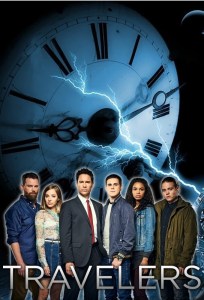
The future is a dystopia, largely due to the fact that a meteor will hit Earth with devastating consequences. They have figured out how to transfer consciousness back in time with the help of a large supercomputer. A team of scientists have their consciousnesses  sent back in time to change the past and make the world a better place. To do this, the supercomputer–known as the Director–pinpoints the moment of a host’s death and transfers the future consciousness in the seconds before the host dies. This show is made interesting by the characters of the hosts, which include an FBI agent with a failing marriage, a mentally impaired woman and her social worker, an addict, a teenaged football player, and a woman who is fighting for custody of her son with her abusive, police officer husband.  Eric McCormack, a long time favourite of mine since Will and Grace, stars.

2. Timeless
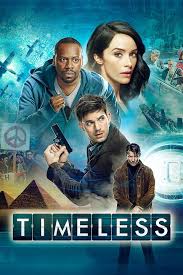
When a seemingly bad guy steals a time machine from a top secret think tank, a historian, a soldier, and a pilot chase him through time in an effort to preserve the timeline. In the first episode, misunderstood Garcia Flynn (expertly played Goran Visnjic) introduces the Rittenhouse Corporation, a Mafia-like group of people who have infiltrated every aspect of government and power corporations for centuries. Through the course of the season, we learn that Flynn is only out to stop Rittenhouse to save his family (whom he believes was murdered by members of Rittenhouse) and make the world a better place. Abigail Spencer, Matt Lanter, and Malcolm Barrett have such incredible chemistry as the team of heroes out to stop Flynn, that by the time they realize they’re fighting for the wrong team, they can do no wrong in the viewers’ eyes.

3. Frequency
Based on the movie by the same name, Frequency supposes that a ham radio can connect the present to the past. In Frequency, police officer Raimy Sullivan learns she can talk to her father over his old radio. The only problem is her father died 20 years ago. Raimy gives her father advice which saves him from the accident that took his life. She goes into work the next morning only to learn that her mother–safe before Raimy had saved her father’s life–went missing twenty years ago and her bones are on the coroner’s table. Her mother, it seems, was a victim of the Nightingale Killer. As if to make matters worse, she is a stranger to her fiancee. Raimy and her father, Frank, spend the season as partners as they try to catch the Nightingale Killer on both ends of the time continuum.


4. Time After Time
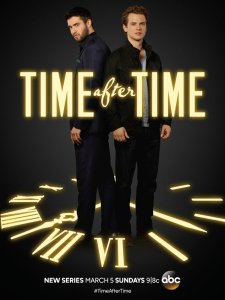
I remember seeing Time After Time, the movie, as a young adult. I loved the fact that H. G. Wells was portrayed as a time traveller. The Time Machine reads more like a journal, after all, documenting the travels of a scientist into the past and incredibly distant future to check in on the evolution of mankind. It’s not hard to imagine that the novel was Wells’s actual journal. In Time After Time, H.G. Wells invents a time machine that is immediately appropriated by Jack the Ripper who goes forward in time to escape capture and continues his murderous ways. The show is more cat and mouse thriller than time travel epic as Dr. John Stephenson (Jack the Ripper) taunts Wells, daring him to follow through with his threat to capture him before his next kill.

*As an aside, is Flash’s H.R. Wells somehow an homage to H.G. Wells? Why else would the character–who hops Earths a la Sliders and who is known to have time travelled in the comic world–have been given a name so similar to the author?

5. Making History
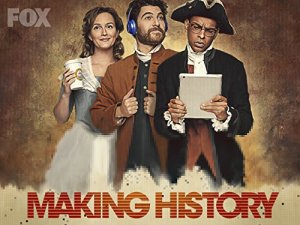
A time travelling duffle bag is absurd on the face of it. Even so, I could accept it provided the show did something smart with it. In the first two episodes, Dan goes back to make sure the American Revolution happens, only to find that the founding fathers are even dumber than he is, and though they love their guns and will only be riled when the British threaten to take them away (cue the political satire), they refuse to do anything more than threaten to take the guns and aver their love for guns. There’s a love affair (as in Time After Time), false identities with modern names, and claiming of song lyrics that won’t be written for centuries (as in Back to the Future). Though there may be a few moments that made me smile, this was even more groan-worthy than Legends of Tomorrow at it’s campy best.

Whether the surge in time travel tales is due to a longing to return to a simpler time, or the desire to turn back the clock, given the number of celebrity deaths and the politics of the previous year, time travel television is a worthy, sentimental diversion.

Are you a fan of time travel fiction? Weigh in with what you think in the comments below.

CW’s The 100 Proves Sometimes the Book Isn’t Always Better

100tvpicThank you so much to Jimmy at Cultured Vultures for posting!

I binge watched the CW’s The 100 over the winter break and was hooked. So hooked, in fact, I wasted no time reading the novel that started it all. I was both disappointed and elated at The 100 by Kass Morgan, and don’t know what to make of it. Here’s why…

To read more, check out my review at the Cultured Vultures site!

Proud to announce, I’m a Cultured Vulture!

cvlogo


Extant casts wide net; may come up empty

image from globaltv.com

image from globaltv.com

It’s Alien.

It’s ET.

It’s Predator.

It’s AI.

It’s Extant, and it’s having trouble deciding what it wants to be.

[Tweet “#Extant is having trouble deciding which #SciFi sub-#genre it wants to be.”]

Extant is the story of astronaut Molly (Halle Berry), her husband, John (Goran Visnjic) and their “son”, an android–called a humanich–named Ethan (Pierce Ganon). After spending 13 months in space, Molly returns pregnant. Half-human, half-alien, the baby is removed from Molly’s body and incubated in a secret facility ran by the Yasumoto Corporation, which also happens to be John’s employer. Molly’s friend and colleague, Alan Sparks (Michael O’Neil), is in charge of the project.

This week, Sparks escapes the facility with the hybrid (known as the Offspring) and goes to an isolated resort where he can be alone with the visions of his deceased daughter the Offspring shows him. He calls his ex-wife to join him in the reunion. In order to maintain enough energy to produce it’s illusions, the Offspring must feed on humans (calling to mind Defiance’s Irisa and Atlantis’s wraith). The people survive the feeding in order to do Alan’s bidding.  Meanwhile, John and Ethan are essentially held captive by Yasumoto (Hiroyuki Sanada) at his house along with Odin (Charlie Bewley), a member of an anti-humanichs group, pretending to be interested in John’s assistant, Julie (Grace Gummer). In a third sub-plot, Molly is handcuffed inside a truck by one of Yasumoto’s men who supposedly wants to help her find, raise and protect the Offspring.

Are you confused yet? I can’t say as I was, but it is an awful lot to take in, the net result being that I have a lot of questions.

[Tweet “#Extant asks more questions than it answers, which is an awful lot to take in.”]

Alan is a die hard professional, determined to see the project proceeds in a by-the-books manner. In this episode, his character moves to the opposite extreme. He is now a devoted father, determined to spend as much time as he can with a facsimile of his daughter, which–on some level–he knows is an illusion produced by the Offspring. Nevertheless, he does his level best to protect her. He feeds the Offspring, not for the creature, but to maintain the illusion of his daughter. Alan is a scientist. Why does he fall so easily for something he knows is in the domain of the heart and not of the head?

Molly is a smart woman. She goes to space hoping absence will make her heart grow fonder for her husband. She knows Alan is working against her even when he insists he’s on her side. She figures out why friend Sam (Camryn Manheim) turns against her and uses Sam’s predicament to work in her favour. Why is she so quick to believe the  ruse Yasumoto’s man portrays about putting all of his employer’s resources at her fingertips once they recover the Offspring?

Ethan is part android, part child. He is inquisitive like a child, but shows incredible logical and analytical deduction ability. Why is he so quick to believe Odin’s bologna  about parents not being trustworthy and shun John as a result? Every character–and I mean EVERY–is a scientist. Why is someone like Odin able to outsmart them all?

My last question deals with the focus of the show. Why can’t Extant decide which sub-genre of science fiction it wants to be? Rather than decide, it tries to be all sub-genres at once. This week alone, Extant covered the following sub-genres: parasitic infestation; vampires; androids; paranormal investigation; mind control and conspiracy theory. And I’m probably missing a few more. I really like Extant. In addition to having two of my favourite actors (Visnjic and Manheim), Extant is refreshing for it’s focus on future families striving to stay together in spite of the perils that threaten to tear it apart, rather than on sci-fi elements alone.

As of this week, I can no longer say that about Extant.

Extant taken on too much? Let me know what you think in the comments below.

[Tweet “Has #Extant taken on too much? Extant casts wide net, comes up empty.”]

Dear Mr. Alan Ball – An open letter to the writers of “True Blood”

Dear Mr. Alan Ball,

WTF dude? Seriously!

First you killed off Tara, whom, along with Lafayette and Jason provided much valued comic relief. It was bad enough you made her into a vampire. Then, just when we were getting used to the idea you kill her again, for real. Tara had it all: a strong female character who was smart, tough, beautiful, black and gay! We didn’t believe it at first. We thought that maybe it was a hallucination, or a dream, that the scene would change and Tara would still be engaging in hand-to-hand combat with a rabid vamp, but no. Tara had finally met her true death.

Maxine Fortenberry had to die, I get that. Since Hoyt left, she really didn’t have much of a role. Now Mrs. Fortenberry is free to take up permanent residence at her country home in Chester’s Mill. Good for her. But why Alcide?

You lulled us into a false sense of security. Sookie was in danger in spite of Vampire Bill’s protection, then came Sam, Alcide, Andy, Jason and the cavalry. Who could predict that when the smoke cleared there would be one random hillbilly (Joe Manganiello’s word, not mine) left to shoot Alcide. And in the head of all places!

I’m sorry, Mr. Ball, but when you killed off my beloved Alcide, you crossed a line. Why Alcide? Why not some of the more annoying characters, like Sookie or Bill?  My friends and I draw another line at Lafayette and Sam. Most of them draw the thickest line you could ever imagine at Eric.

I understand that the show began with Sookie alone until she met Bill and that it would be a neat full circle if it ended the same way, and that the show had to end at some point, but why must it end in letting the blood of our most cherished characters?

I don’t know what you have planned for the rest of the season, but you must stop the insanity! I don’t care what you have to do–re-write, re-film, re-contract–but whatever you do, no more killing off the main characters!

Thank you.

Elise and her “True Blood” buddies

“Orphan Black” is Mind Blowingly, Jaw Droppingly Satisfying

Kerplow!

That’s the sound of my mind being blown.

“Orphan Black” does it again with this week’s episode, “Knowledge of Causes, and Secret Motion of Things.”

[Tweet “”Orphan Black” is mind blowingly, jaw droppingly satisfying.”]

If you aren’t watching “Orphan Black”, you should be, so let me catch you up. Street thug Sarah Manning discovers she’s a clone after watching her “identical twin” commit suicide by train. She joins forces with her clone-mates, suburban housewife and mother, Alison Hendrix, scientist Cosima Niehaus, and her actual twin, the wild Helena, to figure out the story behind the clones’ origin.

This week, sick Cosima can be cured using Sarah’s daughter Kira’s stem cells; both Sarah and Kira are on board with sharing a little of Kira’s DNA. Dr. Aldous Leekie (love that name) is given a chance to live by evil clone Rachel provided he run and never look back. And Alison blabs about her role in her neighbour’s death to Vic (Sarah’s ex) who is selling her out to cop Angela Deangelis (Angel the angel – another great, if not redundant, name).

On to the mind blowing. Fuse Number One: the reunion of Sarah, Felix, Vic and Alison in a clever moment of comic relief.

The last time these four got together Vic lost a finger. Since then, he’s enrolled in rehab where he meets Alison. The two strike up an unlikely friendship which is understandable once we realize Vic plans to sell Alison out to Deangelis. This week was Family Day. Vic won’t send Alison up the creek if she arranges a meeting with Sarah so he can atone for his sins. Sarah and Felix arrive at the facility. Sarah is confused for Alison and forced to role play with Alison’s husband, Donny, with laugh out loud results. Poor Vic is drugged by Felix and everyone in the facility thinks he’s relapsed.

Donny is the key to Fuse Number Two.

Alison has always suspected Donny was her watcher. This week we learned he thought he was involved in a sociology experiment, like they did in university. Turns out he had no idea who he was actually working for or that Alison was a clone. When Alison accuses him of ruining their marriage, Donny seeks out Leekie, forces him into his car at gunpoint and Leekie confesses. Donny accuses Leekie of ruining his marriage. Leekie berates him. Donny gets angry and bangs his hand–and the gun–against the steering wheel. The gun goes off. Leekie’s brains are splattered all over the inside of the car.

My jaw dropped and stayed unhinged for several moments thereafter.

[Tweet “”Orphan Black” made my jaw drop and stay unhinged for several moments thereafter.”]

Then I laughed.

Then I cursed. How dare “Orphan Black” keep me hanging as to what comes next for an entire week?

I don’t know about you, but I can’t wait to see what happens next!


Literary Devices from A to Z – Brought to you by the letter J


is for Juxtaposition


Juxtaposition is when two opposing and parallel characters, plot lines, images or themes are compared for the purpose of “etching out a character in detail, creating suspense or lending a rhetorical effect” (Literary Devices).

In The Revenant, Zulu fancies himself a modern-day superhero. The narrator draws this comparison using juxtaposition. Here’s an example:

Zulu used his super sense of sight to hone in on the man’s eyes, forehead, and nose bridge…Faster than a speeding bullet—and Zulu would have to be faster, given his distance from the man in the suit and the man’s distance from the advancing projectile—Zulu knocked the man from his feet…More powerful than a locomotive, he pulled the weapon from the man’s grip, bowed the shaft, and used the butt to shatter the window.

In this example, words from the opening narrative of the old “Superman” television series are used (“faster than a speeding bullet…more powerful than a locomotive”) to draw the comparison between Zulu’s powers and those of Superman. The comparison to Superman’s sense of sight, while not in the traditional narrative, are nevertheless well-known traits of the Superman archetype.

In a recent episode of “Revolution”, Sebastian Monroe was engaged in hand-to-hand combat with Tom Neville. Scenes of this were interspersed with a simultaneous hand-to-hand combat scene between their sons, Connor and Jason. This is juxtaposed against a similar scene between “Bass” and Connor when they were pitted against each other in a fight to the death the week before.

Can you think of any juxtapositions that stand out in your mind? What were they? Did you make the connection between the two events? Did they bring another level of meaning to the story? Share your thoughts on juxtaposition below.

Orange is the New Black Critique – Memoir and Netflix Series 

Orange is the New Black is the memoir of Piper Kerman, a woman who, at 34, is jailed for a crime she committed ten years earlier. At that time, Piper was in a relationship with Nora, an older woman and drug dealer for an international cartel. Aware of this information, Piper nevertheless agrees to transport money for her girlfriend. When the story takes place, though Piper has a new life, a legitimate job and a fiancée, she must surrender herself to the department of corrections to carry out her sentence.

I found Orange is the New Black, the memoir a day or so after binge-watching Orange is the New Black the Netflix series. Though memoirs aren’t my reading thing, the online reviews were good and the preview was interesting and easy to read, and so I bought it. The memoir turned out to be a quick read, taking me less than a week to complete. Piper’s narrative voice keeps the story moving and the reader turning pages. While I don’t regret reading it, I do regret not reading it before seeing the series.

Memoirs sell for a reason – they help people experience aspects of life they wouldn’t ordinarily get to experience, sleeping with the rich and famous, for example, or living through a long past moment in history. They detail lives out of the ordinary, and are usually didactic or uplifting in nature.  Piper’s story is both. Throughout the story, she gets on her soapbox to tell the reader sad statistics about the number of women who are denied some sort of treatment for ailments while incarcerated, or the proportion of those requesting early release or furlough compared to those who actually get it. Her story is uplifting because she learns to accept the responsibility in her situation and makes peace with Nora and gets out and lives her life, able to put her experience behind her. In the memoir, Piper elevates herself above the rest of the prison population in her narrative, but she is easily able to make friends and fit in, unlike the Piper of the series.

It took me one and a half episodes of Orange is the New Black to decide I wanted to see more. Part of the allure of the series is the way Piper is played as a fish-out-of-water. She wants to fit in, she desperately tries to fit in, but nearly always fails. Though she enters the system thinking she’s different from the other women there, she soon learns she is exactly the same, a point driven home by the last scene of episode 12 of the season. The series is equally horrifying and funny, albeit ironically so. Though Piper tries to mind her own business and quietly serve her sentence, she is dealt random acts of craziness in each episode that she’s forced to deal with, experiencing varying degrees of success. To add to the stress on the inside, she quickly becomes at odds with Larry, her fiancée, on the outside, which impacts the way she reacts to the randomness of events she experiences on a daily basis.

Her rekindling of the relationship she has with Nora on the inside is exaggerated in the series, and characters from the memoir are either similarly exaggerated or made composite for the series (Crazy Eyes, for example, is a composite of 2 or 3 characters alluded to in the memoir). The one thing that attracted me to the series is conspicuously absent from the memoir and that is the way the series gives the backstories of the other prisoners. I found I liked the inmates better when I understood their motivations inside and how, like Piper, they too are fighting to maintain a semblance of normalcy in their lives.

I understand that, while based on a memoir, much of the series is fiction and fictional characters are constructs (see my earlier post) and so the parts that I liked so much are made up to serve that exact purpose. Disregarding the fact that I don’t usually read memoirs, I much preferred the series to the memoir. While the memoir is a good, fast, interesting read, the series fills in the blanks of the story, blanks that, admittedly, Kerman could not know for fact.

Read the memoir first, then go to Netflix to see the fictionalized version. I think you’ll be pleasantly surprised by both. 

Graphic from http://blogs.metrotimes.com/wp-content/uploads/2013/07/orange-is-the-new-black-poster.jpg

About the Author

Elise Abram, English teacher and former archaeologist, has been writing for as long as she can remember, but it wasn’t until she was asked to teach Writer’s Craft in 2001 that she began to write seriously. Her first novel, THE GUARDIAN was partially published as a Twitter novel a few summers back (and may be accessed at @RKLOGYprof). Nearly ten years after its inception Abram decided it was time to stop shopping around with traditional publication houses and publish PHASE SHIFT on her own.

Download PHASE SHIFT for the price of a tweet. Visit http://www.eliseabram.com, click on the button, tweet or Facebook about my novel and download it for FREE!

A Farewell to “Cult”

Cult intertitle.png

What’s this I hear? Cult has been cancelled and the remaining episodes will not be aired? And I was just beginning to have an inkling as to where this series may be going.

Cult is, in many ways, superior to the other cult-oriented show, The Following, in that there seems to be an overall design motivating the characters. Jeff Sefton is a reporter searching for his brother who disappeared shortly after solving a puzzle whose clues are hidden in a television show called “Cult”. He is assisted by show researcher, Skye Yarrow, who is investigating the disappearance of her father who has ties to the show’s mysterious, never-seen-in-public writer. Last week’s episode saw Skye nearly die after being slipped a drug, similar to the one the members of the cult on the show take as a part of their religious ritual. In a prolonged dream/near-death-experience, Skye sees Roger Reeves (played with extreme creepiness by Robert Knepper) who begs her to stay with him—which would equate to her giving up her death-bed fight. To persuade her, he allows her to see her father which only serves as an indication to Skye that what she sees is not real. Meanwhile, in reality, Jeff searches for a sample of the drug that felled Skye so doctors can synthesize an antidote. He breaks into Detective Sakelik’s house and takes the tabs from her freezer. At the end of the episode, Skye is cured and Jeff is punished for his hubris when his colleague turns up dead for his role in helping steal Sakelik’s hidden stash.

Though an interesting premise, Cult tries to take on too much. Events on the television show unfold out of sequence (Kelly Collins is an ex-cult member turned cop who wants to take Reeves down in one episode, and marries him in the past (I think) in the next). On top of this there is a real-life cult devoted to interpreting and exposing the sub-text of the television show. Sakelik lurks in the background waiting to pounce on Jeff and Skye whenever they get close to figuring out the cult’s secret, though her connection to the cult is ambiguous. While I like the duality of the actors having both television and real-life personas, and the notion of a secret society based on the sub-text of a television show, the characters seeking out the truth behind the disappeared uber-fans find things out too slowly, which  may have contributed to the show’s downfall.

The other cult-based show, The Following, is so quick-paced it is, at times, dizzying. James Purefoy plays Dr. Joe Carroll with smarmy sophistication. An English professor and author, he is obsessed with the horrific  elements present in the writings of Edgar Allen Poe. Kevin Bacon plays Ryan Hardy, the former FBI agent responsible for putting Carroll behind bars and subsequently having an affair with his wife. The story shadows Carroll’s followers as they murder to show their devotion, goaded to action by clues in Poe’s writing. The main storyline centres on Carroll’s desire to write the next best-seller and reconstruct his fractured family, and Hardy’s quest to keep Carroll behind bars and then to return him to prison after he escapes. Each week showcases gross brutality and gratuitous murder aplenty, with little ulterior motive. The Following makes me squirm because I don’t understand what about Carroll could turn everyday people into remorseless killers.

As with the fictional “Cult”, the real-life Cult relies on its viewers’ ability to read between the lines to find meaning in the story; The Following lays it all out for its viewers, who are left wondering if there is method to Carroll’s madness. I am disappointed Cult was cancelled, even more so after hearing the final episodes will not be aired. In addition to lamenting the cancellation of the show, I mourn popular culture’s favouritism of the simple and graphic over the subtle and cerebral.

About the Author
Elise Abram, English teacher and former archaeologist, has been writing for as long as she can remember, but it wasn’t until she was asked to teach Writer’s Craft in 2001 that she began to write seriously. Her first novel, THE GUARDIAN was partially published as a Twitter novel a few summers back (and may be accessed at @RKLOGYprof). Nearly ten years after its inception Abram decided it was time to stop shopping around with traditional publication houses and publish PHASE SHIFT on her own.

Download PHASE SHIFT for the price of a tweet. Visit http://www.eliseabram.com, click on the button, tweet or Facebook about my novel and download it for FREE!

Graphic from http://en.wikipedia.org/wiki/Cult_(TV_series)

Being Human Send-off

image

I hate this bittersweet time of year, the time when all my favourite television shows come to a climax and leave me hanging. This week I watched this season’s culminating episode of Being Human, a show about a vampire, a pair of werewolves and a ghost trying to subvert their supernatural sides and…well…be human. This season saw a vampire virus, Aiden siring a son, Sally’s transformation from shredded, limbo-confined ghost to flesh-eating zombie and back to ghost, and Josh’s journey from were to human and back to were. There was a lot of murder and mayhem and sex and a marriage, but no matter the excitement level of each episode (which was stuck in high gear for the duration), it never reached the high of the season finale.

This week’s episode saw Aidan form an unholy alliance with Blake to compel Kat to forget seeing Sally’s rotting corpse in her room; Sally’s return to ghostdom while linked to Donna the Souleater’s spirit; and Josh’s seeming inability to return to (for lack of a better phrase) being human after turning, following being bit by a full-blooded were. To make matters worse, a woman has shown up that looks eerily like Aidan’s long dead wife, there’s a mutated baby vamp on the loose that Aidan suggested to Josh he’d killed, and Werejosh is about to pounce on Humannora.

On the up side, I’m satisfied. This ending promised no fewer cliffhangers than any other episode this season. On the downside, I have to wait the better part of a year before I am able to ride the Being Human roller coaster again. Being Human is one of the better sci-fi shows featuring supes out there today. It lacks the soap of Vampire Diaries, and True Blood’s gratuitous sex and violence. The characters develop every season, and the relationships are believable, which can be attributed to the chemistry of the cast and the skill of the writing. Knowing the British production has been cancelled makes me all the more grateful that this was only the season—and not the series—finale.

To my dear friends Aidan, Josh, Sally and Nora: have a great summer, and try not to eat too many actual humans while on hiatus.

About the Author
Elise Abram, English teacher and former archaeologist, has been writing for as long as she can remember, but it wasn’t until she was asked to teach Writer’s Craft in 2001 that she began to write seriously. Her first novel, THE GUARDIAN was partially published as a Twitter novel a few summers back (and may be accessed at @RKLOGYprof). Nearly ten years after its inception Abram decided it was time to stop shopping around with traditional publication houses and publish PHASE SHIFT on her own.

Download PHASE SHIFT for the price of a tweet. Visit http://www.eliseabram.com, click on the button, tweet or Facebook about my novel and download it for FREE!

Graphic from:http://www.bigdamngeeks.com/wp-content/uploads/2011/04/being-human-1.jpg

A Tale of Two Villains

image

The Once Upon a Time showdown we’ve all been waiting for unfolded last night, and it did not disappoint.

Last night’s episode, “The Outsider”, might have been subtitled “A Tale of Two Villains”, as it pitted Hook against Rumple in a battle, both of wit and strength. Hook, who puts Belle in danger to get Gold out of his shop so he can steal a shawl, Rumple’s prized possession, thinks with his head. Ordinarily, I would argue Hook is no match for The Dark One who pens iron-clad contracts, tricking those with which he bargains into thinking wish fulfillment is within their grasps. But this is not the old, lonely, bitter Rumple. Forging a relationship with Belle whilst believing a reunion with his son is within reach, Rumple is vulnerable. When he saves Belle on The Jolly Roger, he turns his anger on Hook, playing into his trap. The beating he inflicts on the pirate is both disturbing and comic; Belle’s reaction both touching and foolish.

Colin O’Donoghue plays Hook with slimy, sexy, smarminess. His proximity to Belle while threatening her on The Jolly Roger is both scary and (for lack of a better term) hot. But the real showstopper is Robert Carlyle in the role of Rumple/Gold. I melted when, after Belle is trapped in the elevator by Hook, the doors open to reveal Rumple and he and Belle hug. I cringed throughout Hook’s beating, reminiscent of a similar assault perpetrated by Gold on Moe French in season one. I grew excited at the prospect of Rumple in the real world after he crosses the town line and my brain began forming scenarios as to how the search for his son, Baelfire, might play out.

The last minutes of the episode are demonstrative of how a true cliff-hanger should play out. Belle shot. Rumple’s hand covered in her blood. A speeding car. Rumple dropping and rolling he and Belle from harm’s way. Hook hit. Brilliant. The one thing with the ability to top this: next week’s trailer. In the clips, an unconscious Belle lies in her hospital bed. Thinking, no doubt, she will awaken after sharing true love’s kiss, Rumple kisses her. Belle opens her eyes, sees Rumple, and screams, recoiling as she does. The implications are gut-wrenching and exhilarating at once. Oh, and let’s not forget the backstory clip that shows Rumple kissing Cora, which raises the obvious question: could Rumplestiltskin be Regina’s birth father? Is that why he took her under his magical wing?

On the deck of The Jolly Roger, Hook sums it up best when he tells Gold he looks more like the coward he remembers. Rumple, the man, is at his most vulnerable when he has something to lose. Branding him as The Village Coward was unfair. He ran from battle during The Ogre Wars because he had something to live for (his wife and child) and didn’t want to die. He gave fealty to the soldier in front of his son because he wanted to escape and get Bae to safety. He didn’t fight Hook in Storybrooke because he knew they were no match, so he appealed to his sense of decency (which, unfortunately, Hook failed to cultivate) instead. As The Dark One, he had nothing to fear. Finally, he had the means to protect his son. When Bae was lost, he was free to pedal his deals, searching for a way to be reunited with his son all the while.

Belle represents Rumple’s vulnerability personified. When he thought she was dead, he was strong. Since she’s returned, it’s been amusing to watch Rumple embrace his reluctant weakness, sparring with his inner-coward as it threatens to bleed through his hardened exterior. With Belle removed from the equation, will Rumple lose himself in The Dark One once more? Will Rumple be cashing in Emma’s favour IOU? Was Neal the driver of the car? Was it Bae? Are the two one and the same?

Next week’s episode is entitled “In the Name of the Brother”. Speculation has been this episode will focus largely on Dr. Whale/Frankenstein and his family. While I think this is an interesting tangent, much like last night’s Yaoguai tale, I hope they don’t lose sight of the Hook/Belle/Rumple triangle, which in my humble opinion, is much more interesting than the Snow/Charming saga.  

I wait with you and bated breath ‘til next Sunday.   

Download PHASE SHIFT for the price of a tweet. Visit http://www.eliseabram.com, click on the button, tweet or Facebook about my novel and download it for FREE!

Graphic from http://www.wetpaint.com/once-upon-a-time/gallery/once-upon-a-time-behind-the-scenes-pics-season-2-episode-11-the-outsider-photos#5