Tag Archives: books

Revision for Consistency

Revising, revision

Even the best laid plans often go awry. It’s true. No matter how much planning or plotting you might do for your work in progress (WIP), the characters soon develop minds of their own and take you to places you never thought you’d go. So you let them go wherever they want and say whatever they want to say, and your book is better for it, but the moment you let them go off-book, you are opening yourself up to a host of plot holes. This is where your first revision comes in.

Last week, I typed “The End” on my latest WIP, Phoenix Station. But it wasn’t the end. Last week only marked the beginning of my first editing pass: Revision.

I’m an editor, and I’m really good at finding inconsistencies in my clients’ plots. Now is the time to put away my author’s cap and don my developmental editor’s one for my own book. In keeping with that spirit, today’s post is all about revision.

Milanote for Outlining

I’m usually more of a pantser than a plotter, but at some point, I always wind up plotting the rest of the book out. Given its plot, I started writing Phoenix Station as a planner. I started out with handmade notes and ramblings, refined that into a word processed chapter summary, and broke that down even further when I stumbled upon Milanote.

revising, revision
Milanote column with notes

In the months since discovering Milanote, it’s become one of my staple tools for developmental editing. Milanote is similar to an endless bulletin board on which you can stick “columns” and add “notes” to layout your book. I like that everything is on the desktop in front of me. It becomes a living document of the progress of my writing.

Finding Plot holes

My first pass is to tie up all loose ends I might have created along the way, aka plot holes. As I revise, I catalogue each chapter in a separate “column.” I list plot events in a bulletted list and reserve a “notes” section for questions that need to be answered on my next pass through the document. I highlight terms, character names, and the names of places so I will be sure to use the same terminology throughout. Text messages are important in my story, so I also highlight each of the strategically placed cryptic messages my character received. This makes it easier to locate later, though Milanote’s search function helps.

Revise for Consistency

When revising your document, I recommend making several passes. The first pass should be devoted to consistency. This applies to descriptions of characters and places as well as the internal structure of the world you have built (especially important for sci-fi and fantasy). I also edit for grammar and word choice as I go. Each pass through polishes my work even more. Creating a separate document that functions as a “story bible” for your work will help. I’m using Milanote, but you could use Word if you prefer.

Next Steps

What happens next depends on what I find in my first pass. I might need another revision dedicated to plugging the holes in my first (and second) draft. I might need to look at diction, imagery, symbolism, foreshadowing or something else. The important thing to note is that I won’t know where to go next until I complete this draft.

Stay tuned to follow my journey as I take Phoenix Station from first draft through to published (fingers crossed) bestseller!

Writers Circle Workshop on Self-Publishing: Recap

Thank you so much to the Richmond Hill Public Library (RHPL) for hosting my talk this week on Self-Publishing for new authors. The Writers Circle group at the RHPL are always an amazing audience, and I appreciate their attendance and interest. A special thanks to Angie, who was a very gracious host and had the room open, ready, and waiting for me.

Here is a recap of what I said at the meeting on Wednesday, 5 February 2025.

Exploring Publishing Options: Ways to publish, traditional vs. self-publishing

We began our talk with a review of the current publishing landscape and discussed the difference between traditional, vanity, hybrid, and self-publishing, as well as the pros and cons of each path to publishing.

The Self-Publishing Path: How to self-publish your work

Next up was a discussion of the ins and outs of self-publishing, where and how to publish, ISBNs, EIN/TINs, costs, distribution platforms, formatting, and cover creation.

Building Buzz For Your Book: Your Author Platform and Marketing

We finished with a discussion of when and how to begin building your author platform and some concrete ideas for things you can do to help sell your book once it is published.

Keep checking back on my events page for future, upcoming talks and workshops at the RHPL and elsewhere.

I am also available to give this talk to other groups, schools, and organizations in the Greater Toronto Area. Please see the contact information on my About page if you are interested.

AI as a writing partner? Here’s how…

Leave a reply

book cover

My latest book is The Pen and the Pixel: Your Guide to Ethical and Efficient Writing with AI. 

Though AI comes up short when it comes to creating page-turning fiction and interesting non-fiction, you can use the power of AI to your advantage. Learn how to partner up with AI to help plan and polish your writing. Here’s how:

Unlock the secrets of using AI ethically and effectively to supercharge your writing.

Feeling overwhelmed by the blank page? AI writing assistants could be your secret weapon! This book dives deep into the world of AI writing assistants, showing you how to harness their power while keeping your human touch.

Get ready to:

  • Create on Demand: Overcome writer’s block and generate fresh ideas with the help of AI.
  • Boost Productivity: Streamline your writing process and write faster without sacrificing quality.
  • Elevate Your Craft: Sharpen your grammar, sentence structure, and overall writing style with AI’s guidance.
  • Maintain Artistic Control: Learn how to personalize AI-generated content to ensure it reflects your unique voice and vision.
  • Write with Integrity: Understand ethical AI use to avoid plagiarism and ensure your work is always authentically your own.

Whether you’re a seasoned writer or just starting your writing journey, AI is poised to become one of your most valuable tools. Embrace the power of collaboration and let AI spark your creativity, streamline your workflow, and elevate your writing to new heights. With this book as your guide, you can harness the potential of AI writing assistants and confidently navigate the exciting future of human-machine collaboration.

Don’t just write; write smarter. Get ready to start your AI writing journey today!

The Pen and the Pixel: Your Guide to Ethical and Efficient Writing with AI is available at Amazon, Kobo RakutenApple BooksBarnes and Noble, and more

Become an online review-collecting sensation

Book Cover

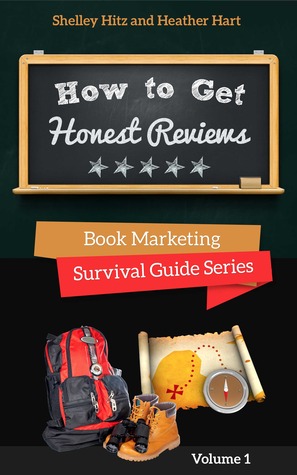
How to Get Honest Reviews

As an author, I can tell you that one of the hardest things is to get reviews for your work. When soliciting friends, relatives and social media followers, comes up nil, what does one do? How to Get Honest Reviews by Shelley Hiltz and Heather Hart is a detailed and precise guide that might help answer that question for authors in their pursuit of reviews for their work.

In their book, Hiltz and Hart leave no digital stone unturned for their readers. How to Get Honest Reviews is a catalogue of places and practical strategies anyone can immediately set into action in their search for reviewers. Of particular interest is the section on how to set up a book review program. Here, the authors include step-by-step instructions for everything from establishing a mailing list to templates to use and adapt to communicate with program participants.

Hiltz and Hart’s writing style is user-friendly and informative which makes for easy reading (if you ignore the awkward “I (author’s name)”  syntax used to introduce which of the two has written the current section). How to Get Honest Reviews makes readers feel as if, with a little elbow grease, they can become an online review-collecting sensations.

Please note that I was provided this book free by the authors in exchange for my honest review.

Dexter Meets Nancy Drew

Dexter Meets Nancy Drew

Harper Curtis squats in a house, the owner dead and rotting in the hallway. In his pocket he finds a key. When he uses the key in the front door, he is taken to whatever time he imagines. He returns later to bludgeon the owner, thus coming full circle in the timeline. Harper travels through time looking for his “shining girls”, girls that emit an aura-like light that he alone can see. He finds them as children, making contact with them when he does, promising to return again, sometime in the future. When he finds them as adults, he brutally slays them, leaving with them a souvenir from a previous kill. The book opens with Harper gifting Kirby a small, plastic horse, years before the date left behind by the mould on the bottom off the horse’s foot. He returns later to murder Kirby, but unbeknownst to Harper, she survives and devotes most of her adult life to bringing Harper to justice. Harper’s hubris in leaving behind these anachronistic souvenirs is what eventually helps Kirby orchestrate his undoing.

The Shining Girls by Lauren Beukes is part Dexter’s evil twin, part grown-up Nancy Drew in the perfect combination. It’s been a while since I’ve read a page-turner, and The Shining Girls is a mesmerizing one at that. Beukes’ prose is literary and compelling. Her tone is gritty and dark, whether from Harper, the murderer’s, Kirby, the victim’s, or Dan, the reporter’s points of view. Whether depression, disco, or near-twenty-first century, Buekes’ story makes the era come to life. I love time travel as a plot device, but it must be done right. I need to know about the technology that transports the characters from one time to the next. Beukes chooses to make the device a psychic key, of sorts. Beyond the question of how the original owner obtains it (which is told in the final chapter), the reader is too caught up in the lives of the characters to question it’s true origin (i.e., from where or whom it originated in all time and how it got its power), which is a credit to the author, as I thought this would hang me up and sour me on the novel altogether; it didn’t.

Like The Time Traveler’s Wife, The Shining Girls is one of those novels I can see myself returning to in the future (no pun intended) to read and re-read before I am able to grasp all of the subtle nuances of the manuscript. And I will do this with gusto.

Graphic from http://www.goodreads.com/book/show/16131077-the-shining-girls

About the Author

Elise Abram, English teacher and former archaeologist, has been writing for as long as she can remember, but it wasn’t until she was asked to teach Writer’s Craft in 2001 that she began to write seriously. Her first novel, THE GUARDIAN was partially published as a Twitter novel a few summers back (and may be accessed at @RKLOGYprof). Nearly ten years after its inception Abram decided it was time to stop shopping around with traditional publication houses and publish PHASE SHIFT on her own.

Download PHASE SHIFT for the price of a tweet. Visit http://www.eliseabram.com, click on the button, tweet or Facebook about my novel and download it for FREE!