Category Archives: Television

Walter White as a Tragic Hero

I realize I’m coming late to the game with my analysis of Breaking Bad, but I just finished season five this weekend. Somewhere in the middle of the last season I realized that the series played out like a tragedy with Walter White as the typical tragic hero, and I needed to write about it.

A tragedy, in the Ancient Greek tradition, includes the following traits:

  1. The hero meets his downfall through a combination of his pride, “fate, and the will of the gods“.
  2. The hero eventually encounters some limits as a result of his quest to attain his goals, usually due to “human frailty  (flaws in reason, hubris, society)“.
  3. The hero must undergo a change in fortune or revelation or recognition (anagnorisis) at the end.

So let’s examine how Breaking Bad adheres to these rules (Warning: spoilers abound from this point on):

The hero meets his downfall through a combination of his pride, fate, and the will of the gods

At the beginning of the series, Walter White is a meek, science geek schoolteacher, well-liked by the people around him.

Walt’s pride rears its ugly head when he begins cooking the purest form of crystal meth the market has ever seen, something in which he takes pride.

The second thing that sends Walt on his downwards spiral is the discovery of his lung cancer (the will of the gods). This prompts him to continue cooking in order to earn enough money to keep his family safe upon his death.

It is only a matter of time before his DEA brother-in-law, Hank, catches up to him (fate). Walt’s only human, and though he does a good job of covering his tracks, making it hard for the DEA to track down the elusive Heisenberg, and for Hank to draw the connection between Heisenberg and his brother-in-law, he eventually slips up due to human frailty where Jessie is concerned, arranging for him to start over rather than killing him when he has the chance.

The hero eventually encounters some limits as a result of his quest to attain his goals, usually due to human frailty

Walt is nothing if not frail. He manages to beat his cancer only for it to return in the final season. Knowing it will get the better of him, Walt figures he has nothing to lose. Consequently, this is also when he is at his most bold (hubris). Love is the most powerful human frailty contributing to Walt’s downfall.

Family is a powerful motivator for Hank (flaw in reason). His main imperative is to keep his wife and children safe. When Jessie begins to break down and Walt realizes he has become his Achilles’ heel, Walt orders his murder. Because he considers Jessie family, he insists it be quick and painless. In the end, his desire to make things right with Jessie is what leads to his death. When Todd and his uncle’s gang of thugs hold Hank at gunpoint, Walt insists Hank is family and should be allowed to live.

In the end, it is only when Walt’s family renounces him they are truly safe. Walt stages a phone call convincing the police (limit from society) wife Skyler was coerced into participating in his drug empire, forcing her to keep her distance. His son wishes him dead. His sister-in-law tells him to kill himself. His brother-in-law is dead as a result of his doings. He assumes pseudo-son Jessie is also dead, having ordered the hit himself.

It is at this point Walt experiences anagnorisis.

 The hero must undergo a change in fortune or revelation or recognition (anagnorisis) at the end

Walt experiences a host of ups and downs throughout the series, always managing to escape his situation and come out on top through sheer dumb luck. He reasons away every death by his hands as necessary for his survival, but at some point that changes. I believe the turning point is Gus Fring’s death. Though one could successfully argue Fring’s death is necessary, the same could not be said for Mike Ehrmantraut’s. Walt kills Mike in a fit of rage, not because he poses a threat, but because Walt wants him dead.

Walt’s change in fortune is simultaneous with the return of his cancer. The DEA becomes aware of his connection with Heisenberg at around the same time. I have to admit, though I never really liked Walt as a protagonist, I began to hate him from this point forward.

It’s not until he’s hiding out and tries to find a way to get his remaining money to his family that he begins to redeem himself. Walt begins to experience recognition with Hank’s death, but it’s not until he speaks with Skyler and admits he stayed in the business because he liked it that his redemption begins. Anagnorisis occurs when he sacrifices himself for Jessie and he accepts his death in the last seconds of the final episode.

What do you think? Is can Breaking Bad be best described as a tragedy? Is Walter White a tragic hero? Weigh in with your comments below.

[Tweet “@BreakingBad_AMC as a #Greek #tragedy. #review #tv #BreakingBad”]

Abraham the Vampire Slayer? Review of “Abe Lincoln: Vampire Hunter”

Image from ia.media-imdb.com/images/M/MV5BNjY2Mzc0MDA4NV5BMl5BanBnXkFtZTcwOTg5OTcxNw@@._V1_SX214_AL_.jpg

Image from ia.media-imdb.com/images/M/MV5BNjY2Mzc0MDA4NV5BMl5BanBnXkFtZTcwOTg5OTcxNw@@._V1_SX214_AL_.jpg

I had the opportunity to catch Abraham Lincoln: Vampire Hunter on Space last night and I was surprisingly impressed. What I thought was going to be a campy movie turned out to be entertaining with amazing CGI.

In case you haven’t seen it, Abraham Lincoln: Vampire Hunter hypothesizes that former President of The United States, Abraham Lincoln, was a trained vampire hunter. After he witnesses his mother being killed by vampire, Jack Barts,  young Abe is trained by Henry to wield his silver-tipped axe to kill vampires. Abe wants to use his training to exact revenge on Barts, but he makes a vow to Henry only to kill those Henry chooses. After learning that the King of Vampires, the aptly named Adam, plans to take over the U.S., Abe take him on.

Like all paranormal hunter/slayers, Abe has his own “Scooby Gang”, composed of “Watcher” Henry, friends Will Johnson, Joshua Speed and wife, Mary Todd. I liked the dynamic between members of the gang, but would have liked to see Mary slay a few vamps of her own, no matter how out of character for the time. I also liked the revisionist history in the movie that draws a parallel between the fight for emancipation from slavery and the fight for the emancipation of the U.S. from becoming a country enslaved by vampires.

Benjamin Walker plays the part of Abe Lincoln well, and looks strong and sexy twisting his axe like a baton as he slices through attacking vampires. I was glad to see Rufus Sewell again, a favourite of mine since Eleventh Hour and Pillars of the Earth, who plays the evil Adam with great aplomb. Deserving equal billing with the actors are the CGI effects. There is an impressive scene in which Abe chases Barts on the backs of a stampede of wild horses. Equally impressive is the climactic scene on top of a speeding train and the final showdown on the burning bridge.

Though the title sounds like it promises to be a groaner, Abraham Lincoln: Vampire Hunter is a movie worth watching.

Dear Mr. Alan Ball – An open letter to the writers of “True Blood”

Dear Mr. Alan Ball,

WTF dude? Seriously!

First you killed off Tara, whom, along with Lafayette and Jason provided much valued comic relief. It was bad enough you made her into a vampire. Then, just when we were getting used to the idea you kill her again, for real. Tara had it all: a strong female character who was smart, tough, beautiful, black and gay! We didn’t believe it at first. We thought that maybe it was a hallucination, or a dream, that the scene would change and Tara would still be engaging in hand-to-hand combat with a rabid vamp, but no. Tara had finally met her true death.

Maxine Fortenberry had to die, I get that. Since Hoyt left, she really didn’t have much of a role. Now Mrs. Fortenberry is free to take up permanent residence at her country home in Chester’s Mill. Good for her. But why Alcide?

You lulled us into a false sense of security. Sookie was in danger in spite of Vampire Bill’s protection, then came Sam, Alcide, Andy, Jason and the cavalry. Who could predict that when the smoke cleared there would be one random hillbilly (Joe Manganiello’s word, not mine) left to shoot Alcide. And in the head of all places!

I’m sorry, Mr. Ball, but when you killed off my beloved Alcide, you crossed a line. Why Alcide? Why not some of the more annoying characters, like Sookie or Bill?  My friends and I draw another line at Lafayette and Sam. Most of them draw the thickest line you could ever imagine at Eric.

I understand that the show began with Sookie alone until she met Bill and that it would be a neat full circle if it ended the same way, and that the show had to end at some point, but why must it end in letting the blood of our most cherished characters?

I don’t know what you have planned for the rest of the season, but you must stop the insanity! I don’t care what you have to do–re-write, re-film, re-contract–but whatever you do, no more killing off the main characters!

Thank you.

Elise and her “True Blood” buddies

My Writing Process: Catch as catch can!

Hello everyone! Welcome to my stop on the Writing Process Blog Hop! I was introduced to this blog hop by Lori L. Schafer:

Lori Schafer is a writer of serious prose and humorous erotica and romance. More than thirty of her short stories, flash fiction, and essays have appeared in a variety of print and online publications, and her first novel, a work of women’s fiction entitled My Life with Michael: A Story of Sex and Beer for the Middle-Aged, will be released in 2015. Also forthcoming in 2015 is her second novel Just the Three of Us: An Erotic Romantic Comedy for the Commitment-Challenged. On the more serious side, her memoir, On Hearing of My Mother’s Death Six Years After It Happened: A Daughter’s Memoir of Mental Illness, will be published in October 2014. When she isn’t writing (which isn’t often), Lori enjoys playing hockey, attending beer festivals, and spending long afternoons reading at the beach.

Website: http://lorilschafer.com/

Like my colleagues also participating in this blog hop, I’ve been asked to answer four questions about my writing and my writing process. Don’t forget to spend some time getting acquainted with authors Rosemary Whittaker, Val Conrad and Jolee Wilson whose bios and links are at the end of this post. Rosemary, Val and Jolee will be hosting the next stop on the blog hop next week.

1. What am I working on?

About a year ago I read a Writer’s Digest featured agent who said she’d be interested in reading a YA Time Traveler’s Wife. I loved that novel, and took it as a personal challenge. What I wound up with was I Am, Was, Will Be Alice something part YA Time Traveler’s Wife, part Alice in Wonderland, part YA romance (yuck!), and all adventure. I am participating in July’s Camp Nanowrimo to give me the kick in the pants to finally get Alice’s story told.

My first YA novel, The Revenant,  is to be released on 10 July 14 and so a good part of my summer will be spent on publicizing and selling that.

I am also working on an adult time travel love triangle novel called Chicken or Egg: A Love Story, not to mention the next instalment in the Molly McBride series, entitled The Next Coming Race, involving evidence of aliens having visited Earth in antiquity in the historic record.

This is where I usually work:

My Writing Space

My writing space.

2. How does my work differ from others of its genre?

I suppose you could call my primary genre science fiction, but when I think of sci-fi I think of alien race wars, lots of tech, space ships, and robots. I call my brand of sci-fi feminine speculative fiction, a made up genre composed of a sort of light-sci-fi, no war (which is stereotypically masculine), modern day tech (also stereotypically masculine), but maybe with a few tweaks. If there is time travel involved, it is in the near future, less than 100 years and not that far removed from the society of today.

[Tweet “I call my brand of sci-fi feminine speculative fiction. That does not mean it only appeals to women.”]

Calling my brand of sci-fi “feminine” does not mean it is chick-lit or only appeals to women. Rather, it is sci-fi of the mind. It takes the world of today, proposes one change, and runs with it to see the effect it may have on society. Phase Shift explores what might happen if the ability to travel to alternate worlds were discovered. The Revenant (not unlike “X-Men” or “Heroes”) supposes there are people among us who have special abilities which some might use for good and others evil. Alice proposes a similar scenario – that people might one day evolve the ability to travel through time. Ditto Cat and Mouse, only this time, the ability for time travel is via technology and not genetic. 

I make small tweaks to people, beliefs and tech and sit back and watch what happens.

3. Why do I write what I do?

I consume popular culture like candy. I also question everything I consume. Star Trek was my first introduction into the world of sci-fi, introduced to me by my father at a young age and the ideas stuck. I grew up telling myself stories before bedtime between lights out and falling asleep. At some point I started writing them down. 

[Tweet “I consume popular culture like candy. I also question everything I consume.”]

It seems like I don’t choose what I write, but rather, it chooses me. Case in point is The Revenant, which grew from a desire to write the penultimate vampire story. The storyline wasn’t gelling so I decided to do some research and found a link on Wikipedia for revenants. The idea blossomed from there. You could almost say Zulu found me and started telling me his story. I really had no choice but to write it down.

4. How does your writing process work?

My first novel, The Guardian, took almost ten years to imagine and another ten years to write. This is partly because I was bogged down with the responsibility of being a new teacher, but also because I didn’t like the way I wrote and struggled over every word. When I took a page from Nanowrimo and just wrote to make up the word count and worry about the editing later, writing became more of a pleasure than a chore. The agony was still there in the revisions and re-writes, but at least the story had already been told.

[Tweet “Accepting you aren’t a real writer if you don’t write every day builds barriers to success.”]

Many sources you read will tell you that writers write every day. I’m here to tell you that’s not necessarily the case. Whole months go by where I don’t add to my current work in progress at all as far as word count goes, but I am always thinking about my work in progress and adding to the story. Taking frequent breaks like that helps the thoughts to percolate so that when I do finally sit to write, I know exactly what I want to say. Accepting that you aren’t a real writer if you don’t write every day is a good way to build barriers to your success. Life happens, especially if you are a student, or are juggling a full-time job with a family. Work on your story every day; write whenever you can.

[Tweet “Work on your story every day; write whenever you can.”]

Don’t forget to spend some time getting acquainted with authors Rosemary Whittaker and Val Conrad whose bios and links are at the end of this post. Rosemary and Val will be hosting the next stop on the blog hop next week.

[Tweet “Writing process blog hop! Get acquainted with authors @LoriLSchafer, @DanzaCRose, Val Conrad and @JoleeWilson!”]

Rosemary Whittaker:

Rosemary is a British born author. She is an English teacher by profession. Since leaving university she has lived and worked in the United States, New Zealand, Australia and twice in Denmark. Her husband works in biodiversity informatics (cataloguing all living species on earth) and this has entailed many moves. They have five children so the moves have been extra challenging.

Her real love has always been writing and she has written several novels, variously set in the countries in which she has lived. She also writes for children. All her novels are available on http://amzn.to/UXJUJp and http://amzn.to/1iUadT. Her recent novels, a set of four, all take the theme of British women who move, by choice or circumstance, to one of the four countries mentioned above. The Cinnamon Snail is set in Denmark, where Rosemary currently lives. [http://bit.ly/1puSPwJ]

Website: rosemarywhittaker.wordpress.com

Val Conrad:

Val Conrad’s life is upside-down to most – her nights are spent working as a nurse in intensive care, leaving her days and more often her nights off to writing.  Her series – Blood of Like Souls, Tears of Like Souls, Promises of Like Souls, and Secrets of Like Souls (Black Rose Writing) is available at Amazon in both paperback and e-book formats.  Much of the skeleton of these stories comes from living in the geographical settings and a career in medicine spanning decades.  She steals moments to write any time, but odd places and crowds of people don’t deter her.  She’s currently working on a new book about how cellular phones are being used to catch criminals.

Website: www.valconrad.com

Jolee Wilson:

Jolee Wilson lives in West Texas with her husband and three children. She has been writing as a hobby since age seven and decided to turn it into a career after the completion of her first novel, Seven Days Normal. With a passion to help hurting relationships, Jolee uses fiction to impart her own lessons in love.

Website: http://www.the-nkwell.blogspot.ca/

“Orphan Black” is Mind Blowingly, Jaw Droppingly Satisfying

Kerplow!

That’s the sound of my mind being blown.

“Orphan Black” does it again with this week’s episode, “Knowledge of Causes, and Secret Motion of Things.”

[Tweet “”Orphan Black” is mind blowingly, jaw droppingly satisfying.”]

If you aren’t watching “Orphan Black”, you should be, so let me catch you up. Street thug Sarah Manning discovers she’s a clone after watching her “identical twin” commit suicide by train. She joins forces with her clone-mates, suburban housewife and mother, Alison Hendrix, scientist Cosima Niehaus, and her actual twin, the wild Helena, to figure out the story behind the clones’ origin.

This week, sick Cosima can be cured using Sarah’s daughter Kira’s stem cells; both Sarah and Kira are on board with sharing a little of Kira’s DNA. Dr. Aldous Leekie (love that name) is given a chance to live by evil clone Rachel provided he run and never look back. And Alison blabs about her role in her neighbour’s death to Vic (Sarah’s ex) who is selling her out to cop Angela Deangelis (Angel the angel – another great, if not redundant, name).

On to the mind blowing. Fuse Number One: the reunion of Sarah, Felix, Vic and Alison in a clever moment of comic relief.

The last time these four got together Vic lost a finger. Since then, he’s enrolled in rehab where he meets Alison. The two strike up an unlikely friendship which is understandable once we realize Vic plans to sell Alison out to Deangelis. This week was Family Day. Vic won’t send Alison up the creek if she arranges a meeting with Sarah so he can atone for his sins. Sarah and Felix arrive at the facility. Sarah is confused for Alison and forced to role play with Alison’s husband, Donny, with laugh out loud results. Poor Vic is drugged by Felix and everyone in the facility thinks he’s relapsed.

Donny is the key to Fuse Number Two.

Alison has always suspected Donny was her watcher. This week we learned he thought he was involved in a sociology experiment, like they did in university. Turns out he had no idea who he was actually working for or that Alison was a clone. When Alison accuses him of ruining their marriage, Donny seeks out Leekie, forces him into his car at gunpoint and Leekie confesses. Donny accuses Leekie of ruining his marriage. Leekie berates him. Donny gets angry and bangs his hand–and the gun–against the steering wheel. The gun goes off. Leekie’s brains are splattered all over the inside of the car.

My jaw dropped and stayed unhinged for several moments thereafter.

[Tweet “”Orphan Black” made my jaw drop and stay unhinged for several moments thereafter.”]

Then I laughed.

Then I cursed. How dare “Orphan Black” keep me hanging as to what comes next for an entire week?

I don’t know about you, but I can’t wait to see what happens next!


Literary Devices from A to Z – Brought to you by the letter K


is for Katharsis


This is hard. Eleven days in to the challenge and I’ve already hit a brick wall. Outside of a few Japanese poetry styles, there are pretty much no literary devices beginning with the letter K. According to The Free Dictionary, the term “catharsis” is taken from the Greek “katharsis,” so today, K is for Katharsis.

Katharsis–better known as “catharsis”–means to achieve an emotional or spiritual cleansing or renewal.

In the Walking Dead episode entitled “Tempus Fugit”, both Beth and Daryl experience katharsis. In this episode, Beth decides to do something she’s never done before–get a drink. When her quest is realized, she has an emotional breakdown crying at the bar in the golf club with an unopened bottle of peach schnapps. Daryl shatters the bottle on the ground, symbolizing the end of Beth’s childhood. What follows is Beth’s spiritual and Daryl’s emotional renewal, for by the end of the episode, Beth sees herself as Daryl’s equal and Daryl is able to open up to Beth about his past. Neither character will be the same moving forward as a result of their katharses.

Kartharsis may be experienced by the audience as well. If a reader identifies with a character in a novel and feels an emotional release as a result, s/he has undergone katharsis.

Have your read or watched anything lately in which either you or the characters experienced katharsis? Share your examples of katharsis in the comments below.

“Saving Hope” from an Identity Crisis


In “Saving Hope”, Charlie (Michael Shanks) is in a car accident leaving him in a coma for most of the first season. While in the coma, his spirit roams the hospital interacting with other dead or nearly dead patients, helping them solve their dilemmas, watching his fiancée, Alex (Erica Durance), and  ex-wife, Dawn (Michelle Nolden), fight over whether or not to pull the plug. When Charlie finally awakens, he is left with the “gift” of seeing dead and nearly dead spirits in the hospital. He reluctantly makes the effort to help them with their problems, afraid he may be going insane. He finally lets hospital psychiatrist, Gavin (Kristopher Turner) know he may be hallucinating and is prescribed medication, but his ability doesn’t go away. After a near overdose, he decides to let Alex know. She doesn’t take it well and Charlie decides the best thing to do is to take a break from the relationship while he sorts out his situation. This serves to complicate matters, as free of Charlie, Alex finds herself drawn to colleague and ex-boyfriend Joel (Daniel Gillies).

I love “Saving Hope”. I like the characters and would be as happy seeing Alex with Charlie as I would with Joel. It’s filmed locally, right here in Toronto, Ontario, Canada, which is a bonus as–like with “Rookie Blue” and “Orphan Black“–it doesn’t try to hide or disguise the city. The stories are every bit as compelling as “Grey’s Anatomy” and sometimes as cringe-worthy as the most gross “Grey’s” emergency case or “Bones” opening segment. I like that it’s a guy who sees ghosts, and that he does so reluctantly. Charlie’s a good guy who means well, but he’s also worried for his career and social life and we get to see his internal struggle. Unlike “Ghost Whisperer”, Charlie has yet to experience catharsis into acceptance of his ability, and Shanks does an excellent job portraying this.

Where “Saving Hope” fails, is deciding if it’s a supernatural show or a hospital drama. This week’s episode was a prime example of that indecision, as there wasn’t a single ghostly encounter in the entire show. The odd thing is, as a pure medical drama, it worked. Maybe the confusion is not on the part of the writers, but on me. The show has potential as a supernatural-slash-medical drama. It works as a purely medical drama. The question is would it work as a purely supernatural one? If they took the action outside of the hospital, perhaps, but then you’d be taking away Charlie’s source of spirit. People die in the hospital. As a doctor, Charlie is in a position to be their first welcome into the afterlife. Without the medicine, “Saving Hope” would be nothing more than “Ghost  Whisperer: the early years”–assuming Charlie eventually comes to terms with his ability and whether he ultimately decides it is more a blessing than a curse.

Did you watch this week’s “Saving Hope”? What did you think? Were you disappointed there were no ghosts? Let’s talk in the comments below.

Dracula is a page turner

Bram Stoker’s Dracula is the gothic horror story that put down roots for modern day vampire lore.

In Dracula, lawyer Jonathan Harker is sent to Transylvania to close a deal on the sale of a house for Count Dracula in England. Confined to a limited number of rooms in Dracula’s castle, Harker goes  exploring where he discovers siren-like creatures and Dracula’s dark nature. Harker eventually escapes, goes nearly mad, and convalesces in a hospital where fiance Mina Murray retrieves him and marries him. They return to England to find Mina’s friend, Lucy, mysteriously ill from blood loss. Harker and Dr. Seward enlist a retired Van Helsing for help. They replenish Lucy’s blood nightly to no avail. Eventually Lucy dies, her body claimed by Dracula. It’s not long before Mina falls prey to the same “illness,” with one strange symptom–she has a connection with Count Dracula. Harker, Seward and Van Helsing use this connection to ambush Dracula and kill him for good at last.

Fan of vampire stories that I am, I had always meant to read the original Dracula, but never got around to it. But after watching NBC’s Dracula, I needed to go back to the archetype to see which characters and events were borrowed from the original and which were new.

In NBC’s Dracula, the count assumes the name Alexander Greyson and pretends to be an American newly arrived in England on business. In a grand spectacle opening, Greyson holds a party at his mansion where he introduces his guests to free, wireless power which sends the oil magnates into a tizzy. At this gala is socialite Lucy Westenra who has invited her friend and medical student Mina Murray and Mina’s boyfriend, reporter Jonathan Harker. When Dracula sees Mina he sees his wife’s doppelganger and is determined to have her, but not by force. To that end, he hires Harker as his assistant, puts him up in a mansion and pays him enough to marry Mina and live happily ever after. The idea is to keep Mina close and gradually insinuate himself into her life. Pursued by the Order of the Dragon, an ancient organization whose members are involved in (among other things I can’t figure out) maintaining a power monopoly and killing vampires, Greyson’s goal is to punish members of the Order for their role in making him what he is today.

Other than character names and the time in which the story takes place, there is little comparison between the original book and the television show. In the book, Dracula has no alter ego and there is no mention of Mina the doppelganger. TV’s Renfield is Dracula’s manservant, a far cry from Stoker’s raving, bug-eating lunatic and Stoker’s Van Helsing is out to kill Dracula, not form an unholy alliance with him in order to seek revenge on the Order of the Dragon. Reading the book  also shed some light on other supernatural works, including  an explanation as to why the brothers on Supernatural bear the last name Winchester and the origin of the title “Vampire Diaries”, adopted because most of Stoker’s novel is told in journal or diary format.

The novel is a page turner at times, boring at others, but worth the time to read.

The series picks up pace midway through episode two and becomes the television version of a page turner. I binge watched the first three episodes and regret not watching the fourth as well (but Once Upon a Time was about to begin and priorities must be set).

Are you watching NBC’s Dracula? What do you think?

Dr. Who’s A Christmas Carol

day of the doctor poster

image from skinnyglasses.deviantart.com

Imagine Alex Kingston in the guise of River Song saying, “Spoilers,” in that sing-songy way of hers.

In The Day of the Doctor, the very first Doctor (John Hurt), the one responsible for saving the universe and causing the destruction of Gallifrey in the process, meets his Kobayashi Maru. In priming the weapon to do this, a weapon so sophisticated it has developed a conscience (Billie Piper), the Doctor is connected through a time funnel with the tenth (David Tennant) and eleventh (Matt Smith) regenerations of himself. While engaged (literally) in trying to save Queen Elizabeth the First from shape-shifting Zygons, the three doctors realize that Gallifrey must perish in order to save the universe. In a nice parallel, UNIT agents realize they must destroy England to save the world from the Zygons. The solution to a win-win scenario is clear: all characters–UNIT and Zygon, and all Doctors–must come together to save themselves. Smith’s Doctor uses a memory wiping device in the bowels of UNIT’s storage vault to make both human and Zygon forget they are human and Zygon respecfully to keep them honest during negotiations. As for the Doctors, they enlist all iterations of previous Doctors and their TARDISes (TARDI?) to freeze Gallifrey in a moment in time. To the Daleks firing on the planet it will seem as if the planet were destroyed and they’ll wind up firing against themselves. In this way, the Doctor lifts a huge weight from his shoulders as he no longer regrets killing all of his kind, though he must live without knowing if what they did saved or destroyed them.

The Day of the Doctor might be better named “A Dr. Who Carol”, as the present Doctor meets two past iterations of himself and one future iteration. Like Dickens’s Carol, each iteration of the Doctor is held up for consideration by another. The very first Doctor–known as the “War Doctor”–realizes he has choices he didn’t know existed, barring the use of timey-wimey things he could only do with the other Doctors. The tenth and eleventh Doctors–cleverly dubbed “The One Who Regrets” and “The One Who Forgets”–learn they must accept their past, because at the time in question, there really was no other option. At the end, a previous (I think–I’m not up on my Who trivia) Doctor , number gives number eleven hope that his solution to the unwinnable scenario was the right one, and that Gallifrey lives on, but as more than a memory of a moment in time.

I have to admit–I’m a reluctant Dr. Who fan. I never cared for the series in the past, finding it too silly and fantastic for my sci-fi sensibilities. When my husband told me they’d revived the series, I had no interest to watch. When he insisted I watch I liked it, but not to fanatic proportions. I found the ninth Doctor, my first Doctor (Christopher Eccelston) rather arrogant. Then he regenerated into Tennant and I was hooked. The episodes are not consistently exciting, or even interesting, but The Day of the Doctor was one of the best, if not THE best, Who episode yet. William Hurt plays the War Doctor as the reluctant hero. Tennant and Smith are wonderful together playing parts more alike than not, Tennant channeling his inner Hamlet in contrast to Smith’s child-like, devil-may-care attitude. I liked the Torchwood nod, allowing Who companion Clara (Jenna-Louise Coleman) to escape from the Zygons with Captain Jack’s device, as well as the return of Rose (Piper), even if only as a facsimile of the original.

Though Tennant is still my favourite Doctor, I’m looking forward the Christmas special next month, though without Tennant and after this episode, it has a tough act to follow.

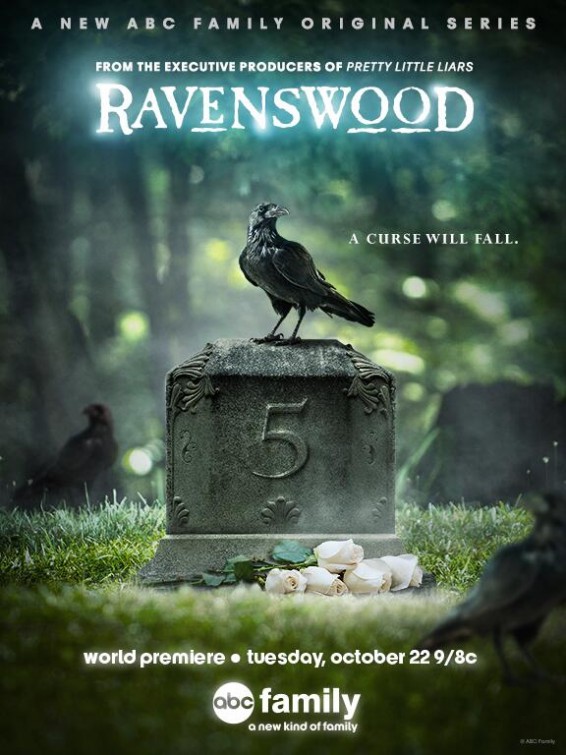
“Ravenswood” rocks the horror cliche

A haunted funeral home, shadow figures, disembodied hands, and distant relative doppelgangers; these are the foundations of Ravenswood, spin-off of Pretty Little Liars. In Ravenswood, runaway Miranda Collins, strikes up a friendship with Caleb Rivers, regular on Pretty Little Liars. Together they delve into the mysteries that plague Ravenswood, including why their names and pictures appear on ancient tombstones, why Miranda’s Lurch-like uncle didn’t raise her when her parents died, and what Caleb’s ties to the town are. Mysteries aren’t the only thing plaguing Ravenswood. True to scary form, there is a curse. Twice in history, a bunch of teens drowned after a soldier returned from the war, both times the sole survivours of their troops. As a portend, Remy Beaumont’s mom has just returned from Afghanistan, the only survivour of her troop. When Remy stops her car on a dark road to pick up twins Luke and Olivia Matheson bringing the body count in the car to five, you know something’s going to happen. The episode ends with Remy’s car partially submerged after going off the edge of a bridge.

While watching the episode, my fourteen year old daughter ran upstairs during every commercial to fill me in on the horrors of Ravenswood. She was both excited and a little spooked by the pilot plot. Though intrigued while watching, I found the horror more cliche than bonafide. I grew up watching horror flicks like Friday the Thirteenth, Nightmare on Elm Street and Halloween, and gave up on them some time in my twenties because sooner or later, the stories and the franchises began to blur. Something’s always not quite right at the funeral home. Whenever someone crawls into a hot bath they’re always going under (kudos to Ravenswood for putting the boy–rather than the curvy blonde girl–into the tub, breaking the stereotype). And there’s always an adult or two trying to keep the pesky kids from uncovering town secrets. In a nod to Stephen King’s Carrie (currently enjoying a re-release at the theatres), the disgraced prom queen–in this case, Olivia trying to come to grips with the fact that the town (her brother included) believes her mother has just murdered her father–is doused with blood.

Though the pilot didn’t bring the nail-biting moments for me as for my daughter, I will be watching the next episode. I liked the first two seasons of Pretty Little Liars, and watched as long as I was curious about who “A” was, why s/he was tormenting the main characters, and if Alison really was dead. I gave up midway through season three because the mystery grew lacklustre, there wasn’t enough character growth, and the clues were too few and far between to hold my interest. Ravenswood sets up enough mysteries to promise intrigue for years to come, provided they don’t try to kill all of the main characters at the end of every episode. It’s pretty obvious Miranda’s Uncle Lurch got rid of her because Ravenswood’s not the best place to raise a child. I predict the twins’ father probably faked his death to escape the far reaching fingers of the town curse. I’m also left wondering about Remy’s mother who remains silent as long as Remy’s father is around and who sleeps on the couch, allegedly due to nightmares. Has her mother actually returned in body as well as in soul?

Why do you think Miranda’s uncle sent her away? Who really killed the twins’ father? Has Remy’s mother returned to anyone but Remy? Who is the wet shadow woman Miranda saw in her uncle’s parlour?