Category Archives: Television

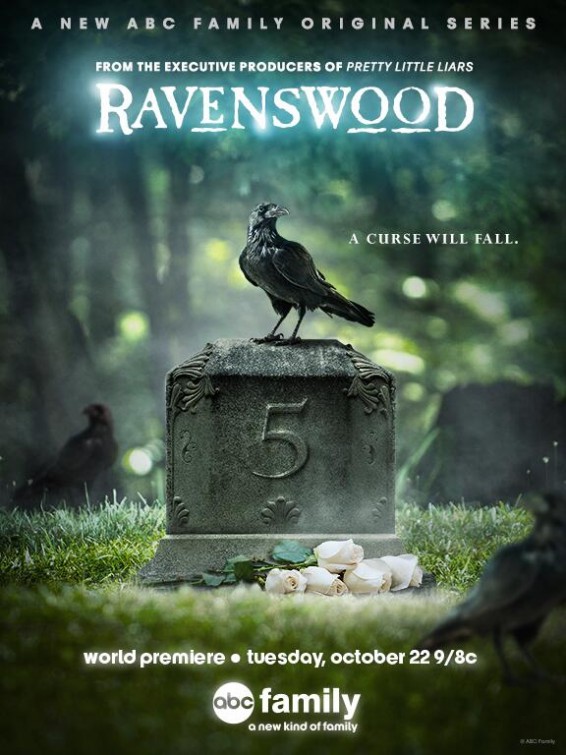
“Ravenswood” rocks the horror cliche

A haunted funeral home, shadow figures, disembodied hands, and distant relative doppelgangers; these are the foundations of Ravenswood, spin-off of Pretty Little Liars. In Ravenswood, runaway Miranda Collins, strikes up a friendship with Caleb Rivers, regular on Pretty Little Liars. Together they delve into the mysteries that plague Ravenswood, including why their names and pictures appear on ancient tombstones, why Miranda’s Lurch-like uncle didn’t raise her when her parents died, and what Caleb’s ties to the town are. Mysteries aren’t the only thing plaguing Ravenswood. True to scary form, there is a curse. Twice in history, a bunch of teens drowned after a soldier returned from the war, both times the sole survivours of their troops. As a portend, Remy Beaumont’s mom has just returned from Afghanistan, the only survivour of her troop. When Remy stops her car on a dark road to pick up twins Luke and Olivia Matheson bringing the body count in the car to five, you know something’s going to happen. The episode ends with Remy’s car partially submerged after going off the edge of a bridge.

While watching the episode, my fourteen year old daughter ran upstairs during every commercial to fill me in on the horrors of Ravenswood. She was both excited and a little spooked by the pilot plot. Though intrigued while watching, I found the horror more cliche than bonafide. I grew up watching horror flicks like Friday the Thirteenth, Nightmare on Elm Street and Halloween, and gave up on them some time in my twenties because sooner or later, the stories and the franchises began to blur. Something’s always not quite right at the funeral home. Whenever someone crawls into a hot bath they’re always going under (kudos to Ravenswood for putting the boy–rather than the curvy blonde girl–into the tub, breaking the stereotype). And there’s always an adult or two trying to keep the pesky kids from uncovering town secrets. In a nod to Stephen King’s Carrie (currently enjoying a re-release at the theatres), the disgraced prom queen–in this case, Olivia trying to come to grips with the fact that the town (her brother included) believes her mother has just murdered her father–is doused with blood.

Though the pilot didn’t bring the nail-biting moments for me as for my daughter, I will be watching the next episode. I liked the first two seasons of Pretty Little Liars, and watched as long as I was curious about who “A” was, why s/he was tormenting the main characters, and if Alison really was dead. I gave up midway through season three because the mystery grew lacklustre, there wasn’t enough character growth, and the clues were too few and far between to hold my interest. Ravenswood sets up enough mysteries to promise intrigue for years to come, provided they don’t try to kill all of the main characters at the end of every episode. It’s pretty obvious Miranda’s Uncle Lurch got rid of her because Ravenswood’s not the best place to raise a child. I predict the twins’ father probably faked his death to escape the far reaching fingers of the town curse. I’m also left wondering about Remy’s mother who remains silent as long as Remy’s father is around and who sleeps on the couch, allegedly due to nightmares. Has her mother actually returned in body as well as in soul?

Why do you think Miranda’s uncle sent her away? Who really killed the twins’ father? Has Remy’s mother returned to anyone but Remy? Who is the wet shadow woman Miranda saw in her uncle’s parlour?
We’re not in Storybrooke anymore!

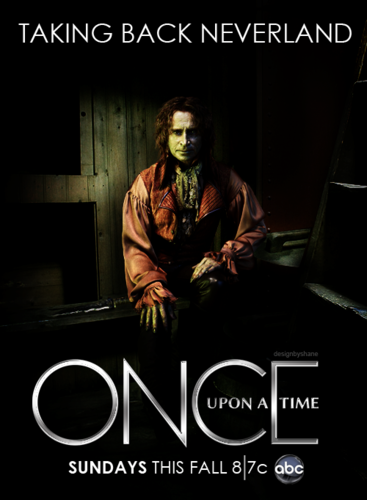
If the Enchanted Forest is heavenly, Neverland is hellish. Sure there are ogres, evil witches, and dark wizards in the forest, but Snow White and Prince Charming keep them at bay and away from the castle and surrounding lands under their protection. There seems no similar safe haven in Neverland.

Once Upon A Time‘s Neverland is rife with shark-like mermaids that would as soon kill you as die themselves, a shadow wraith that steals souls, and Peter Pan, Neverland’s equivalent of the Dark One, and his sworn enemy. Claiming to be on the run from the Lost Boys who are after his vial of pixie dust, Peter gains Henry’s trust. When he learns Henry has the heart of a true believer, he reveals himself. Peter is now in possession of the body and heart of the true believer, a parallel to Rumplestiltskin’s possession of the Dark One’s dagger. I hope Henry gets to keep both to himself.

Meanwhile, back on the deck of the Jolly Roger, Emma and Snow pull a mermaid from the deep. The mermaid (could this be Ariel?) conjures a storm fuelled by the animus the crew has for each other. Fights ensue–Hook vs. Charming, Snow vs. Regina–and Emma realizes the storm can only be quelled when they agree to bury their respective hatchets. Emma nearly commits suicide jumping overboard; the crew works together to save her. When they arrive on shore, Emma proclaims herself their fearless leader and they go in search of Henry.

In the Enchanted Forest, Neal teams with Sleeping Beauty and Mulan on a quest to Rumplestiltskin’s castle to find an enchanted object that will help them contact Emma to let her know he’s still alive. Rumplestiltskin disappears from the deck of the Jolly Roger only to materialize in Neverland’s woods for a sit down with the head Lost Boy who throws a doll at him that reduces the Dark One to tears. Intriguing.

Season three’s opener was worth the wait. Not only does it turn the page on the old storyline (please forgive the pun), it sets up a chapter of new mysteries. What is the significance of the doll? Will Neal find his way back to Storybrooke? To Neverland? Is Rumplestiltskin really destined to die in Neverland? Are Neal and Tamara really dead? Will Emma and Hook ever get a room? Will Regina be content to assume the role of follower and to Emma, of all people? Do Neal and Mulan join Robin Hood’s band of Merry Men? Will there be any tie-ins between Wonderland and the Enchanted Forest? Between Wonderland and Storybrooke? Wonderland and Neverland? I’m certainly looking forward to finding out.

Weigh in on what you thought of the season première. Was it worth the wait?

“Sleepy Hollow” builds rich mythology

Fox’s Sleepy Hollow premièred last week to rave reviews. Like its predecessors Grimm and Once Upon a Time, Sleepy Hollow offers an interesting spin on an archetypal story.

The town of Sleepy Hollow was a small valley in the settlement of Tarrytown, New York in 1820 when Washington Irving published his short story about a Revolutionary War soldier in search of his head, lost when it was taken by a cannonball. In Irving’s The Legend of Sleepy Hollow, which takes place in 1790, Ichabod Crane is a gangly schoolteacher in competition for the love of Katrina Van Tassel, the daughter of a wealthy farmer. His competition is the burly Abraham “Brom” Van Brunt, who sets Ichabod up as an object of ridicule. Katrina sees through Brom’s antics and appears content to give her heart to Ichabod when he meets the horseman and disappears. Katrina marries Brom instead. Other than his horse and a shattered pumpkin, there is no sign of Ichabod to be found. Ichabod considers the horseman might be Brom in disguise during the attack, but the description of the horseman, headless and awash in fire and brimstone, is too horrific to have been pulled off by Ichabod’s rival, given the technology at the time. When the horseman throws his head at him, Ichabod falls from his horse and is never seen again.

Irving’s Sleepy Hollow is a typical horror story. Its setting is a place reputed to have been bewitched by “an old Indian chief, the prophet or wizard of his tribe”. People believe it to be overrun by “haunted spots and twilight superstitions” where they “see strange sights and hear music and voices in the air.”  In this way, Sleepy Hollow is no different than Vampire Diaries‘s Mystic Falls or Buffy the Vampire Slayer‘s Sunnydale. Similar to these towns, witches, ghosts and evil supernatural entities abound. Irving’s Ichabod is the stereotypical geek, described as tall, lank, “narrow shoulders, long arms and legs,” small head, “huge ears, large green glassy eyes and a long snipe nose.” He is later described as scarecrow-like, hardly the physique one would expect from a leading man. The fact that he would have the girl in the end were it not for his disappearance, shows the advantage of brains over brawn, which may very well be the moral of the story. Also, don’t go out at night, particularly alone and on a path reputed to be haunted by a headless Hessian hefting a pumpkin head.

In the Fox series, Sleepy Hollow is a thriving town with a Starbucks on every corner. Abbie Mills (Nicole Beharie), a black, female police lieutenant finds a decidedly anti-gangly Ichabod Crane (Tom Mison) wandering around town and arrests him for a series of murders. People report sightings of a headless horseman and since Ichabod seems to know quite a bit on the topic, Mills enlists his help to try to stop the body count from rising even further. The backstory, we learn, is that during the Revolutionary War, a Hessian soldier mortally wounded Crane, and Crane beheaded him with his sword. They died together, their blood mixing in the field, forever linking their souls. When someone in 2013 resurrects the horseman–believed to be Death, one of the horsemen of the apocalypse–Ichabod is similarly resurrected. Mills convinces her colleagues to let Ichabod go free to help her stave off the supernatural and catch the horseman before the coming of the Apocalypse.

I love the Supernatural-slash-Fringe-slash-X-Files vibe of Sleepy Hollow. I was a little upset when Officer Andy Dunn (John Cho) and Sherriff Corbin (Clancy Brown) were killed off in the first episode, but delighted to see their return in the second. Cho plays a (literal) devil’s advocate with creepy excellence while Brown’s character’s ghost becomes Mills’s Yoda, giving her cryptic clues when she asks for help. Mison is more than competent as the handsome yet fearless hero-type, solving problems with ages old wisdom over technology. Subtle humour is hidden in Crane’s curiosity about the modern world, feeding much of the banter between he and Mills.  Unlike many of the new science fictiony shows of last season (Zero Hour, Do No Harm, Cult and 666 Park Avenue, to name a few), I think Sleepy Hollow can look forward to finishing out this season while building a rich mythology with the potential to move forward for many seasons to come.

Once Upon A Time is Coming!

In preparation for the new season of ABC’s Once Upon A Time, I took some time to go over some of the classics associated with the show. I re-read Alice’s Adventures in Wonderland and Through the Looking Glass, partially to “borrow” allusions and create symbols for my Alice Untitled story, but also in anticipation of the premiere of Once Upon A Time in Wonderland. I also went back to read up on Rumplestiltskin’s origins.

In the Grimms’  version, a miller boasts that his daughter can spin straw into gold. The greedy king of the realm locks the daughter up demanding she spin a roomful of straw into gold. The daughter cries and Rumplestiltskin, a plain-looking dwarf of a man, helps her in exchange for a necklace. The same thing happens the next day and, thanks to Rumplestiltskin, the daughter delivers. On the third day, the king promises that if she spins the gold he will make her his queen. Having nothing else to trade, the daughter promises Rumplestiltskin her first born. After the child is born and she decides she doesn’t want to give the child up, Rumplestilstkin tells her that if she guesses his name, she will be allowed to keep it. They hire someone to tail the dwarf and hear him singing his name as he gloats. The next day, the queen “guesses” his name and is allowed to keep the child.

OUAT’s version incorporates much of Rumple’s archetypal story in “The Miller’s Daughter”, and in snippets woven into other characters’ origin stories. OUAT’s Rumple starts out as the fearless trickster imp, granting favours in exchange for what each of the characters holds dear. The character is broadened by the writers to personify Belle’s Beast and Hook’s Croc. The Trickster, the Cowardly Lover and the Adversary are portrayed with most excellent skill by Robert Carlyle. The same goes for Gold, Rumple’s real-world counterpart.

In my search for an online version of Rumple’s origin story, I found “Rumpelstiltskin in Love“, a flash-fiction short story by KC Norton that tells the story of the dwarf as he raises a child. We learn Rumpel is not the child’s father. He has also raised other children, now grown and moved away. The child asks about his mother and Rumpel answers vaguely, hoping to spare the child the heartache of knowing his mother gave him up to save herself. This shows that in addition to being a trickster who is vain and greedy he is caring and lonely, someone who longs for human love, someone who cannot find a woman to love him because he is ugly, so he settles for the unconditional love of a succession of children, each of which winds up breaking his heart when they grow to maturity.

OUAT‘s Rumple embodies the characteristics of both tellings. As previously stated, he is a trickster, someone who makes deals with desperate people without compassion. But he also has a human side, one that is achingly lonely, and believes himself unlovable, in spite of–or maybe because of–his power. This Rumple has compassion, though begrudgingly so. He is a romantic who believes in his own happy ending in spite of himself.

I don’t know about you, but I can’t wait for OUAT season 3 to unfold as the crew travels to Neverland to rescue Henry and discover new facets to the characters, especially Rumplestiltskin. In the mean time, go to the Flash Fiction website and read “Rumpelstiltskin in Love” to tide you over. Let me know what you think about this poignant addition to the mythology.