You’ve sweated out your story, lived, died, and bled with your characters, edited your work tens if not hundreds of times, published, and your first reviewer complains about the mistakes.
Tear hair out here!
Though I can’t find a scientific article to prove it, I did search “Why can’t we edit our own work” and most sites agree: it’s because we’re too invested in what we’ve written. Because we’ve read it over so many times, our brains know what we want to say, fill in the blanks, and we miss our errors. Microsoft Word does a good job of highlighting what it thinks are spelling, punctuation, and grammatical errors, but even that might not be good enough.
Enter Grammarly.
Grammarly might just be the best invention since sliced bread where publishing is concerned, but it does have its faults. Grammarly is only a computer program, it’s not an editing god, and every suggestion it makes must be taken with a grain of salt (i.e., don’t go making haphazard changes just because Grammarly–or Word, for that matter–says so).
Having published five of my own books with the sixth on the way, and about seven or so more by other authors under my EMSA Publishing imprint, I’ve adopted Grammarly as my last ditch edit before publishing. Here are a few things I’ve learned.
1. Canadian spellings are marked as errors.
I’ve blogged about this before. Did you know that Canada (and the UK) are the rule and the US is the exception? What I mean is that what my American friends think are “cute”, Canadian foibles are actually the norm practically everywhere else in the world. And while you can change Grammarly’s dictionary for British English, there is no Canadian option. This might pose a problem because like the UK, we have the odd double consonant rule before adding a suffix, and then there’s the whole “our” ending thing, but unlike the UK, Canadians, for example, prefer “mom” to “mum”. It is for this reason I prefer to keep my dictionary set to American English.
The bottom line is that you have a choice if you’re Canadian: write in American English, or know your Canadian spelling rules and be sure to do a Google search to check all spellings Grammarly marks as incorrect.
2. Do a search and replace.
Grammarly marks words that should be hyphenated but aren’t, or words that are hyphenated but shouldn’t be. It also marks compound words that shouldn’t be or vice versa. The trouble is that it doesn’t do this consistently. I’ve found that, in many cases, it really doesn’t matter as long as you hyphenate or compound consistently.
For example, should it be “eco-terrorist” or “ecoterrorist”? I did a Google search and discovered that Wikipedia and The Toronto Star use the hyphenated version, while the FBI and The Washington Post don’t (and though the Star is Canadian, I don’t believe this is another US-Canada dichotomy). My conclusion is that both are correct, as long as I pick one and stick to it throughout. In some cases, Grammarly picked up on this, in others it didn’t, and I had to go through my manuscript with a search and replace to make sure I was consistent throughout.
3. Know your comma rules.
Oh, those dreaded commas!
I’ve learned quite a bit about them on my editing journey, most of which can be read here, but the bottom line is that while there are rules, there are some exceptions due to style. Grammarly often told me I was missing a comma where I believed there should be none, and told me I had an incorrect comma where I believed there should absolutely be one. The bottom line is, you have to know your comma rules.
Perhaps the biggest issue I have when using Grammarly is with the Oxford comma, the one that says you must separate all items of a list with a comma. Here’s an article on the Grammarly blog explaining what the Oxford comma is and why people care so much about it. The Oxford comma conundrum is compounded with the rule about commas and conjunctions (that unless you have two independent clauses on either side of the conjunction, no comma is necessary). Grammarly often thought I was connecting two dependent clauses with a comma before my “and” when in fact, it was an item in a list with the Oxford comma.
For example:
He tried to patch things up, went into my room, discovered I was gone, and was waiting up for me.
In this case, Grammarly marks the comma in red as being incorrect, but in my mind, it denotes the fourth item in a list with an Oxford comma. This sentence has a parallel structure, detailing four things my main character’s father did:
- he tried to patch things up
- he went into her room
- he discovered she was gone
- and he was waiting up for her when she returned.
According to the way the Oxford comma works, to separate items in a list, this is absolutely the correct place for a comma to be, yet Grammarly marked it as an error.
Here’s another example:
Not to mention the fact that I’d just broken my dad’s heart.
So first: yes, this is a sentence fragment, but stylistically so. Secondly, Grammarly suggests a comma go after “dad’s” and before “heart”. The reason: “When speaking directly to people, their names must be set off by commas. Consider adding the comma(s).”
This sentence is a part of my main character’s internal conflict. She is in her bedroom, alone, thinking to herself and not speaking to anyone, least of all her father. Grammarly was way off the mark on this one.
The takeaway? Question every change Grammarly suggests before you make it.
4. Check, check, and double-check.
Grammarly occasionally marks incorrect word use when there is none. Case in point:
“Cain broke up with me,” I bawl, barely intelligible, to myself, anyway, between the sobs.
Grammarly wondered if I didn’t mean “bowl” instead of “bawl”, as if “I bowl, barely intelligible” makes any more sense.
“My sobs have long subsided into sniffles…”
Grammarly wants to change “sobs” to “sons”, because it makes more sense in the context.
Note that I’m not bashing Grammarly here. Rather, I use these examples to explain why it is important to check everything Grammarly suggests against alternate sources, particularly if the resulting change would make little sense.
5. Is your apostrophe used to indicate a possessive or a contraction?
Knowing how and when to use an apostrophe is paramount, especially when you’re relying on an app to find your errors.
For example,
They made it into the news because of their less than conventional behaviour during the protest and was forgotten a few days later.
Grammarly suggests that “their” is a “confused possessive and contraction” and goes on to tell me that “It appears that the possessive pronoun their should be a contraction instead. Consider changing it.”
My option for change is therefore:
because of they are less than conventional
rather than “their” which Google defines as “belonging to or associated with the people or things previously mentioned or easily identified,” which seems to be the obvious choice.
The moral of the story is: Grammarly is great, but only if you know what you’re doing when you’re using it. Technology should not be used as a replacement for our learning proper spelling, punctuation, and grammatical rules. Having said that, we must recognize that we live in a revolutionary age. We have millions (if not more) web pages to suggest spelling, and punctuation and grammatical usage at our fingertips, and authors must get into the habit of looking things up before they make changes, particularly when a collection of ones and zeros–which have the capacity for neither human speech nor human creativity–tells us our instincts are incorrect.

 Check out any writing site and it will tell you how important it is for an author to build her mailing list. Mailing lists help you to get noticed and build a relationship with your readers which, in turn, helps sell books.
 Many sources will tell you to offer people an incentive for subscribing to your email list. Plenty of authors offer free books as an incentive, so I put together a book documenting how I’d planned and executed my last blog tour, complete with links to actual sites I used and statistics for click-throughs vs. impressions vs. sales. It was the perfect incentive for authors.
 The last book I released, I Was, Am, Will Be Alice, is a time travel fiction (largely inspired by The Time Traveler’s Wife), as is my as of yet unfinished manuscript, tentatively entitled Cat and Mouse: A Love Story, largely inspired
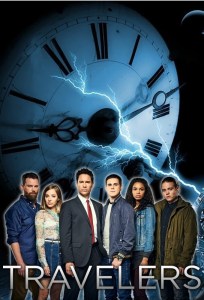 The future is a dystopia, largely due to the fact that a meteor will hit Earth with devastating consequences. They have figured out how to transfer consciousness back in time with the help of a large supercomputer. A team of scientists have their consciousnesses sent back in time to change the past and make the world a better place. To do this, the supercomputer–known as the Director–pinpoints the moment of a host’s death and transfers the future consciousness in the seconds before the host dies. This show is made interesting by the characters of the hosts, which include an FBI agent with a failing marriage, a mentally impaired woman and her social worker, an addict, a teenaged football player, and a woman who is fighting for custody of her son with her abusive, police officer husband. Eric McCormack, a long time favourite of mine since Will and Grace, stars.
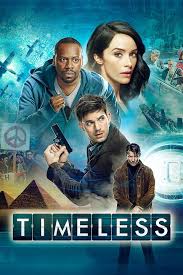 When a seemingly bad guy steals a time machine from a top secret think tank, a historian, a soldier, and a pilot chase him through time in an effort to preserve the timeline. In the first episode, misunderstood Garcia Flynn (expertly played Goran Visnjic) introduces the Rittenhouse Corporation, a Mafia-like group of people who have infiltrated every aspect of government and power corporations for centuries. Through the course of the season, we learn that Flynn is only out to stop Rittenhouse to save his family (whom he believes was murdered by members of Rittenhouse) and make the world a better place. Abigail Spencer, Matt Lanter, and Malcolm Barrett have such incredible chemistry as the team of heroes out to stop Flynn, that by the time they realize they’re fighting for the wrong team, they can do no wrong in the viewers’ eyes.
 Based on the movie by the same name, Frequency supposes that a ham radio can connect the present to the past. In Frequency, police officer Raimy Sullivan learns she can talk to her father over his old radio. The only problem is her father died 20 years ago. Raimy gives her father advice which saves him from the accident that took his life. She goes into work the next morning only to learn that her mother–safe before Raimy had saved her father’s life–went missing twenty years ago and her bones are on the coroner’s table. Her mother, it seems, was a victim of the Nightingale Killer. As if to make matters worse, she is a stranger to her fiancee. Raimy and her father, Frank, spend the season as partners as they try to catch the Nightingale Killer on both ends of the time continuum.
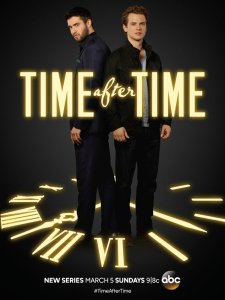 I remember seeing Time After Time, the movie, as a young adult. I loved the fact that H. G. Wells was portrayed as a time traveller. The Time Machine reads more like a journal, after all, documenting the travels of a scientist into the past and incredibly distant future to check in on the evolution of mankind. It’s not hard to imagine that the novel was Wells’s actual journal. In Time After Time, H.G. Wells invents a time machine that is immediately appropriated by Jack the Ripper who goes forward in time to escape capture and continues his murderous ways. The show is more cat and mouse thriller than time travel epic as Dr. John Stephenson (Jack the Ripper) taunts Wells, daring him to follow through with his threat to capture him before his next kill.
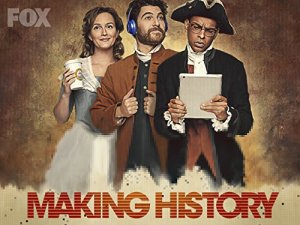 A time travelling duffle bag is absurd on the face of it. Even so, I could accept it provided the show did something smart with it. In the first two episodes, Dan goes back to make sure the American Revolution happens, only to find that the founding fathers are even dumber than he is, and though they love their guns and will only be riled when the British threaten to take them away (cue the political satire), they refuse to do anything more than threaten to take the guns and aver their love for guns. There’s a love affair (as in Time After Time), false identities with modern names, and claiming of song lyrics that won’t be written for centuries (as in Back to the Future). Though there may be a few moments that made me smile, this was even more groan-worthy than Legends of Tomorrow at it’s campy best.


 Elise Abram

