Category Archives: The Revenant

My Writing Process: Catch as catch can!

Hello everyone! Welcome to my stop on the Writing Process Blog Hop! I was introduced to this blog hop by Lori L. Schafer:

Lori Schafer is a writer of serious prose and humorous erotica and romance. More than thirty of her short stories, flash fiction, and essays have appeared in a variety of print and online publications, and her first novel, a work of women’s fiction entitled My Life with Michael: A Story of Sex and Beer for the Middle-Aged, will be released in 2015. Also forthcoming in 2015 is her second novel Just the Three of Us: An Erotic Romantic Comedy for the Commitment-Challenged. On the more serious side, her memoir, On Hearing of My Mother’s Death Six Years After It Happened: A Daughter’s Memoir of Mental Illness, will be published in October 2014. When she isn’t writing (which isn’t often), Lori enjoys playing hockey, attending beer festivals, and spending long afternoons reading at the beach.

Website: http://lorilschafer.com/

Like my colleagues also participating in this blog hop, I’ve been asked to answer four questions about my writing and my writing process. Don’t forget to spend some time getting acquainted with authors Rosemary Whittaker, Val Conrad and Jolee Wilson whose bios and links are at the end of this post. Rosemary, Val and Jolee will be hosting the next stop on the blog hop next week.

1. What am I working on?

About a year ago I read a Writer’s Digest featured agent who said she’d be interested in reading a YA Time Traveler’s Wife. I loved that novel, and took it as a personal challenge. What I wound up with was I Am, Was, Will Be Alice something part YA Time Traveler’s Wife, part Alice in Wonderland, part YA romance (yuck!), and all adventure. I am participating in July’s Camp Nanowrimo to give me the kick in the pants to finally get Alice’s story told.

My first YA novel, The Revenant,  is to be released on 10 July 14 and so a good part of my summer will be spent on publicizing and selling that.

I am also working on an adult time travel love triangle novel called Chicken or Egg: A Love Story, not to mention the next instalment in the Molly McBride series, entitled The Next Coming Race, involving evidence of aliens having visited Earth in antiquity in the historic record.

This is where I usually work:
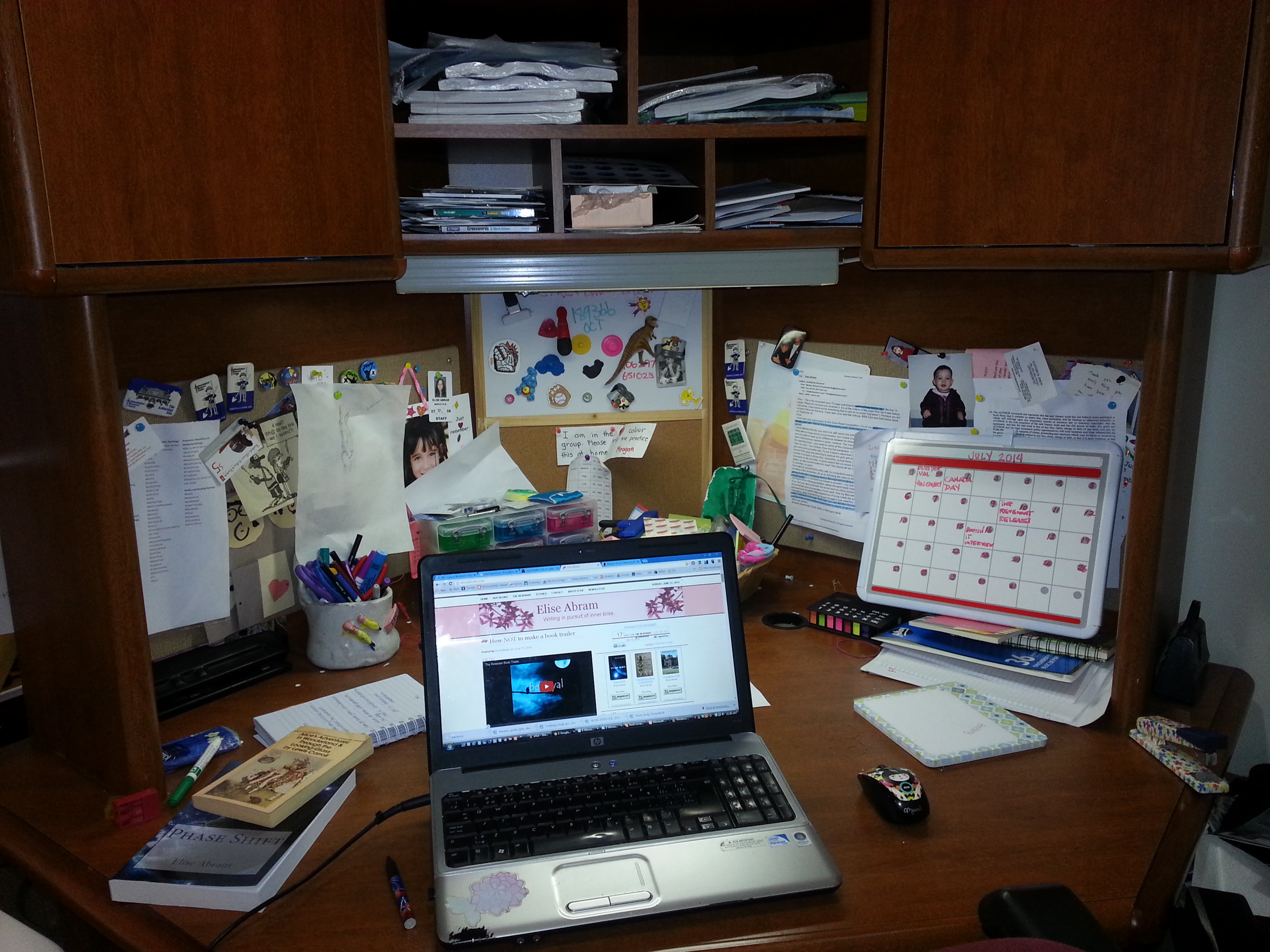
My Writing Space

My writing space.

2. How does my work differ from others of its genre?

I suppose you could call my primary genre science fiction, but when I think of sci-fi I think of alien race wars, lots of tech, space ships, and robots. I call my brand of sci-fi feminine speculative fiction, a made up genre composed of a sort of light-sci-fi, no war (which is stereotypically masculine), modern day tech (also stereotypically masculine), but maybe with a few tweaks. If there is time travel involved, it is in the near future, less than 100 years and not that far removed from the society of today.

[Tweet “I call my brand of sci-fi feminine speculative fiction. That does not mean it only appeals to women.”]

Calling my brand of sci-fi “feminine” does not mean it is chick-lit or only appeals to women. Rather, it is sci-fi of the mind. It takes the world of today, proposes one change, and runs with it to see the effect it may have on society. Phase Shift explores what might happen if the ability to travel to alternate worlds were discovered. The Revenant (not unlike “X-Men” or “Heroes”) supposes there are people among us who have special abilities which some might use for good and others evil. Alice proposes a similar scenario – that people might one day evolve the ability to travel through time. Ditto Cat and Mouse, only this time, the ability for time travel is via technology and not genetic. 

I make small tweaks to people, beliefs and tech and sit back and watch what happens.

3. Why do I write what I do?

I consume popular culture like candy. I also question everything I consume. Star Trek was my first introduction into the world of sci-fi, introduced to me by my father at a young age and the ideas stuck. I grew up telling myself stories before bedtime between lights out and falling asleep. At some point I started writing them down. 

[Tweet “I consume popular culture like candy. I also question everything I consume.”]

It seems like I don’t choose what I write, but rather, it chooses me. Case in point is The Revenant, which grew from a desire to write the penultimate vampire story. The storyline wasn’t gelling so I decided to do some research and found a link on Wikipedia for revenants. The idea blossomed from there. You could almost say Zulu found me and started telling me his story. I really had no choice but to write it down.

4. How does your writing process work?

My first novel, The Guardian, took almost ten years to imagine and another ten years to write. This is partly because I was bogged down with the responsibility of being a new teacher, but also because I didn’t like the way I wrote and struggled over every word. When I took a page from Nanowrimo and just wrote to make up the word count and worry about the editing later, writing became more of a pleasure than a chore. The agony was still there in the revisions and re-writes, but at least the story had already been told.

[Tweet “Accepting you aren’t a real writer if you don’t write every day builds barriers to success.”]

Many sources you read will tell you that writers write every day. I’m here to tell you that’s not necessarily the case. Whole months go by where I don’t add to my current work in progress at all as far as word count goes, but I am always thinking about my work in progress and adding to the story. Taking frequent breaks like that helps the thoughts to percolate so that when I do finally sit to write, I know exactly what I want to say. Accepting that you aren’t a real writer if you don’t write every day is a good way to build barriers to your success. Life happens, especially if you are a student, or are juggling a full-time job with a family. Work on your story every day; write whenever you can.

[Tweet “Work on your story every day; write whenever you can.”]

Don’t forget to spend some time getting acquainted with authors Rosemary Whittaker and Val Conrad whose bios and links are at the end of this post. Rosemary and Val will be hosting the next stop on the blog hop next week.

[Tweet “Writing process blog hop! Get acquainted with authors @LoriLSchafer, @DanzaCRose, Val Conrad and @JoleeWilson!”]

Rosemary Whittaker:

Rosemary is a British born author. She is an English teacher by profession. Since leaving university she has lived and worked in the United States, New Zealand, Australia and twice in Denmark. Her husband works in biodiversity informatics (cataloguing all living species on earth) and this has entailed many moves. They have five children so the moves have been extra challenging.

Her real love has always been writing and she has written several novels, variously set in the countries in which she has lived. She also writes for children. All her novels are available on http://amzn.to/UXJUJp and http://amzn.to/1iUadT. Her recent novels, a set of four, all take the theme of British women who move, by choice or circumstance, to one of the four countries mentioned above. The Cinnamon Snail is set in Denmark, where Rosemary currently lives. [http://bit.ly/1puSPwJ]

Website: rosemarywhittaker.wordpress.com

Val Conrad:

Val Conrad’s life is upside-down to most – her nights are spent working as a nurse in intensive care, leaving her days and more often her nights off to writing.  Her series – Blood of Like Souls, Tears of Like Souls, Promises of Like Souls, and Secrets of Like Souls (Black Rose Writing) is available at Amazon in both paperback and e-book formats.  Much of the skeleton of these stories comes from living in the geographical settings and a career in medicine spanning decades.  She steals moments to write any time, but odd places and crowds of people don’t deter her.  She’s currently working on a new book about how cellular phones are being used to catch criminals.

Website: www.valconrad.com

Jolee Wilson:

Jolee Wilson lives in West Texas with her husband and three children. She has been writing as a hobby since age seven and decided to turn it into a career after the completion of her first novel, Seven Days Normal. With a passion to help hurting relationships, Jolee uses fiction to impart her own lessons in love.

Website: http://www.the-nkwell.blogspot.ca/
How NOT to make a book trailer

For years I thought that if I were ever in a position to need a book trailer I’d be independently wealthy and could hire a professional to do it for me.

Barring that, I’d use Flash. I have a basic working knowledge of Flash. I’ve had to teach it to Travel and Tourism students for use in their end of semester presentations, and I’ve had occasion to teach entire semesters of Flash Action Script through eLearning courses. I never considered that when the time finally came, the proliferation of operating systems and browsers that do not support Flash would make that option all but obsolete.

The only other software I had was Windows Movie Maker. My kid made a movie with it while still in grade school–how hard could it be? Little did I know, the software would be the least of my worries.

Here are my three pearls of wisdom of what NOT to do, should you ever consider to go it alone when making a book trailer.

[Tweet “3 pearls of wisdom about what NOT to do when making a book trailer.”]

Pearl #1 – use royalty-free but not for commercial use graphics

I never considered that what I was embarking on was a commercial endeavour. All I wanted to do was get the word out about my book release; I wasn’t ready to start selling books yet. Nevertheless, all of those people I alerted to the release of my book were potential buyers which ultimately made my project a commercial one.

Back to the drawing board.

I eventually stumbled upon Flickr.com (make sure you click “Commercial use allowed” on the licence tab) and foter.com (make sure you click “Commercial Use” at the top of the page after doing a search).  Keep in mind you must still check the licence to ensure you have fulfilled your end of the use agreement. Most of the pictures will say to link back to the Creative Commons agreement as well as give the photographer credit, which you can do in the rolling credits at the end of your trailer.

For music, try FreeMusicArchive.org.

Pearl #2 – forget to record your titles, artists and URLs as you go

As someone who just wrote a post entitled “Just Cite the Damn Cite!” I don’t know what I was thinking. Too absorbed with ensuring I wasn’t breaking copyright to realize that if I didn’t have the credits right I was breaking copyright anyway.

Open a NotePad file (or create a file on similar software or go old school and do it on paper) and record the title of each photo, the artist, and the URL (Flickr and foter seem to want a link to the author on their site and not directly to the author) as well as a description so you’re sure you attribute the correct photo to the correct photographer. List your photos in order of appearance in the credits (and say you are doing this in your credits).

Pearl #3 – use Windows Movie Maker

I’m not sure if this should be a “pearl” or not, but like all Windows products, Movie Maker has its ups and downs.

On the up side is its ease of use. Movie Maker has the same drag and drop functionality of any other Windows product making it sort of intuitive to learn.

On the down side is just about everything else. Though the learning curve for any new app is steep, it seemed insurmountable at times for Movie Maker. Problems included how to coordinate the video with the title overlay (video should come first but since mine was a book, I started with the text), getting “slides” close enough to eliminate pauses between them (which made bang-on coordination with the audio file near impossible) and having to convert my MP3 file to a WAV file before I could even import it (I used Zamzar.com). I also could not holistically change the font, but had to do it piecemeal, one “slide” at a time, which was aggravating because it was super time consuming. Also, Movie Maker only creates WMV files, which meant I needed to do yet another conversion to the less proprietary MP4. And I couldn’t change the background of the file so my  background graphic is a different colour than the surrounding “stage” (which continues to miff me to no end).

In the end I have a passable book trailer for my new release (on 10 July 14), The Revenant, that I can display with pride. I pass this on to you now because forewarned is forearmed. You  can create a sort of professional-looking book trailer on the cheap (FREE!) with a bit of time invested (weekends for a month) and a lot of patience.

[Tweet “Making a book trailer? You’ve gotta read this!”]

Did you find this article useful? Still have questions about creating a book trailer?  Let me know in the comments below.


Overcoming Writer’s Doubt

This blog post represents my entry in the “Overcoming Writer’s Doubt” Writing Contest held by The Positive Writer.

[Tweet “Read Elise Abram’s entry in the “Overcoming Writer’s Doubt” #Writing #Contest.”]

“I wish I could write like that,” I said to my husband. We were in the car heading home from the theatre having just seen “The Mummy Returns.”

“You can,” he told me, and for the first time, I shared the story that had been tumbling around in my head for the twenty or so years prior.

The rest of that summer was spent in the eye of a perfect storm of creative fury, spurred on by my love for science fiction, the abundant resources of the Internet, and the fact that I had been tasked to teach Writer’s Craft that coming September. As I researched the finer points of structuring plot, character, imagery and theme while preparing my lessons, the trickle of words I’d only ever been able to muster soon became a deluge. In my dreams I saw my novel on the shelves of bookstores and on bestsellers’ lists worldwide.

Nearly ten years passed before my masterpiece was complete and I was ready to shop for the perfect venue for my book. Back then, few publishers and agents were accepting submissions via email. Printing out my novel and mailing it was cumbersome, not to mention expensive. I soon succumbed to doubt and gave up on my writing career before it had even begun.

Then the next idea took root.

I ignored it at first, reluctant to take another ride on the writing roller coaster. Before long, the incessant chatter of the characters could not be silenced by anything other than my transcribing their story.

[Tweet “I ignored the idea, reluctant to take another ride on the #writing roller coaster.”]

Five years later Phase Shift was finished. A few more publishers and agents were accepting unsolicited manuscripts than before, but not many. After a year of fighting the good fight, and another twenty or so rejections added to my pile, I realized my submissions had amounted to nothing more than expensive lottery tickets. Actually, I’d convinced myself, I probably had a better chance of winning the lottery than getting published.

I took time to lick my wounds, wallow in writer’s doubt and decide if the writing life truly was for me.

I was teaching grade ten English at the time. Over a period of about three years, I’d listened to near a thousand student presentations on young adult novels. Every semester my awe at the torture YA novelists foisted on their characters grew; global apocalypse, false accusation, abuse, addiction, pregnancy, murder–no topic was sacred.

In my discussions with them, the librarians at my school encouraged me to write YA. At first, I had no clue where to begin. I’d always wanted to write a vampire story, I thought, so I began where I’d begun almost every project I’d ever tackled–doing research. It was during the  research phase I discovered revenants, kissing cousins to vampires in traditional lore. I soon realized I’d stumbled upon an untilled field of possibility. As little was known about revenants, I could shape them into almost anything I wanted.

Coincidentally, Nanowrimo was not far off that year. If I could force myself to stick to the regimen the contest demanded, I could bang out most if not all of my first draft in as little as thirty days. In spite of the demands of my job and my family, I “won” Nanowrimo and spent most of the next six months finishing and polishing my manuscript.

I felt good. I’d written my best work yet. I was going to be published by a traditional publishing house, but not before a knock-down drag-out bidding war between publishing bigwigs for the rights to my book. I was going to be the next Stephanie Meyer! The next J.K. Rowling! Bigger!

And then I began to send out queries.

When the responses started to roll in, elation was replaced with the first buds of writer’s doubt.

[Tweet “When the responses started to roll in, elation was replaced with the first buds of #writer’s doubt.”]

“Your book doesn’t seem right for us.” I could deal with this kind of rejection;  the problem wasn’t me, it was them. I soldiered on, but with each successive rejection I started to realize maybe the problem was me. What if It was worse than me? What if it was my writing? I could always change a plot or write a new story, but if my writing was the problem…?

With each new rejection it became harder to navigate the waters of the river of writer’s doubt without slipping under.

I decided to focus on my next novel (which I tentatively titled I Am, Was, Will Be Alice), allowing The Revenant to stew on the back burner for a while. I liked my Alice novel. I liked The Revenant, too, but if it wasn’t meant to be then I’d have to write another magnum opus and try again. I believed in The Revenant, even if no one else did. I took a course on how to market a book, resolving to self-publish and run with it myself if no one had picked it up by the summer.

Then the gloriously unthinkable happened: one of the publishers I’d contacted was interested in publishing my book. A week after I’d heard the news I’d signed the contract. The stormy waters of self-doubt settled, the clouds parted, the sun came out. I might have heard harp music and choral angels sing.

I was going to be published!

I’m not going to lie and say I’ve managed to permanently banish writer’s doubt from my life. As long as my success hinges on how well others receive my work those thin tendrils of writer’s doubt, the ones that threaten to take root and sprout buds will always be there.

Let’s just say I’ve managed to prune back the branches for the time being.

The Revenant, a YA paranormal adventure novel by Elise Abram is set for a 10 July 14 release by Black Rose Writing.

[Tweet “Watch for The Revenant by Elise Abram, released on July 10 by Black Rose Writing.”]


Literary Devices from A to Z – Brought to you by the letter Z


is for Zoomorphism


According to The Free Dictionary, zoomorphism is the use”of animal forms in symbolism, literature, or graphic representation.” When using zoomorphism, animal traits are given to a human or inanimate object (Literary Terms and Definitions).

The morning after Malchus awakes in The Revenant, the weather is described as follows:

The air was chilled and damp, wind whistling as it pranced through the leaves of the tree-lined street. Sheila linked her arm through Malchus’s and shivered. A snowflake lit on the tip of her nose and then another.

In this passage, the wind prances, something we usually attribute to horses during a show. The snowflakes light on her nose, something we usually attribute to bugs or birds.

Pop quiz: Zoomorphism is closely linked to two other literary devices described in this blog through the challenge. What are they? Post your answers in the comments below.

Afterword:

The A to Z Blog Challenge 2014 was a blast! I hope you had as much fun reading my posts and writing your own as I did. 

Best wishes, everyone. I’ll catch up with you during Challenge 2015!

Literary Devices from A to Z – Brought to you by the letter Y


is for Young Adult


Young adult (YA) novels are novels that appeal to adolescents and teenagers. In YA the main character is usually a pre-teen or teen and theme is often emphasized over the more traditional elements of storytelling such as plot and character. I’ve recently begun my foray into YA novel writing, with the soon to be released The Revenant and next year’s release (hopefully) of I am, Was, Will be Alice.

YA novels are usually subdivided into 3 genres, middle-grade (10 – 13ish), true YA (14ish to 18 or so) and new adult (19+). Most of the time the main character is the same age as the target audience.

The actual target audience of YA is hard to gauge as, quite often, adults enjoy these novels, too. This accounts for the popularity of such blockbuster series as Twilight or Harry Potter.

Do you read YA? Do you purposely seek out YA or do you read a book if it appeals to you regardless of it’s intended audience. Post your opinion of YA novels in the comments below.


Literary Devices from A to Z – Brought to you by the letter V


is for Verisimilitude


Verisimilitude is the appearance of reality in a work of fiction.

I have written before about how all narrative is a construct of reality. This means that it is supposed to seem real, but it’s not really reality, it’s just constructed to appear that way.

My soon to be released novel, The Revenant, is case in point. Revenants as described in my novel do not exist in reality. And though they are believed to exist in certain circles of belief, the jury is still out as to whether seers, aura readers, empaths and possessed spirits actually exist. As a writer, that is none of my concern. As a writer, my job is to make you, the reader, believe my story could be real, that these creatures could–and in fact do–exist.

I recently had a verisimilitude shocker. I set out to travel the downtown core taking pictures of places documented in The Revenant. When I arrived at Yonge-Eglinton Square, I was surprised to see that the square was under construction. By the looks of it, they were extending the shopping plaza there out and into the square! My heart sunk at the thought of the size of the re-write–I’d have to relocate the scenes there to Dundas Square if I wanted to maintain the verisimilitude of the scene. That is, if I wanted people to believe the scene was real based on the scenery I described.

How important is verisimilitude in a piece of literature to you? If you read about a scene and there are errors in the location or the science being described does it spoil the story for you? Post your comments below.

Literary Devices from A to Z – Brought to you by the letter T


is for Theme


A theme is a recurring idea that is alluded to throughout a piece of literature. It is almost like a hidden message about people and the human condition buried deep inside a story that you must read between the lines to figure out. Theme may be expressed in the form of a thematic statement as follows:

The novel Phase Shift is about the environment and reveals that if people continue to choose economy over ecology then our planet is doomed.

The novella Throwaway Child is about the injustice of the residential school system and reveals how one’s culture and family are inseparable from one’s identity.

The novella The Mummy Wore Combat Boots is about online video gaming and suggests that too much gaming may cause one to lose reality as a priority of life.

The novel The Revenant is about good vs. evil and reveals that these distinctions are not mutually exclusive.

You try it! Pick a story, decipher the theme of the work and write a thematic statement about it. Post your thematic statements in the comments below.


Literary Devices from A to Z – Brought to you by the letter S


is for Symbolism


Sometimes a red rose is just a pretty flower sitting in a vase on the shelf while others it is a symbol of love. Visual symbols, like the rose, are usually linked to imagery. Other symbols may be linked to theme. The bottom line is that if something recurs in a story and means something other than the obvious literal meaning, it’s probably a symbol and not just another pretty flower.

In The Revenant, Morgan is a symbol of good, his brother Malchus, a symbol of evil. The sum of their lives show that good and evil are more than simple black and white divisions. There is a little bit of evil thought and good intentions in the best of us, but in the case of Morgan and Malchus, their personalities ultimately polarize and repeated references to this polarization is what makes them symbols (and foils).

In I am, Was, Will be Alice, the ability of Alice to control her time traveling becomes a symbol of hope. If she can control when she travels, maybe she can save the lives of her teacher and student peers and ultimately, herself.

Likewise, in the short story “Hope Floats”, a butterfly found by a child in a dystopic world becomes a symbol of hope. Having settled underground, a child ventures to the surface and captures a butterfly to give to his mother to show her there is still hope for returning to the old way of life. But when the butterfly dies, he realizes there is no turning back the clock.

Symbols are all around us in everyday life and in popular culture. I prefer the puzzle of the subtler symbols, no rose = love in my writing! Do you think of symbols at all? Can you think of any you noticed recently? Share examples of the best ones in the comments below.

Literary Devices from A to Z – Brought to you by the letter J


is for Juxtaposition


Juxtaposition is when two opposing and parallel characters, plot lines, images or themes are compared for the purpose of “etching out a character in detail, creating suspense or lending a rhetorical effect” (Literary Devices).

In The Revenant, Zulu fancies himself a modern-day superhero. The narrator draws this comparison using juxtaposition. Here’s an example:

Zulu used his super sense of sight to hone in on the man’s eyes, forehead, and nose bridge…Faster than a speeding bullet—and Zulu would have to be faster, given his distance from the man in the suit and the man’s distance from the advancing projectile—Zulu knocked the man from his feet…More powerful than a locomotive, he pulled the weapon from the man’s grip, bowed the shaft, and used the butt to shatter the window.

In this example, words from the opening narrative of the old “Superman” television series are used (“faster than a speeding bullet…more powerful than a locomotive”) to draw the comparison between Zulu’s powers and those of Superman. The comparison to Superman’s sense of sight, while not in the traditional narrative, are nevertheless well-known traits of the Superman archetype.

In a recent episode of “Revolution”, Sebastian Monroe was engaged in hand-to-hand combat with Tom Neville. Scenes of this were interspersed with a simultaneous hand-to-hand combat scene between their sons, Connor and Jason. This is juxtaposed against a similar scene between “Bass” and Connor when they were pitted against each other in a fight to the death the week before.

Can you think of any juxtapositions that stand out in your mind? What were they? Did you make the connection between the two events? Did they bring another level of meaning to the story? Share your thoughts on juxtaposition below.

Yawping My Verse

Yawp your verse!

Yawp your verse!

I’m teaching poetry to my 11C students and the way I began the lesson was with watching “Dead Poet’s Society.” In the movie, Robin Williams’s character has the boys “yawp” to assert their power. He reads them a poem by Walt Whitman that was later used in a MacAir commercial. I showed them the commercial and put the words “The powerful play goes on and you may contribute a verse!” on the board. As an exemplar, I stood on a chair and yawped my verse. Here it is.

I’m going to be published.

I’m going to be published.

After all these years

–all these years–

It’s finally happening.

I’m going to be published.

I’m going to be published.

I’ll sell a thousand…

Ten thousand…

A million books…

Be on every best seller list.

I’m going to be published.

I’ll be interviewed for the papers–

The CBC…

Jimmy Fallon…

I could be famous!

I’m going to be published

And the world will read

–the whole wide world!–

What I’ve written

…oh my God!

I can’t believe I’m going to be published!

What’s your verse?

Look for The Revenant to be released on 10 July 2014!