Full confession: I watch a lot of television. Like, maybe too much television. I enjoy it most of the time, but I really enjoy revisiting my favourites by reading the books the series were based on. Most of the time, the books don’t disappoint.
Here are my favourite books from which series have been made, and I’ve thoroughly enjoyed both (if not the book more).
The Handmaid’s Tale
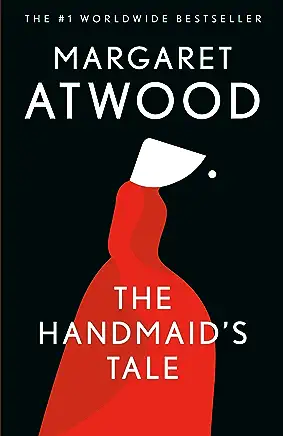
Margaret Atwood is, perhaps, one of my favourite authors. I actually read The Handmaid’s Tale in high school, quite a while before I became a fan of the series (and several more times over the years). Season one, especially, captures the flavour of the novel. Subsequent seasons have continued in the same style and world as the book, helping to build a richer world and flesh out the characters. Parallels to the world in the 2020s are made even more obvious in the series, drawing home the fact that, in addition to being a brilliant author, Atwood is also part visionary.
I should also note that I wasn’t crazy about the book’s sequel, The Testaments. I recommend that you watch the series, but most of all, read The Handmaid’s Tale.
Kindred

Octavia E. Butler’s Kindred was a fast, fascinating read, but the series was mesmerizing. Due to the format of a series with ten episodes and the possibility of several seasons, the narrative is slowed and we get to know the characters better. Kevin and Dana’s backstories are significantly different and Kevin is given more to do in the series, but it is worth both the watch and the read.
All Creatures Great and Small
James Herriot’s memoir has been fictionalized as a dramedy entitled All Creatures Great and Small. Though one is a memoir and the other a fiction, the flavour of Herriot’s writing is perfectly interpreted in the series. I thoroughly enjoyed reading this memoir, but discovered that three seasons weren’t enough. Luckily, season four is scheduled to debut in fall of 2023/sometime in 2024, and I can hardly wait.
The Midwife: A Memoir of Birth, Joy, and Hard Times
Another fictionalized memoir is The Midwife, made into the ten-season (so far) long Call the Midwife television series. Though I haven’t checked, I wouldn’t be surprised if the voiceover in the series (purporting to be Worth but played by Vanessa Redgrave) was taken directly from the novel.
The first book in the series made me feel as if I were re-watching the television series. I also read the second book, Call the Midwife, Shadows of the Workhouse, the stories of which were also dramatized in the early seasons of the series, but didn’t like it enough to venture into book three of the trilogy. The thing I like most about the television series, the characters and the theme of the way women’s rights–and specifically women’s reproductive rights–have evolved just wasn’t strong enough for me.
At any rate, I recommend watching the entire television series and reading at least book one of Jennifer Worth’s trilogy.
Outlander

Wow! Just…wow.
I am only a quarter of the way through the first Outlander book, and I know I’m going to love it as much as I do the series. The series has matched the characters so closely to the writing that I can see and hear Claire and Jamie as I read, as well as the other characters. I’m not usually one for re-watching a series as I find the process tedious when you know what’s going to happen next or where it’s going to end up, but for some reason, I absolutely love that feeling while reading. I will be reading more than one book in this series, for sure. The book is easy to read, whimsical in its narrative, and not as huge a bodice-ripper as the first few seasons of the television series was (which is a huge plus, in my opinion, as I much prefer character development and page-turning plots to graphic depictions of sex).
Watch Outlander on television. Read the books. You won’t be sorry.
You: A Novel
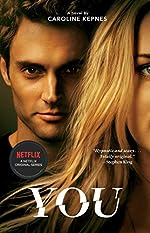
I almost didn’t watch the tv series You, as I was turned off by the point of view and found it unsettling. I’m glad I went back to watch more. I really enjoyed all three seasons of the Netflix series, but I gave up on the series of books after the second one, Hidden Bodies, as I found the narrative tedious.
Reading book one in the series is like revisiting the television series season one. Kudos to the screenwriters who were able to transfer the creepy-factor from the books to the small screen. The stories are no less compelling, no matter the medium you choose.
My recommendation is to watch the series, and read at least book one.
Pines
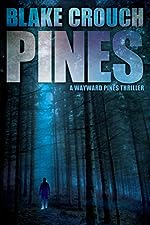
Season one of the television series Wayward Pines was phenomenal. It kept me on the edge of my seat, questioning everything as I tried to figure out what, exactly, was going on. Once that secret of the town was exposed, the series jumped the shark. I read the entire trilogy of Wayward Pines books, which didn’t suffer the same glitch. By all means, watch the series, but be sure to read the entire trilogy. In this case, the books are so much better than the series.
The Magicians

I absolutely love the entire television series of The Magicians and was sorry to see it end. There were some amazing story arcs, and I didn’t mind the fantasy aspect of the plot. Book one of the book series The Magicians was great. The series was very much like the book, and I enjoyed comparing how similar the two were. Unfortunately, book two began in Fillory, and based on Amazon’s the free sample, seemed too much fantasy for my liking, and I didn’t read any further.
My recommendation is to watch all five seasons of the tv series, and read as many of the books as you can when you’re feeling nostalgic.
Bonus Books
Other times I’ve written about books made into television series:

 The last book I released, I Was, Am, Will Be Alice, is a time travel fiction (largely inspired by The Time Traveler’s Wife), as is my as of yet unfinished manuscript, tentatively entitled Cat and Mouse: A Love Story, largely inspired
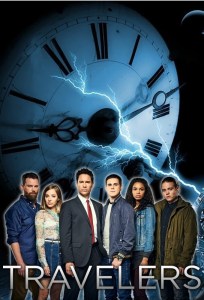 The future is a dystopia, largely due to the fact that a meteor will hit Earth with devastating consequences. They have figured out how to transfer consciousness back in time with the help of a large supercomputer. A team of scientists have their consciousnesses sent back in time to change the past and make the world a better place. To do this, the supercomputer–known as the Director–pinpoints the moment of a host’s death and transfers the future consciousness in the seconds before the host dies. This show is made interesting by the characters of the hosts, which include an FBI agent with a failing marriage, a mentally impaired woman and her social worker, an addict, a teenaged football player, and a woman who is fighting for custody of her son with her abusive, police officer husband. Eric McCormack, a long time favourite of mine since Will and Grace, stars.
 When a seemingly bad guy steals a time machine from a top secret think tank, a historian, a soldier, and a pilot chase him through time in an effort to preserve the timeline. In the first episode, misunderstood Garcia Flynn (expertly played Goran Visnjic) introduces the Rittenhouse Corporation, a Mafia-like group of people who have infiltrated every aspect of government and power corporations for centuries. Through the course of the season, we learn that Flynn is only out to stop Rittenhouse to save his family (whom he believes was murdered by members of Rittenhouse) and make the world a better place. Abigail Spencer, Matt Lanter, and Malcolm Barrett have such incredible chemistry as the team of heroes out to stop Flynn, that by the time they realize they’re fighting for the wrong team, they can do no wrong in the viewers’ eyes.
 Based on the movie by the same name, Frequency supposes that a ham radio can connect the present to the past. In Frequency, police officer Raimy Sullivan learns she can talk to her father over his old radio. The only problem is her father died 20 years ago. Raimy gives her father advice which saves him from the accident that took his life. She goes into work the next morning only to learn that her mother–safe before Raimy had saved her father’s life–went missing twenty years ago and her bones are on the coroner’s table. Her mother, it seems, was a victim of the Nightingale Killer. As if to make matters worse, she is a stranger to her fiancee. Raimy and her father, Frank, spend the season as partners as they try to catch the Nightingale Killer on both ends of the time continuum.
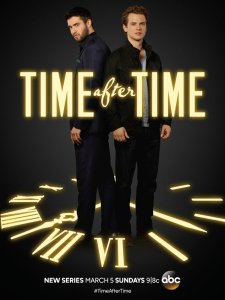 I remember seeing Time After Time, the movie, as a young adult. I loved the fact that H. G. Wells was portrayed as a time traveller. The Time Machine reads more like a journal, after all, documenting the travels of a scientist into the past and incredibly distant future to check in on the evolution of mankind. It’s not hard to imagine that the novel was Wells’s actual journal. In Time After Time, H.G. Wells invents a time machine that is immediately appropriated by Jack the Ripper who goes forward in time to escape capture and continues his murderous ways. The show is more cat and mouse thriller than time travel epic as Dr. John Stephenson (Jack the Ripper) taunts Wells, daring him to follow through with his threat to capture him before his next kill.
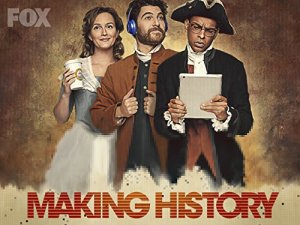 A time travelling duffle bag is absurd on the face of it. Even so, I could accept it provided the show did something smart with it. In the first two episodes, Dan goes back to make sure the American Revolution happens, only to find that the founding fathers are even dumber than he is, and though they love their guns and will only be riled when the British threaten to take them away (cue the political satire), they refuse to do anything more than threaten to take the guns and aver their love for guns. There’s a love affair (as in Time After Time), false identities with modern names, and claiming of song lyrics that won’t be written for centuries (as in Back to the Future). Though there may be a few moments that made me smile, this was even more groan-worthy than Legends of Tomorrow at it’s campy best.



 Elise Abram