Category Archives: Phase Shift

Re-issues of Police Procedural Mystery Fiction Books

In 2012 I published my first book, Phase Shift, the adventures of Molly McBride and Palmer Richardson. Phase Shift was actually the second book I wrote with these characters, the (still) unpublished The Guardian being the first. Since then, I’ve written a number of short stories and novellas with these characters including Aliens’ Waltz–featuring Josef Schliemann; The Nexus–featuring Molly, Palmer, and Josef (both of which have now been published in The Nexus and Other Stories); The Mummy Wore Combat Boots–featuring Palmer and Michael Crestwood; and Throwaway Child-featuring Molly, Palmer, and Josef, with a nod to Clinton Johns from The Guardian.

This month, I’ve re-issued Throwaway Child and The Mummy Wore Combat Boots. Here’s what the two books are about, both of them reissues of police procedural mystery fictions involving forensic anthropology to solve the case:

Throwaway Child

A recent report written after a six-year investigation into residential schools for Canadian First Nations people stated that at least 3,201 student deaths occurred in these schools, with many more going unrecorded.

The report goes on to state that “many students who went to residential school never returned. They were lost to their families…No one took care to count how many died or to record where they were buried.”

Prime Minister Justin Trudeau, in a 2016 speech to the Assembly of First Nations Special Chiefs Assembly said, “We know all too well how residential schools and other decisions by governments were used as a deliberate tool to eliminate Indigenous languages and cultures.”

 Throwaway Child is the story of one of these children.

The skeleton of a young girl is found beneath the cement basement floor in an abandoned Victorian in Toronto. On duty is Detective Constable Michael Crestwood who contacts forensic anthropologist Dr. Palmer Richardson to assist in the investigation. What they uncover is the story of a six-year-old Cree girl, stolen from her family, warehoused in a government run facility and then forgotten.

In a story with ties to current headlines, Throwaway Child explores the injustice experienced by two girls imprisoned in a mid-twentieth century residential school, their families, and the tragedy that results from one girl’s need to find a home.

Buy Throwaway Child on Amazon and wherever eBooks are sold. 


mummy, archaeology, police procedural, toronto, gaming

The Mummy Wore Combat Boots

The Sandy Hook School shooting, the Colorado movie theatre massacre…was online gaming to blame?

Psychologists believe that engaging in violent virtual gaming desensitizes the player and dehumanizes opponents. When the division between what is real and what is virtual becomes unclear, the results can be catastrophic.

When forensic anthropologist Palmer Richardson is called to investigate an uncatalogued sarcophagus found in storage at the Royal Ontario Museum, he has his work cut out for him. Upon investigation, he discovers the mummy inside is that of a teenage boy and involves Detective Constable Michael Crestwood of the Metropolitan Toronto Police.

Their investigation delves into the world of online gaming, where losing health points in a skirmish could have serious implications for a player’s life in the real world.

Inspired by real-life headlines, The Mummy Wore Combat Boots highlights the growing divide between children who live their lives immersed in a digital culture and the adults tasked with raising them who live in the real world.

Buy The Mummy Wore Combat Boots on Amazon and wherever eBooks are sold. 

The “Meet My Main Character Blog Tour” Gone Rogue

blog-tour-graphic

The “Meet My Main Character Blog Tour” is a real thing. While I admit I was not tagged in the tour, I’m crashing the party. I discovered the tour on Eden Baylee’s Website, so I’ll pretend she tagged me in the tour.

To participate I have to answer seven questions about a main character from one of my novels, then I nominate five other authors to answer the same questions. Instead, I’m tagging all Black Rose authors to participate. Post the link to your blog tour post here or on Facebook so we can introduce each other to our main characters.

[Tweet “Zulu the Revenant revealed in the Meet My Main Character Blog Tour #YA #paranormal #book.”]

Here’s a link to Eden’s blog where I found the idea for doing this. Eden is currently promoting her novel, Stranger at Sunset on her site, a mystery/thriller from a number of viewpoints.

1. Tell us a little about this main character. Is he fictional or a historic person?

Zulu the Revenant, aka Janke Dappleford, is the fictional protagonist of my YA paranormal novel, The Revenant.

2. When and where is the story set?

The story takes place mostly in Toronto, Ontario, Canada in the present with flashbacks to the late 1800s in order to explain the origin stories of characters Zulu, Morgan the Seer and his brother, Malchus the Necromancer.

3. What should we know about him?

Zulu is a hopeless romantic who was killed when thrown from his horse on his way to elope with his girlfriend, Alma. He was buried and resurrected the next day, doomed to live forever as a revenant. He was trained in combat by Morgan the Seer so Zulu could use his powers–speed, strength and hearing–to help the people in Morgan’s premonitions.

4. What is the main conflict? What messes up his life?

Malchus, Morgan’s brother, manages to come back from the dead when a group of kids opens a portal with a Ouija board. Malchus believes Morgan responsible for his death and is out to seek revenge. Though still alive, Morgan has aged considerably over the past century and is no match for Malchus, currently in possession of a teenage body. Zulu intervenes to save  the Seer who has become a sort of father figure to him.

5. What is his personal goal?

His goal is to eliminate Malchus and emerge unscathed. Zulu and Morgan join forces with Kat the Empath and Father Paul along the way. The four of them form a sort of “Scooby Gang” out to slay Malchus and his zombie minions, while keeping themselves intact.

6. What are the titles of your novels, and where can we read more about them?

The Revenant is my latest novel. I have three other novels currently published, all of them featuring archaeologist Molly McBride and her husband Palmer Richardson, calledPhase ShiftThe Mummy Wore Combat Boots and Throwaway Child. Read more about my books at eliseabram.com/book-table.

7. When can we expect your next book to be published?

I hope to have my fifth novel, ready for publication by the end of 2014. I Was, Am, Will Be Alice is a YA science fiction novel involving time travel. I started out writing a YA version ofThe Time Traveler’s Wife after getting the idea from an agent posting on the Writer’s Digest website. As I wrote, I began to incorporate ideas from Alice in Wonderland as well. Here’s the logline for the novel: after narrowly escaping death in a school shooting, 9 year old Alice Carroll realizes she can time travel when under extreme stress, a situation she is determined to learn to control in order to go back to that day and save the lives of her teacher and classmates and discover the identity of the woman who sacrificed her life so Alice could live.


My Writing Process: Catch as catch can!

Hello everyone! Welcome to my stop on the Writing Process Blog Hop! I was introduced to this blog hop by Lori L. Schafer:

Lori Schafer is a writer of serious prose and humorous erotica and romance. More than thirty of her short stories, flash fiction, and essays have appeared in a variety of print and online publications, and her first novel, a work of women’s fiction entitled My Life with Michael: A Story of Sex and Beer for the Middle-Aged, will be released in 2015. Also forthcoming in 2015 is her second novel Just the Three of Us: An Erotic Romantic Comedy for the Commitment-Challenged. On the more serious side, her memoir, On Hearing of My Mother’s Death Six Years After It Happened: A Daughter’s Memoir of Mental Illness, will be published in October 2014. When she isn’t writing (which isn’t often), Lori enjoys playing hockey, attending beer festivals, and spending long afternoons reading at the beach.

Website: http://lorilschafer.com/

Like my colleagues also participating in this blog hop, I’ve been asked to answer four questions about my writing and my writing process. Don’t forget to spend some time getting acquainted with authors Rosemary Whittaker, Val Conrad and Jolee Wilson whose bios and links are at the end of this post. Rosemary, Val and Jolee will be hosting the next stop on the blog hop next week.

1. What am I working on?

About a year ago I read a Writer’s Digest featured agent who said she’d be interested in reading a YA Time Traveler’s Wife. I loved that novel, and took it as a personal challenge. What I wound up with was I Am, Was, Will Be Alice something part YA Time Traveler’s Wife, part Alice in Wonderland, part YA romance (yuck!), and all adventure. I am participating in July’s Camp Nanowrimo to give me the kick in the pants to finally get Alice’s story told.

My first YA novel, The Revenant,  is to be released on 10 July 14 and so a good part of my summer will be spent on publicizing and selling that.

I am also working on an adult time travel love triangle novel called Chicken or Egg: A Love Story, not to mention the next instalment in the Molly McBride series, entitled The Next Coming Race, involving evidence of aliens having visited Earth in antiquity in the historic record.

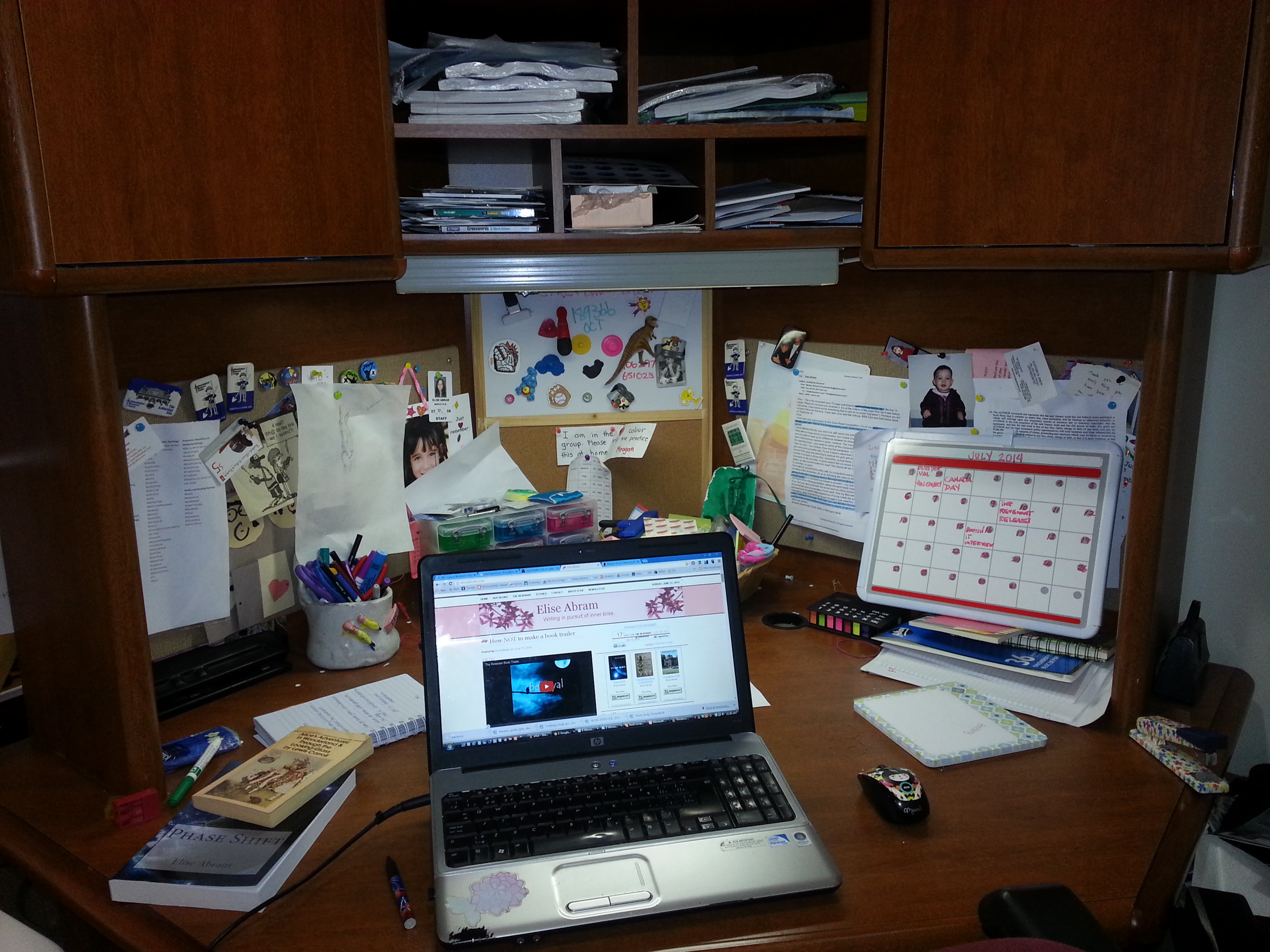
This is where I usually work:

My Writing Space

My writing space.

2. How does my work differ from others of its genre?

I suppose you could call my primary genre science fiction, but when I think of sci-fi I think of alien race wars, lots of tech, space ships, and robots. I call my brand of sci-fi feminine speculative fiction, a made up genre composed of a sort of light-sci-fi, no war (which is stereotypically masculine), modern day tech (also stereotypically masculine), but maybe with a few tweaks. If there is time travel involved, it is in the near future, less than 100 years and not that far removed from the society of today.

[Tweet “I call my brand of sci-fi feminine speculative fiction. That does not mean it only appeals to women.”]

Calling my brand of sci-fi “feminine” does not mean it is chick-lit or only appeals to women. Rather, it is sci-fi of the mind. It takes the world of today, proposes one change, and runs with it to see the effect it may have on society. Phase Shift explores what might happen if the ability to travel to alternate worlds were discovered. The Revenant (not unlike “X-Men” or “Heroes”) supposes there are people among us who have special abilities which some might use for good and others evil. Alice proposes a similar scenario – that people might one day evolve the ability to travel through time. Ditto Cat and Mouse, only this time, the ability for time travel is via technology and not genetic. 

I make small tweaks to people, beliefs and tech and sit back and watch what happens.

3. Why do I write what I do?

I consume popular culture like candy. I also question everything I consume. Star Trek was my first introduction into the world of sci-fi, introduced to me by my father at a young age and the ideas stuck. I grew up telling myself stories before bedtime between lights out and falling asleep. At some point I started writing them down. 

[Tweet “I consume popular culture like candy. I also question everything I consume.”]

It seems like I don’t choose what I write, but rather, it chooses me. Case in point is The Revenant, which grew from a desire to write the penultimate vampire story. The storyline wasn’t gelling so I decided to do some research and found a link on Wikipedia for revenants. The idea blossomed from there. You could almost say Zulu found me and started telling me his story. I really had no choice but to write it down.

4. How does your writing process work?

My first novel, The Guardian, took almost ten years to imagine and another ten years to write. This is partly because I was bogged down with the responsibility of being a new teacher, but also because I didn’t like the way I wrote and struggled over every word. When I took a page from Nanowrimo and just wrote to make up the word count and worry about the editing later, writing became more of a pleasure than a chore. The agony was still there in the revisions and re-writes, but at least the story had already been told.

[Tweet “Accepting you aren’t a real writer if you don’t write every day builds barriers to success.”]

Many sources you read will tell you that writers write every day. I’m here to tell you that’s not necessarily the case. Whole months go by where I don’t add to my current work in progress at all as far as word count goes, but I am always thinking about my work in progress and adding to the story. Taking frequent breaks like that helps the thoughts to percolate so that when I do finally sit to write, I know exactly what I want to say. Accepting that you aren’t a real writer if you don’t write every day is a good way to build barriers to your success. Life happens, especially if you are a student, or are juggling a full-time job with a family. Work on your story every day; write whenever you can.

[Tweet “Work on your story every day; write whenever you can.”]

Don’t forget to spend some time getting acquainted with authors Rosemary Whittaker and Val Conrad whose bios and links are at the end of this post. Rosemary and Val will be hosting the next stop on the blog hop next week.

[Tweet “Writing process blog hop! Get acquainted with authors @LoriLSchafer, @DanzaCRose, Val Conrad and @JoleeWilson!”]

Rosemary Whittaker:

Rosemary is a British born author. She is an English teacher by profession. Since leaving university she has lived and worked in the United States, New Zealand, Australia and twice in Denmark. Her husband works in biodiversity informatics (cataloguing all living species on earth) and this has entailed many moves. They have five children so the moves have been extra challenging.

Her real love has always been writing and she has written several novels, variously set in the countries in which she has lived. She also writes for children. All her novels are available on http://amzn.to/UXJUJp and http://amzn.to/1iUadT. Her recent novels, a set of four, all take the theme of British women who move, by choice or circumstance, to one of the four countries mentioned above. The Cinnamon Snail is set in Denmark, where Rosemary currently lives. [http://bit.ly/1puSPwJ]

Website: rosemarywhittaker.wordpress.com

Val Conrad:

Val Conrad’s life is upside-down to most – her nights are spent working as a nurse in intensive care, leaving her days and more often her nights off to writing.  Her series – Blood of Like Souls, Tears of Like Souls, Promises of Like Souls, and Secrets of Like Souls (Black Rose Writing) is available at Amazon in both paperback and e-book formats.  Much of the skeleton of these stories comes from living in the geographical settings and a career in medicine spanning decades.  She steals moments to write any time, but odd places and crowds of people don’t deter her.  She’s currently working on a new book about how cellular phones are being used to catch criminals.

Website: www.valconrad.com

Jolee Wilson:

Jolee Wilson lives in West Texas with her husband and three children. She has been writing as a hobby since age seven and decided to turn it into a career after the completion of her first novel, Seven Days Normal. With a passion to help hurting relationships, Jolee uses fiction to impart her own lessons in love.

Website: http://www.the-nkwell.blogspot.ca/

Literary Devices from A to Z – Brought to you by the letter T


is for Theme


A theme is a recurring idea that is alluded to throughout a piece of literature. It is almost like a hidden message about people and the human condition buried deep inside a story that you must read between the lines to figure out. Theme may be expressed in the form of a thematic statement as follows:

The novel Phase Shift is about the environment and reveals that if people continue to choose economy over ecology then our planet is doomed.

The novella Throwaway Child is about the injustice of the residential school system and reveals how one’s culture and family are inseparable from one’s identity.

The novella The Mummy Wore Combat Boots is about online video gaming and suggests that too much gaming may cause one to lose reality as a priority of life.

The novel The Revenant is about good vs. evil and reveals that these distinctions are not mutually exclusive.

You try it! Pick a story, decipher the theme of the work and write a thematic statement about it. Post your thematic statements in the comments below.


Literary Devices from A to Z – Brought to you by the letter M


is for Mood


Mood (often called “atmosphere“) is the feeling a piece of writing evokes in the reader. This is often done through narrative tone, description and setting.

After Molly finds Stanley’s body in Phase Shift, she goes into shock:

At the foot of Stanley’s driveway. In the rain.  Police offer me hot drinks and dry blankets. Refuge from the drizzle in a cruiser. They think they’re helping. Won’t help take the chill off.

Three police cars. Two fire engines. One ambulance. Yellow police tape on the property line. Surreal. Like I’m on television. A TV crime show. Waiting on the coroner. Where’s Palmer? Time passes in waves. Folds in and around itself. Inconsistent.

In this passage, the use of short sentences and sentence fragments as well as confused observations help to demonstrate the shock Molly experiences.  Because the narrative has changed in this chapter, the goal is for the reader to experience Molly’s disorientation. In this case, the mood is set using narrative tone.

If the death of Stanley represents a sort of mini-climax in the story, the chapter that follows is a falling action of sorts. The chapter begins:

The rhythmic patter of the rain on the windshield has a calming effect. In spite of the fact we’re out of the weather, I can’t help but shiver. I can sense Palmer considering me, wet puppy, licking her wounds. Stanley’s dead, my mind repeats and repeats again, needle stuck in a groove. Stanley‘s dead and I killed him. Palmer wriggles out of his overcoat and then his suit jacket. He drapes the jacket over me and wriggles back into his overcoat, gifting me his woollen warmth and spicy scent.

In this chapter, a calmer, comforting mood is evoked in the patter of the rain, and the warm comfort of Palmer’s jacket. The reader should experience a respite from the tense shock of the previous scene and be lulled by a sense of security before thrown back into the fray as the climax of the novel nears.

What novels or short stories do you remember as most effective? “The Monkey’s Paw” by WW Jacobs comes to mind for me. Record your thoughts on mood and/or atmosphere in the comments below.

Literary Devices from A to Z – Brought to you by the letter B


is for Bias


Bias occurs when an author incorporates his or her own beliefs into a piece of writing. Incorporating elements of a person’s social, political, religious and life experience, bias can be as explicit as arguing a single side of a conflict or as implicit as omitting evidence that doesn’t conform to an author’s worldview.

Many years ago, I engaged with a self-described bottle-hunter online. I wrote a totally unsolicited email to him chastising for what I considered looting behaviours–“recovering” artifacts from known archaeological sites for their resale value. An active archaeologist at the time, my bias was toward preserving the archaeological record, admiring cultural remains for their intrinsic and historic value,  and fostering the same respect in others. My newly discovered nemesis insisted that, since most of the bottles he collected were from backwoods and beaches that were not parts of the existing record and therefore had no provenance, the bottles were okay to collect. I argued that the only reason there was no provenance was because people like him picked up and sold the artifacts rather than reporting them to the proper authorities. In the end, both of us were so mired in our personal, political, social and educational bias, no amount of back and forth was about to change either of our minds and we eventually gave up the fight.

I’m still fighting the good fight, trying to persuade others to see things clearly (that’s my way, in case you’re wondering) via my writing. The following excerpt imagines how one might feel after arriving on site after pot hunters have finished with it. It’s from an unfinished manuscript tentatively called The Next Coming Race:

We’d arrived on site too late.

I surveyed the marred landscape, barely able to breathe, mired in the horror of it, unable to look away. Craters the size of meteorites; random piles of dirt peppered the grass like shrapnel. A gentle hand on my shoulder broke the trance. “Oh, Moll,” Palmer, my husband, said, barely above a whisper. “I’m sorry.” He squeezed my shoulder. Numb, immobile, unable to manage even the slightest nod, I said nothing.

“You okay?” he asked. I felt the warmth of his breath on the back of my neck, imagined his words edged with a fine cloud of mist hanging in the air between us. He placed his other hand on my other shoulder, and attempted to draw me near. Though I longed for solace in the shelter of his embrace, the shock of the potential archaeological site, ruined, kept hold.

One by one the members of our failed rescue attempt muttered their goodbyes until there were only Palmer, Michael and myself left.

I turned to face Palmer. He smiled. Those were his scruffy years. Clean shaven and hair close cropped since I’d met him, he’d taken to wearing his beard grown, but marginally so. His hair had grown in salt and pepper, and wavy. He kept it long, just this side of needing a cut. I’m not complaining, mind you; I’ve always liked a man in a beard. Combine that look with his dark, watery eyes, add a billowy shirt, and Palmer’d be at home on the cover of any romance novel, I used to think. I worried the look was a sign he was in the throes of a mid-life crisis, but God-forbid I’d ever say that to him—at more than fifteen years’ my senior, Palmer was a little touchy about his age.

That night he wore a dark pea coat, the collar hiked up around his neck as if about to head asea. He shoved his hands into his pockets, shoulders raised nearly to his ears, and asked, “Timmy’s?” Michael, Detective Constable Michael Crestwood of the Metropolitan Toronto Police Department, nodded his assent.

“I need something with more caffeine,” I said. “Second Cup anyone?”

What would you do if you found an abandoned artifact washed up by the side of a cottage country lake? Would you notify the local archaeological association, or cultivate it for your own collection? Post your thoughts or opinions in the comments section below.