Tag Archives: stephen king

Literary Devices from A to Z – Brought to you by the letter D


is for Doppelganger


A doppelganger is a character’s double. The two characters have identical looks but different personalities and agendas.

Both The Talisman and it’s sequel, Bleak House, by Stephen King, feature doppelgangers. In The Talisman, a boy discovers his parents are doppelgangers of the king and queen in another universe. Mistaken for the prince, he is drawn into a life or death adventure to restore order to the duplicate world. In Bleak House, the boy, now a man, must once more return to the other universe to impersonate the prince and put things right in the doppelganger universe.

The notion of duplicate universes is also used in Phase Shift. In Phase Shift,  Molly McBride, an archaeologist, discovers an artifact which is the key to the other world. In this scene, Molly meets with Reyes Prefect and she realizes she’s actually traveled to a doppelganger Earth:

“And where exactly is ‘here’?”

He looks confused. “Why, Theran Prefecture, of course.”

That’s not what I meant. “I mean where, geographically?”

“Theran Prefecture resides on the mass of Selene.”

I continue to look at him, trying to process this information.

“On the planet of Gaia,” he offers.

It’s nothing new, nothing I haven’t already read in Prescott’s memoirs, nothing I wasn’t anticipating in the event our experiment worked. Still, I can’t help but wonder: is this actually happening? Am I really to believe I’m on another world?

“You said you were expecting me.”

“Not you, precisely.” He picks at the upholstery on the padding of his chair. “Perhaps someone like you.” He looks up at me. “We knew it was only a matter of time before someone discovered how to bridge the gap from the other side.”

“The gap? I don’t understand.”

“Between our world and yours.”

I must still look confused because he takes it upon himself to explain further: “Every living thing, from the smallest insect to the largest animal, has a life force that sustains it through its existence. It is the phase pitch at which a life force resonates that binds it to its earth.

“And this ‘gap’ you speak of?”

“Our clerisy posits at some point in time, a cataclysmic event ensued on our planet, forcing a shift in the phase of all living things.

“History tells us at the time of the cataclysmic event our world spawned a doppelganger, an exact duplicate. Your world.” Reyes’s explanation was a lot like chocolate: it tasted good, but did nothing to sate the appetite.

“So the ‘gap’ refers to the difference in our…broadcast frequencies?”

“In the pitch of our phase resonances, yes. Your world and mine co-exist, occupying the same space-time, only slightly out of phase. Here, yet not here.

“We have known of your world for some time now, known how to travel between the two worlds as well. In the interest of science, this technology has been banned until your world could discover our existence, learning how to bridge the gap on your own accord. Our clarists posited the coming of this day.”

What doppelgangers have you read about in fiction? Watched on television? Did the trope work? Post your comments and observations about doppelgangers in literature below.

“Heart Shaped Box” not for the faint of heart

In Heart Shaped Box by Joe Hill, Judas Jude Coyne, aging grunge rocker and collector of oddities and antiquities, purchases a ghost online. He later learns the ghost, Craddock McDermott, is the step-father of his ex-girlfriend, Anna, and he has a vendetta settle with Jude. Both Craddock and Anna’s sister, Jessica blame Jude for Anna’s death. After the ghost kills Jude’s assistant Danny and nearly killing Jude, he and his current girlfriend, Marybeth (whom Jude has nicknamed Georgia) set out on a quest to deliver Craddock’s ghost home.

Heart Shaped Box is a novel reminiscent of Stephen King’s early horror stories, such as Christine, Carrie or The Shining, that is to say, it is more gory horror than spooky horror. For me, the joy of reading horror should have the same effect as rushing down the highest embankment of a roller coaster–heart pumpingly scary. When I was a preteen, I was hooked on the Real Canadian Ghost Stories series I used to buy from the Scholastic Books magazine. Those stories were freaky, so much so that I had to stop reading them once I found I couldn’t sleep soundly without my bedroom door open, the hallway light on, and first checking in my closet and under my bed for ethereal trespassers. In this respect, Heart Shaped Box does not deliver.

Hill’s horror is gruesome and violent and not for the faint of heart. After Marybeth pricks her finger on a ghostly pin hidden in Craddock’s suit, and the wound festers, Hill describes it in high definition. When Jude’s finger is blown off after he’s shot, Hill paints the picture for the reader in glorious, living technicolor. It’s a testament to Hill’s prose and storytelling ability that I continued to read in spite of being utterly and totally grossed out. Coyne’s character (think Treasure Trader’s Billy Jamieson) is a reluctant anti-hero. A drug abuser and alcoholic raised by an abusive father, he goes through a series of girls half his age, referring to them by their cities of origin rather than their given names. He pities himself enough to want to give in to Craddock’s mind control and end his life, but when that plan is thwarted by Marybeth, Jude turns around, vowing to do her the same favour. The only way to do that is to see his quest through to the bitter end, in spite of the fact that it may mean the end of his life as well.

Heart Shaped Box is a good read, but it’s not true horror. Quite frankly, there are more chills to be had listening to voices from Zak Bagans’s ghost box on The Travel Channel’s Ghost Adventures series or TAPS EVPs than reading this novel, but that’s not to say it’s not worth reading. Joe Hill is an excellent author, worthy of my earlier King comparison. He tells a great story, sure to put a chill in your heart and a churn in your belly.

Do you read Joe Hill? What do you think about his knack for tale telling this bloody brand of horror?


“Ravenswood” rocks the horror cliche

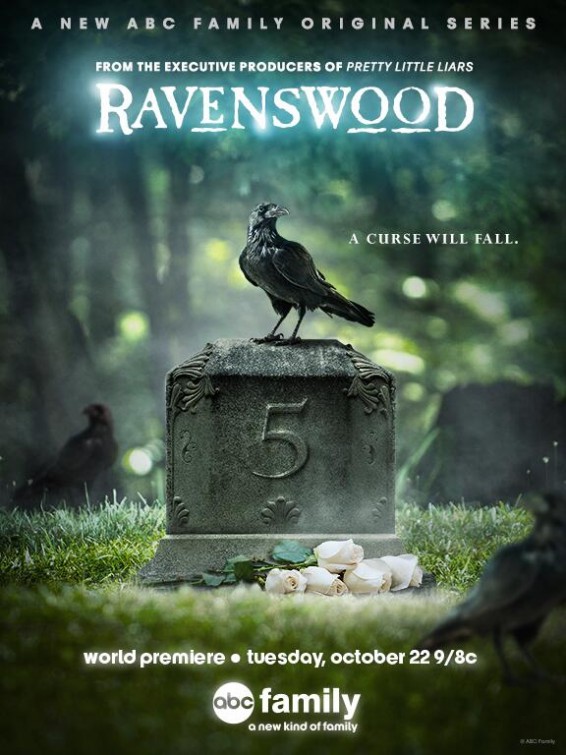
A haunted funeral home, shadow figures, disembodied hands, and distant relative doppelgangers; these are the foundations of Ravenswood, spin-off of Pretty Little Liars. In Ravenswood, runaway Miranda Collins, strikes up a friendship with Caleb Rivers, regular on Pretty Little Liars. Together they delve into the mysteries that plague Ravenswood, including why their names and pictures appear on ancient tombstones, why Miranda’s Lurch-like uncle didn’t raise her when her parents died, and what Caleb’s ties to the town are. Mysteries aren’t the only thing plaguing Ravenswood. True to scary form, there is a curse. Twice in history, a bunch of teens drowned after a soldier returned from the war, both times the sole survivours of their troops. As a portend, Remy Beaumont’s mom has just returned from Afghanistan, the only survivour of her troop. When Remy stops her car on a dark road to pick up twins Luke and Olivia Matheson bringing the body count in the car to five, you know something’s going to happen. The episode ends with Remy’s car partially submerged after going off the edge of a bridge.

While watching the episode, my fourteen year old daughter ran upstairs during every commercial to fill me in on the horrors of Ravenswood. She was both excited and a little spooked by the pilot plot. Though intrigued while watching, I found the horror more cliche than bonafide. I grew up watching horror flicks like Friday the Thirteenth, Nightmare on Elm Street and Halloween, and gave up on them some time in my twenties because sooner or later, the stories and the franchises began to blur. Something’s always not quite right at the funeral home. Whenever someone crawls into a hot bath they’re always going under (kudos to Ravenswood for putting the boy–rather than the curvy blonde girl–into the tub, breaking the stereotype). And there’s always an adult or two trying to keep the pesky kids from uncovering town secrets. In a nod to Stephen King’s Carrie (currently enjoying a re-release at the theatres), the disgraced prom queen–in this case, Olivia trying to come to grips with the fact that the town (her brother included) believes her mother has just murdered her father–is doused with blood.

Though the pilot didn’t bring the nail-biting moments for me as for my daughter, I will be watching the next episode. I liked the first two seasons of Pretty Little Liars, and watched as long as I was curious about who “A” was, why s/he was tormenting the main characters, and if Alison really was dead. I gave up midway through season three because the mystery grew lacklustre, there wasn’t enough character growth, and the clues were too few and far between to hold my interest. Ravenswood sets up enough mysteries to promise intrigue for years to come, provided they don’t try to kill all of the main characters at the end of every episode. It’s pretty obvious Miranda’s Uncle Lurch got rid of her because Ravenswood’s not the best place to raise a child. I predict the twins’ father probably faked his death to escape the far reaching fingers of the town curse. I’m also left wondering about Remy’s mother who remains silent as long as Remy’s father is around and who sleeps on the couch, allegedly due to nightmares. Has her mother actually returned in body as well as in soul?

Why do you think Miranda’s uncle sent her away? Who really killed the twins’ father? Has Remy’s mother returned to anyone but Remy? Who is the wet shadow woman Miranda saw in her uncle’s parlour?

I am proud to announce the publication of my first guest blog post on the WriteToDone.com website.

Modelling expert text is something I learned about in teachers’ college and have used many times over the years, both as a tool with which to develop my own writing voice (as I discuss in the article) as well as with my students as a writing exercise.

The post’s direct link is http://writetodone.com/2013/05/02/develo-your-narrative-voice-by-stealing-from-bestselling-authors/. Please feel free to visit the site and post in the comments. I will make every effort to get back to you within 24 hours of posting.

Above is the Twitter announcement for the post:

YA Novels

You’d think as a teacher of high school English in a school that requires students to read a young adult (YA) novel and in which I have to listen to presentations and read analysis of said novels, that I’d know quite a bit about YA novels. In reality, I know very little.

Is it folly, then, to take on a YA novel as my Nanowrimo challenge this month? Perhaps. But I’m going full speed ahead with it anyway.

I don’t remember reading many YA novels growing up, besides Judy Blume novels and Nancy Drew mysteries. I remember reading Hemingway’s Old Man and the Sea in grade six (no teen issues to be found in that one). In junior high I read the then scandalous Forever and Wifey before a friend’s mother turned me on to Stephen King in high school. I also remember reading quite a few soap-opera-type novels, cast-offs of my mother’s reading, mostly about Jewish immigrants finding their place in the New World, but not many teen novels.

In university I read Bette Greene’s The Summer of My German Soldier, and a number of classics (Winnie The Pooh, Peter Pan, Anne of Green Gables, The Sword in the Stone, Wind in the Willows) in university. I’ve taught Crabbe (William Bell), A Night To Remember (Walter Lord), Dreamspeaker (Cam Hubert), and Monster (Walter Dean Myers). On my own I’ve read Shelley Hrdlitschka’s Sister Wife, Hana’s Suitcase by Karen Levine, Virals by Kathy Reichs, and Only You Can Save Mankind by Terry Prachett. My intention here is to neither brag nor complain about the YA novels I’ve read. It is to establish that I am, by no means, an expert in the field.

Nevertheless, it doesn’t take a rocket scientist to deduce that YA novels are those which are published for and market to young adults (i.e., teenagers). The main characters in the novels are young adults. Issues explored are of interest to young adults. Forever is about a young woman losing her virginity. Pooh, Peter and Anne are all coming of age novels.  Crabbe is about a runaway. Ditto Dreamspeaker. The perennial Go Ask Alice (of which I have a still unread copy procured in my own teenage years) is about drug abuse, Monster: crime and punishment—all things you’d expect a YA novel to be about. But wait. Based on what my students report, it is much more than that. The novels my students read are tales of suicide, rape, cancer stricken youth and parents, sexual disorientation and/or ambiguity, terrorism, sexual abuse, self-abuse as in cutting, and murder, quite weighty topics for someone that can’t comprehend the difference between karma and divine retribution, I think.

Which brings me to The Revenant, the YA novel I’m chipping away at this month. Repeating the mantra “hurt your characters” (1), I am doing my best to put my characters through the ropes. Every night I sit down and type away, watching the word count mount to my goal of 1,600 plus words as I watch the story take shape. My characters have to battle with the fact that they’re empaths, seers and the undead. The main character, Zulu the Revenant, fanaticizes about superheroes as he goes about righting wrongs dreamt of by The Seer, his father figure (whom I must eventually kill). He gets stabbed, shot, and has to deal with the fact that the love of his life died a century ago and isn’t ever coming back—or is she? I haven’t yet decided. The empathy feels people’s emotions and sees auras so she is able to pick bad guys out in a crowd. So far the only hurt she experiences is that she may be falling in love with Zulu who she’s pretty sure is a vampire. She also has to deal with a meddling mother. It’s possible she may lose her mother and Malchus, the necromancer, may have to bring her back, though the way things are shaping up, it would only be temporary. Malchus is the long dead brother of The Seer (an old man cursed with longevity) in possession of a teenager’s body. He has raised two from the dead so far (one of which he killed himself), but they keep decomposing. I think the coroner may have to call his childhood friend, now the priest in the girl’s parish for religious advice as to how people who have been dead for some time are able to walk into city centres before they die one last time. Malchus struggles to get his powers back and under control and then he will have to find his brother because he must exact revenge on him for killing him.

At any rate, I have about 24 hours to percolate the next idea before I must force it to gel.

16,095 words and counting.

Viva Nanowrimo!

(1) Chartand, James. Fiction Writing: Hurt Your Characters. Men With Pens. 2006-2012. < http://menwithpens.ca/fiction-writing-hurt-your-characters/>. 10 Nov 2012.