Tag Archives: star trek

4 New Time Travel Shows Worth Watching (and 1 not so much)

The first time travel story I ever saw was when I was about 8 and watching Classic Trek re-runs (of course, back then, it was called Star Trek and not “Classic”). I’d never seen anything like The City on the Edge of Forever before, and I was hooked. The Star Trek franchise has always done time travel well, which is high praise, given the other memorable movies and series incorporating the time-worn trope since.

The last book I released, I Was, Am, Will Be Alice, is a time travel fiction (largely inspired by The Time Traveler’s Wife), as is my as of yet unfinished manuscript, tentatively entitled Cat and Mouse: A Love Story, largely inspired

This recent television season has seen an explosion of time travel television shows and it doesn’t disappoint, for the most part. In a medium in which good science fiction (and sometimes, any science fiction) is hard to find, you might ask why this particular genre has exploded at this moment in time. A recent CBC broadcast proposed that the phenomenon is due to the current political climate and how people seemed to view the past as a simpler time. With what is happening in the world today, the influx of time travel television reflects people’s desire to turn the clock back to that simpler time. Glamour suggests this may be because we, as a society, have acknowledged the error of our ways and long for a way to fix our future by  going back and fixing our past.

To honour the current television season, here’s a list of 4 new time travel shows (in no particular order) worth watching (and 1 not so much).

1. Travelers
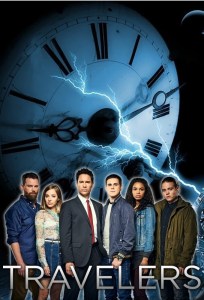
The future is a dystopia, largely due to the fact that a meteor will hit Earth with devastating consequences. They have figured out how to transfer consciousness back in time with the help of a large supercomputer. A team of scientists have their consciousnesses  sent back in time to change the past and make the world a better place. To do this, the supercomputer–known as the Director–pinpoints the moment of a host’s death and transfers the future consciousness in the seconds before the host dies. This show is made interesting by the characters of the hosts, which include an FBI agent with a failing marriage, a mentally impaired woman and her social worker, an addict, a teenaged football player, and a woman who is fighting for custody of her son with her abusive, police officer husband.  Eric McCormack, a long time favourite of mine since Will and Grace, stars.

2. Timeless
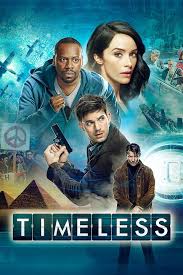
When a seemingly bad guy steals a time machine from a top secret think tank, a historian, a soldier, and a pilot chase him through time in an effort to preserve the timeline. In the first episode, misunderstood Garcia Flynn (expertly played Goran Visnjic) introduces the Rittenhouse Corporation, a Mafia-like group of people who have infiltrated every aspect of government and power corporations for centuries. Through the course of the season, we learn that Flynn is only out to stop Rittenhouse to save his family (whom he believes was murdered by members of Rittenhouse) and make the world a better place. Abigail Spencer, Matt Lanter, and Malcolm Barrett have such incredible chemistry as the team of heroes out to stop Flynn, that by the time they realize they’re fighting for the wrong team, they can do no wrong in the viewers’ eyes.

3. Frequency
Based on the movie by the same name, Frequency supposes that a ham radio can connect the present to the past. In Frequency, police officer Raimy Sullivan learns she can talk to her father over his old radio. The only problem is her father died 20 years ago. Raimy gives her father advice which saves him from the accident that took his life. She goes into work the next morning only to learn that her mother–safe before Raimy had saved her father’s life–went missing twenty years ago and her bones are on the coroner’s table. Her mother, it seems, was a victim of the Nightingale Killer. As if to make matters worse, she is a stranger to her fiancee. Raimy and her father, Frank, spend the season as partners as they try to catch the Nightingale Killer on both ends of the time continuum.


4. Time After Time
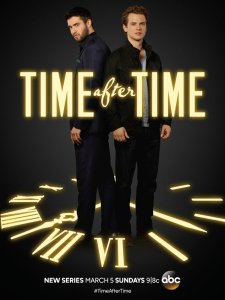
I remember seeing Time After Time, the movie, as a young adult. I loved the fact that H. G. Wells was portrayed as a time traveller. The Time Machine reads more like a journal, after all, documenting the travels of a scientist into the past and incredibly distant future to check in on the evolution of mankind. It’s not hard to imagine that the novel was Wells’s actual journal. In Time After Time, H.G. Wells invents a time machine that is immediately appropriated by Jack the Ripper who goes forward in time to escape capture and continues his murderous ways. The show is more cat and mouse thriller than time travel epic as Dr. John Stephenson (Jack the Ripper) taunts Wells, daring him to follow through with his threat to capture him before his next kill.

*As an aside, is Flash’s H.R. Wells somehow an homage to H.G. Wells? Why else would the character–who hops Earths a la Sliders and who is known to have time travelled in the comic world–have been given a name so similar to the author?

5. Making History
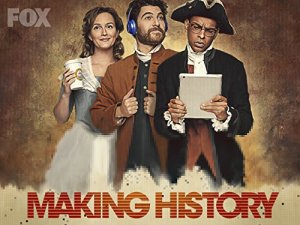
A time travelling duffle bag is absurd on the face of it. Even so, I could accept it provided the show did something smart with it. In the first two episodes, Dan goes back to make sure the American Revolution happens, only to find that the founding fathers are even dumber than he is, and though they love their guns and will only be riled when the British threaten to take them away (cue the political satire), they refuse to do anything more than threaten to take the guns and aver their love for guns. There’s a love affair (as in Time After Time), false identities with modern names, and claiming of song lyrics that won’t be written for centuries (as in Back to the Future). Though there may be a few moments that made me smile, this was even more groan-worthy than Legends of Tomorrow at it’s campy best.

Whether the surge in time travel tales is due to a longing to return to a simpler time, or the desire to turn back the clock, given the number of celebrity deaths and the politics of the previous year, time travel television is a worthy, sentimental diversion.

Are you a fan of time travel fiction? Weigh in with what you think in the comments below.

My Writing Process: Catch as catch can!

Hello everyone! Welcome to my stop on the Writing Process Blog Hop! I was introduced to this blog hop by Lori L. Schafer:

Lori Schafer is a writer of serious prose and humorous erotica and romance. More than thirty of her short stories, flash fiction, and essays have appeared in a variety of print and online publications, and her first novel, a work of women’s fiction entitled My Life with Michael: A Story of Sex and Beer for the Middle-Aged, will be released in 2015. Also forthcoming in 2015 is her second novel Just the Three of Us: An Erotic Romantic Comedy for the Commitment-Challenged. On the more serious side, her memoir, On Hearing of My Mother’s Death Six Years After It Happened: A Daughter’s Memoir of Mental Illness, will be published in October 2014. When she isn’t writing (which isn’t often), Lori enjoys playing hockey, attending beer festivals, and spending long afternoons reading at the beach.

Website: http://lorilschafer.com/

Like my colleagues also participating in this blog hop, I’ve been asked to answer four questions about my writing and my writing process. Don’t forget to spend some time getting acquainted with authors Rosemary Whittaker, Val Conrad and Jolee Wilson whose bios and links are at the end of this post. Rosemary, Val and Jolee will be hosting the next stop on the blog hop next week.

1. What am I working on?

About a year ago I read a Writer’s Digest featured agent who said she’d be interested in reading a YA Time Traveler’s Wife. I loved that novel, and took it as a personal challenge. What I wound up with was I Am, Was, Will Be Alice something part YA Time Traveler’s Wife, part Alice in Wonderland, part YA romance (yuck!), and all adventure. I am participating in July’s Camp Nanowrimo to give me the kick in the pants to finally get Alice’s story told.

My first YA novel, The Revenant,  is to be released on 10 July 14 and so a good part of my summer will be spent on publicizing and selling that.

I am also working on an adult time travel love triangle novel called Chicken or Egg: A Love Story, not to mention the next instalment in the Molly McBride series, entitled The Next Coming Race, involving evidence of aliens having visited Earth in antiquity in the historic record.

This is where I usually work:

My Writing Space

My writing space.

2. How does my work differ from others of its genre?

I suppose you could call my primary genre science fiction, but when I think of sci-fi I think of alien race wars, lots of tech, space ships, and robots. I call my brand of sci-fi feminine speculative fiction, a made up genre composed of a sort of light-sci-fi, no war (which is stereotypically masculine), modern day tech (also stereotypically masculine), but maybe with a few tweaks. If there is time travel involved, it is in the near future, less than 100 years and not that far removed from the society of today.

[Tweet “I call my brand of sci-fi feminine speculative fiction. That does not mean it only appeals to women.”]

Calling my brand of sci-fi “feminine” does not mean it is chick-lit or only appeals to women. Rather, it is sci-fi of the mind. It takes the world of today, proposes one change, and runs with it to see the effect it may have on society. Phase Shift explores what might happen if the ability to travel to alternate worlds were discovered. The Revenant (not unlike “X-Men” or “Heroes”) supposes there are people among us who have special abilities which some might use for good and others evil. Alice proposes a similar scenario – that people might one day evolve the ability to travel through time. Ditto Cat and Mouse, only this time, the ability for time travel is via technology and not genetic. 

I make small tweaks to people, beliefs and tech and sit back and watch what happens.

3. Why do I write what I do?

I consume popular culture like candy. I also question everything I consume. Star Trek was my first introduction into the world of sci-fi, introduced to me by my father at a young age and the ideas stuck. I grew up telling myself stories before bedtime between lights out and falling asleep. At some point I started writing them down. 

[Tweet “I consume popular culture like candy. I also question everything I consume.”]

It seems like I don’t choose what I write, but rather, it chooses me. Case in point is The Revenant, which grew from a desire to write the penultimate vampire story. The storyline wasn’t gelling so I decided to do some research and found a link on Wikipedia for revenants. The idea blossomed from there. You could almost say Zulu found me and started telling me his story. I really had no choice but to write it down.

4. How does your writing process work?

My first novel, The Guardian, took almost ten years to imagine and another ten years to write. This is partly because I was bogged down with the responsibility of being a new teacher, but also because I didn’t like the way I wrote and struggled over every word. When I took a page from Nanowrimo and just wrote to make up the word count and worry about the editing later, writing became more of a pleasure than a chore. The agony was still there in the revisions and re-writes, but at least the story had already been told.

[Tweet “Accepting you aren’t a real writer if you don’t write every day builds barriers to success.”]

Many sources you read will tell you that writers write every day. I’m here to tell you that’s not necessarily the case. Whole months go by where I don’t add to my current work in progress at all as far as word count goes, but I am always thinking about my work in progress and adding to the story. Taking frequent breaks like that helps the thoughts to percolate so that when I do finally sit to write, I know exactly what I want to say. Accepting that you aren’t a real writer if you don’t write every day is a good way to build barriers to your success. Life happens, especially if you are a student, or are juggling a full-time job with a family. Work on your story every day; write whenever you can.

[Tweet “Work on your story every day; write whenever you can.”]

Don’t forget to spend some time getting acquainted with authors Rosemary Whittaker and Val Conrad whose bios and links are at the end of this post. Rosemary and Val will be hosting the next stop on the blog hop next week.

[Tweet “Writing process blog hop! Get acquainted with authors @LoriLSchafer, @DanzaCRose, Val Conrad and @JoleeWilson!”]

Rosemary Whittaker:

Rosemary is a British born author. She is an English teacher by profession. Since leaving university she has lived and worked in the United States, New Zealand, Australia and twice in Denmark. Her husband works in biodiversity informatics (cataloguing all living species on earth) and this has entailed many moves. They have five children so the moves have been extra challenging.

Her real love has always been writing and she has written several novels, variously set in the countries in which she has lived. She also writes for children. All her novels are available on http://amzn.to/UXJUJp and http://amzn.to/1iUadT. Her recent novels, a set of four, all take the theme of British women who move, by choice or circumstance, to one of the four countries mentioned above. The Cinnamon Snail is set in Denmark, where Rosemary currently lives. [http://bit.ly/1puSPwJ]

Website: rosemarywhittaker.wordpress.com

Val Conrad:

Val Conrad’s life is upside-down to most – her nights are spent working as a nurse in intensive care, leaving her days and more often her nights off to writing.  Her series – Blood of Like Souls, Tears of Like Souls, Promises of Like Souls, and Secrets of Like Souls (Black Rose Writing) is available at Amazon in both paperback and e-book formats.  Much of the skeleton of these stories comes from living in the geographical settings and a career in medicine spanning decades.  She steals moments to write any time, but odd places and crowds of people don’t deter her.  She’s currently working on a new book about how cellular phones are being used to catch criminals.

Website: www.valconrad.com

Jolee Wilson:

Jolee Wilson lives in West Texas with her husband and three children. She has been writing as a hobby since age seven and decided to turn it into a career after the completion of her first novel, Seven Days Normal. With a passion to help hurting relationships, Jolee uses fiction to impart her own lessons in love.

Website: http://www.the-nkwell.blogspot.ca/

Literary Devices from A to Z – Brought to you by the letter X


is for Xenophobia


Xenophobia is a fear of strangers or of the unknown. It is frequently used as a device in literature, especially science fiction literature.

My theory is that, in times of war, the stranger is the enemy, be they German, Russian, or Mid-Eastern. During times of war there is an upswing in the number of books, movies and television shows where the stranger is the enemy. In World War I and II, most people had no idea what the typical German was like, except that s/he was different from typical Americans (or Canadians or Britains). Ditto Russians during the Cold War or people from the Mid-East since 9-11. It makes sense to cast the stranger with the unknown culture, the object of fear, in the position of the enemy in the media.

In times of so-called “peace”, there is an upswing in the number of popular culture projects in which the alien–as in from another planet–is the enemy. This is because with the advent of the Internet, the world has gotten smaller and we pretty much know about every culture there is. But a stranger from another planet? Now that is something to fear.

Most works simply assume aliens are out to annihilate the human race. Aliens speak a foreign language, they look different than us, and their culture–if it exists–would be different than ours as well. The truth is, most aliens would probably look more like Star Trek‘s Horta than its Klingons. Does a steaming mass of lava  or a shimmering plasma field have a culture? Can it/he/she/schlee have a culture?

I’m not sure what is more frightening to me, the likes of  Hannibal Lechter and Joe Carroll, or Lrrr and Ndnd from Omicron Persei 8. What’s scarier to you–an ordinary human psychopath or an alien from another planet? Would you fall prey to xenophobia and automatically assume the alien is your enemy? Post your opinions in the comments below.


Literary Devices from A to Z – Brought to you by the letter G


is for Genre


Genre is used to describe types of literature. Some examples are science fiction, young adult, supernatural, thriller, adventure, and police procedural.

In the genre of science fiction, authors take current social mores and technology and project how that might change in the future. One example of this is “Star Trek” and communicators. In “Trek”, Gene Roddenberry imagined how people might communicate in the future and came up with the small, handheld devices. It’s no coincidence that when real life engineers were designing handhelds they used the communicator as a model and came up with the flip phone. Incidentally, modern smart phones appear modelled after another “Trek” device, the PADD (personal access display device).

In Phase Shift, museums on Gaia meld high and low tech in their dioramas. A description follows:

…the display was lifeless, a series of plaster casts of various skeletal remains sitting dully on a number of podiums, arranged in chronological order according to the era of each animal’s evolution.  Now, one by one, each piece of bone is animated in turn.  I watch as the first skull grows holographic muscle and skin and then rotates a full three hundred and sixty degrees on its podium.  Following that, the hologram grows a body, a three-dimensional representation of what Gaians believe the animal to have looked like when alive.  The three-D body comes away from the skull on the podium and it, too, rotates full circle.  Lastly, for its magnum opus, the hominid looks me square in the eye and takes a series of steps toward me, leaving the diorama behind.  Once more it rotates a full three hundred and sixty degrees before vanishing into thin air.  It takes almost a full five minutes for each specimen on the Gaian human evolutionary line to cycle through its trip down the runway.

When the last specimen has finished, the gallery is once more still.

Here, holographic technology is melded with a low-tech plaster diorama to create an interactive museum display. Given the state of holographic technology today, it’s not such a long stretch to assume one day the two might be joined to make history come to life for museum patrons.

The key to writing science fiction is to make it plausible. Readers should be able to imagine a future in which the technology and social structures might exist.

How many genres of literature can you think of? Write them below and I’ll compile a master list and share it in a future blog post.


Literary Devices from A to Z – Brought to you by the letter A


is for Allusion


An allusion is a reference to a person, place or thing outside of the current text. It is assumed that the reader or viewer will recognize the reference and draw a deeper connection with the text.

Different types of allusions require different levels of critical thought in order to form connections. A simple allusion might be a casual reference to something from popular culture:

The plan was simple enough–bring the girls to the ancient Victorian, that Addams Family knock-off, scare the pants off them, be all “there, there” when the time was right, and then literally take the pants off them.

-from The Revenant

In this example, “Addams Family knock-off” connotes a dilapidated mansion with mansard-style roofs, quite possibly haunted, with a belfry, bats included.

A more complex allusion might be an extended metaphor that, when taken as a whole, paints a picture for the reader:

Zulu heard his watch mark off the time: tick…tick…tick. He fancied himself Captain Hook on the deck of the Jolly Roger, hearing the clock in the belly of the crock that took his hand. He stood upright, hands on hips, right foot on an overturned trash can. For a moment he was Hook. “He tasks me,” he whispered. “He tasks me and I shall have him.”

Wait, he thought. Wrong movie.

-from The Revenant

This allusion relies, not only on the reader’s knowledge of J.M. Barrie’s Peter Pan, but also “Star Trek II: The Wrath of Khan.” While the reference to Pan is more of an explicit allusion as it identifies characters in the text, the reference to “Khan” is more subtle in that it doesn’t. Here the author is hoping her target audience has seen the movie, recognizes the quote, and makes the connection.

I leave you with one final allusion I wrote, just because I’m proud of it, from my I am, Was, Will be Alice YA novel:

“I’m not sick.”

“Paralyzing fear is a kind of sickness,” she says and just like that, we’re replaying the scene from The Big Bang Theory, the one where Sheldon is locked out of his house and spending the night at Penny’s, but he can’t sleep and Sheldon says he’s not sick and Penny says, “Homesickness is a kind of sickness.” Mom doesn’t disappoint–she asks if I want her to sing “Soft Kitty” to me. Or maybe she does disappoint, I mean, here I am, scared to frozen that if I go to school I will one day dematerialize in front of people in an imperceptible poof of air leaving behind nothing but my clothes (including my underwear) or even worse, rematerialize in front of the entire ninth grade population in the altogether, my privates on display, and all she can do is play out a corny scene from a stupid television show. I know she means well, to ease the tension in the room, but come on!

Feel free to share any allusions you’ve written or comments you have below.

Critique of “Star Trek: Into Darkness”

Critique of Star Trek: Into Darkness

Warning: Spoilers follow.

I’ve been a Star Trek fan for as long as I can remember, so devout a fan, in fact, that the first time I heard of the JJ Abrams re-boot, I thought it was sacrilege. And then I watched it. In light of the cancellation of Deep Space Nine and the failure of Enterprise, 2009’s Star Trek brought a breath of fresh air to the franchise.

After the vacuum in which there was no new Trek after the original series ended, I looked forward to the first Trek movie with anticipation. After watching it, I didn’t know what to make of it. Any new Trek is good Trek, I argued, but I loathed calling the new Trek good Trek. Then the second movie premiered and I went, in spite of the first, and was blown away. The Wrath of Khan was the best epic epi of Star Trek ever. I think I must’ve seen it a dozen times or more in the emptiness between it and The Search for Spock, only to be disappointed once more. The third movie in the franchise was too short and too proscribed. A mistake had been made in killing Spock and the purpose of The Search for Spock was an ends to a means—to put the canon right.

By contrast, The Voyage Home shined because it was a return to the two things Trek does best—the buddy relationship between Kirk and Spock (made better by Spock’s newfound struggle with humanity/vulcanry) and time travel. After movie number four, the original flavour of Trek would not return until movie seven, Final Contact. This movie, capitalizing on the popularity of The Next Generation series, was a winner as it was as good as TNG’s best television episodes. The movies that followed never, in my opinion, recaptured the camaraderie and adventure that made the series such a hit.

On the heels of TNG movies came a slew of television series linked to the Trek franchise. Deep Space Nine played out in mediocrity alongside a bland Final Contact and lacklustre Andromeda, followed by a struggling Enterprise, and it seemed like the franchise—and Gene Roddenbery’s future ideal—had petered out.

Then came the 2009 re-boot, followed by 2013’s Into Darkness. I went to see it because, like all other Trek movies, it was Star Trek. The reviews were mixed, everything from amazing and that it was a must see to nothing special, and that it recycled several episodes of the original Trek. While the movie does recycle many original Trek ideas, such as the characters of Khan, and Carol Marcus, as well as a conveniently placed zombie tribble, Into Darkness is amazingly fun. In it, the crew is sent to kill the character we later learn is Khan Noonian Singh in a deserted area on Kronos, the Klingon home world, without starting a war. Talked out of the hit by Spock, Kirk and crew are targeted by Marcus’ father as a part of a cover-up to hide the fact that Khan had been working with The Federation to develop a type of photon torpedo. It turns out the torpedoes disguise stasis pods for Khan’s eugenically engineered mates, and Kirk and his gang emerge victorious, thwarting the evil Marcus senior, and securing Khan and group back in their stasis pods, ready to be set afloat on the SS Botany Bay where they will be found by Kirk et al in the original Trek timeline.

I enjoyed the re-invention of the Khan character, seeing the start of Kirk’s relationship with Carol Marcus, and the cameos by both the tribble and Leonard Nimoy as the elder Spock. It is interesting how the roles of Kirk and Spock are switched for the retake of Wrath’s critical warp core scene. This time it is Kirk who asks about the status of the ship and Spock who answers “Out of danger,” as well as shouting “Khan!” with more emotion than you’d think a Vulcan could ever muster. I know Kirk is supposed to be the star of the series, but the Spock character, pioneered by Leonard Nimoy and wonderfully interpreted by Zachary Quinto, in my mind, has become my favourite and most important Trek character by far. I love the chemistry between Spock and Uhura as well. Though Kirk still has a lot of growing up to do, this movie helps the character travel down that road by miles from where he was at the end of the first movie.

Into Darkness is a fine addition to the popular Trek canon. I look forward to seeing it again when it comes out on DVD as well as where JJ Abrams will “boldly go” with the franchise in the next movie.

Graphic from http://collider.com/star-trek-into-darkness-app-image/

About the Author

Elise Abram, English teacher and former archaeologist, has been writing for as long as she can remember, but it wasn’t until she was asked to teach Writer’s Craft in 2001 that she began to write seriously. Her first novel, THE GUARDIAN was partially published as a Twitter novel a few summers back (and may be accessed at @RKLOGYprof). Nearly ten years after its inception Abram decided it was time to stop shopping around with traditional publication houses and publish PHASE SHIFT on her own.

Download PHASE SHIFT for the price of a tweet. Visit http://www.eliseabram.com, click on the button, tweet or Facebook about my novel and download it for FREE!

A Fan is an Enthusiastic Devotee…

Xmas Rumpy and BelleWhen I was younger I was, admittedly, a fan girl. I can remember having more than 200 pictures of Gregory Harrison posted on my bedroom walls when I was twelve. As a teenager, it was Simon LeBon of Duran Duran. I’ve seen them in concert a total of four times and own every album they’ve ever recorded. Ditto The Human League. But those were the days before the advent of The Internet, when the only fans you connected with were your friends or the people in the audience. Though we argued over whether Simon was hotter than Roger or Nick, there was no debating our love for the music.

I’m also a Star Trek fan. I collect memorabilia, everything from action figures to decorative plates. I’ve watched every television episode and movie multiple times and connected with actors and other “Trekkers” at conventions. We disagree over which Trek is best, which captain is most commanding and whether Romulans or Klingons have the ability to kick the most Federation butt, but the atmosphere at these gatherings is congenial.

My first foray into online fandom occured nearly ten years ago now I joined Nick Mancuso’s Yahoo group, which ultimately led to my meeting the actor, an experience which I will never forget. While I was active in the group, I was surprised at the vehemence many of the fans brought to it. Though we knew the actor tuned in from time to time, some of the members felt no compunctions posting unfavourable criticisms of his work, critiquing his choice of scripts and his acting ability in a voice that could be described as anything but constructive. Other members used the group as a forum to spew racist remarks at which some of the fans (including myself) took umbrage to the point of bowing out of the group. At times I was surprised Mr. Mancuso didn’t do the same.

The idea for this blog post came after a similar experience regarding fans of ABC’s Once Upon a Time in which people who are so passionate about the show they are willing to post artwork, fan fiction, critiques and predictions about it online for the whole world to see, only for some to be shot down for their admiration in the most horrific way.

In planning for this blog, I returned to the dictionary definition of “fan”, which is: “an enthusiastic devotee, follower, or admirer of a sport, pastime, celebrity”. Dictionary.com pinpoints the origin of the word to 1885-1890 as an “Americanism; short for fanatic”. Synonyms include “supporter, enthusiast [and] addict”. Another definition it gives is “a person with an extreme and uncritical enthusiasm or zeal” (emphasis added).

What strikes me as most interesting about this definition is the synonym “addict” and the fact that a fan typically has an “uncritical” zeal. Many people who blog about OUaT are anything but uncritical, both of the show and of their fellow “fans”. Everyone is entitled to an opinion, and as an opinion is made with insufficient grounds to produce complete certainty (dictionary.com), an opinion can never be wrong. An opinion can be formulated based on ignorance or misinterpretation of fact, but it can never be wrong because, by definition, it is based on uncertain grounds. What this means is that if I thing Belle and Hook would make a better ship than Belle and Gold, that’s my opinion. You can disagree, but I am not wrong because this is my personal view. (I don’t by the way. I so love seeing Gold thrown off kilter as he tries to figure out how to win and keep Belle’s favour.)

As a mature adult, I may think that someone is off his rocker for even suggesting Belle be shipped with anyone other than Gold, but I must voice my opinion in a way that expounds my personal view without personally attacking anyone whose opinion differs from mine. This all goes back to my previous post which discussed online personas. I can make a name for myself as a diplomat who is willing to engage in an adult discussion of fact without devolving into schoolyard name calling, or I can make a name for myself as a foul-mouthed, narrow-minded dictator who is unwilling to allow for any opinion other than the one I’ve formed for myself. As I told the student who used Twitter as a sounding board which included a lot of unkind epithets directed at my teaching ability, there are ways to express your frustration without resorting to swearing and personal attacks.

I love the online debate that ensues as a result of the twists and turns Kitsis and his staff throw at OUaT’s fan base, but I could do without the swearing, name-calling and personal attacks. And while I’m sure those who see themselves in this blog will no doubt take umbrage in its posting and wind up throwing a few of those epithets my way, I am, like so many of you out there, sticking my neck out to post this nevertheless.

I leave you with the following two quotes, which I think sum this post up nicely:

Can we all get along?” (Rodney King, I believe) 

If you can’t say something nice, shh, say nothing.” (Thumper)