Tag Archives: phase shift

Literary Devices from A to Z – Brought to you by the letter W


is for Weather


Pathetic fallacy is when inanimate objects of nature–specifically the weather–mimic human emotion. The distinction between pathetic fallacy and personification is as follows: personification “gives human attributes to abstract ideas, animate objects of nature or inanimate non-natural objects” (Literary Devices).

An example of this occurs in Phase Shift. After Molly finds Stanley’s body, she says,

At the foot of Stanley’s driveway. In the rain.  Police offer me hot drinks and dry blankets. Refuge from the drizzle in a cruiser. They think they’re helping. Won’t help take the chill off. 

On this night, the weather is cold and rainy, the perfect atmosphere for coming to terms with finding a body that appears to have spontaneously combusted and for finding out that you may be under investigation for setting the fire.

Think about the weather during “There’s a Light (Over at the Frankenstein Place)” in “The Rocky Horror Picture Show”, or the lightening gathering as Macbeth meets the witches on the heath. What other notable uses of the weather via pathetic fallacy stick out in your mind? Share your ideas in the comments below.


Literary Devices from A to Z – Brought to you by the letter M


is for Mood


Mood (often called “atmosphere“) is the feeling a piece of writing evokes in the reader. This is often done through narrative tone, description and setting.

After Molly finds Stanley’s body in Phase Shift, she goes into shock:

At the foot of Stanley’s driveway. In the rain.  Police offer me hot drinks and dry blankets. Refuge from the drizzle in a cruiser. They think they’re helping. Won’t help take the chill off.

Three police cars. Two fire engines. One ambulance. Yellow police tape on the property line. Surreal. Like I’m on television. A TV crime show. Waiting on the coroner. Where’s Palmer? Time passes in waves. Folds in and around itself. Inconsistent.

In this passage, the use of short sentences and sentence fragments as well as confused observations help to demonstrate the shock Molly experiences.  Because the narrative has changed in this chapter, the goal is for the reader to experience Molly’s disorientation. In this case, the mood is set using narrative tone.

If the death of Stanley represents a sort of mini-climax in the story, the chapter that follows is a falling action of sorts. The chapter begins:

The rhythmic patter of the rain on the windshield has a calming effect. In spite of the fact we’re out of the weather, I can’t help but shiver. I can sense Palmer considering me, wet puppy, licking her wounds. Stanley’s dead, my mind repeats and repeats again, needle stuck in a groove. Stanley‘s dead and I killed him. Palmer wriggles out of his overcoat and then his suit jacket. He drapes the jacket over me and wriggles back into his overcoat, gifting me his woollen warmth and spicy scent.

In this chapter, a calmer, comforting mood is evoked in the patter of the rain, and the warm comfort of Palmer’s jacket. The reader should experience a respite from the tense shock of the previous scene and be lulled by a sense of security before thrown back into the fray as the climax of the novel nears.

What novels or short stories do you remember as most effective? “The Monkey’s Paw” by WW Jacobs comes to mind for me. Record your thoughts on mood and/or atmosphere in the comments below.

Literary Devices from A to Z – Brought to you by the letter L


is for Lyric


A lyric is a song-like poem meant to express the thoughts and feelings of a person. Shakespeare’s sonnets are a form of lyric poetry.

In the short story “Aliens’ Waltz”, Josef Scheliemann describes his alien sighting using lyric prose:

Slowly move, quick box step, twirling round, open, turn. One-two-three, two-two-three. Shoulders rise. Fall again. Moving on single plain, tall and completely poised. Triangular faces showcase ovular eyes. Smoky and luminous in celestial moonlight. Fabric of dress gowns shine twinkling in the night. One-two-three, two-two-three, weightlessly promenade. Steam buoys from the wheat stalks forming nebulous mist. Feet barely skim farmland in a spiraling glide.

Though admittedly not perfect, the prose in this passage is meant to sound like a waltz. Effort was made to ensure stressed and unstressed symbols and pauses approximate the one-two-three-one-two-three time of a waltz. Ideally, because it is lyric, it should sound as if it were meant to be paired with music, such as (my favourite) “The Blue Danube Waltz”.

What do you think? Does it sound like a waltz when read out loud, or am I asking too much of the reader? Have you ever tried something similar? Was it as mind-numbingly difficult to execute as my sample lyric text?


Literary Devices from A to Z – Brought to you by the letter D


is for Doppelganger


A doppelganger is a character’s double. The two characters have identical looks but different personalities and agendas.

Both The Talisman and it’s sequel, Bleak House, by Stephen King, feature doppelgangers. In The Talisman, a boy discovers his parents are doppelgangers of the king and queen in another universe. Mistaken for the prince, he is drawn into a life or death adventure to restore order to the duplicate world. In Bleak House, the boy, now a man, must once more return to the other universe to impersonate the prince and put things right in the doppelganger universe.

The notion of duplicate universes is also used in Phase Shift. In Phase Shift,  Molly McBride, an archaeologist, discovers an artifact which is the key to the other world. In this scene, Molly meets with Reyes Prefect and she realizes she’s actually traveled to a doppelganger Earth:

“And where exactly is ‘here’?”

He looks confused. “Why, Theran Prefecture, of course.”

That’s not what I meant. “I mean where, geographically?”

“Theran Prefecture resides on the mass of Selene.”

I continue to look at him, trying to process this information.

“On the planet of Gaia,” he offers.

It’s nothing new, nothing I haven’t already read in Prescott’s memoirs, nothing I wasn’t anticipating in the event our experiment worked. Still, I can’t help but wonder: is this actually happening? Am I really to believe I’m on another world?

“You said you were expecting me.”

“Not you, precisely.” He picks at the upholstery on the padding of his chair. “Perhaps someone like you.” He looks up at me. “We knew it was only a matter of time before someone discovered how to bridge the gap from the other side.”

“The gap? I don’t understand.”

“Between our world and yours.”

I must still look confused because he takes it upon himself to explain further: “Every living thing, from the smallest insect to the largest animal, has a life force that sustains it through its existence. It is the phase pitch at which a life force resonates that binds it to its earth.

“And this ‘gap’ you speak of?”

“Our clerisy posits at some point in time, a cataclysmic event ensued on our planet, forcing a shift in the phase of all living things.

“History tells us at the time of the cataclysmic event our world spawned a doppelganger, an exact duplicate. Your world.” Reyes’s explanation was a lot like chocolate: it tasted good, but did nothing to sate the appetite.

“So the ‘gap’ refers to the difference in our…broadcast frequencies?”

“In the pitch of our phase resonances, yes. Your world and mine co-exist, occupying the same space-time, only slightly out of phase. Here, yet not here.

“We have known of your world for some time now, known how to travel between the two worlds as well. In the interest of science, this technology has been banned until your world could discover our existence, learning how to bridge the gap on your own accord. Our clarists posited the coming of this day.”

What doppelgangers have you read about in fiction? Watched on television? Did the trope work? Post your comments and observations about doppelgangers in literature below.

Is the world ready for self-driving cars?

auto-car


“As Reyes speaks to me, the car lurches into action.  He uses the rudder control to join the traffic stream, and then flips a toggle switch on the dash. The car moves forward, speed ebbing and flowing with the pool of traffic. I get the idea the vehicle uses auto-pilot to arrive at its destination.  Once he has flipped the switch, he keeps his eyes on me instead of the road. Not once does Reyes busy himself with the drudgeries of defensive driving.”

Phase Shift

Google uses them; “Toyota Priuses equipped with self-driving technology“. Once the stuff of science fiction, self-driving cars may be a reality within four years. Already we have cruise control and anti-lock breaks (which always take me by surprise and do nothing but make me brace for uncontrolled impact), proximity cameras and cars that parallel park themselves, is it such a stretch to think they could do so much more in the very near future? The argument is that cars on auto-pilot could drive closer together, alleviating traffic. They could eliminate the need to stop at intersections if the coast is clear. They would take out the human error factor that causes so many deaths on the road. To extrapolate, if there is no danger of collision, there is no need for heavy, internal structure and safety features, so cars could be made of lighter-weight materials making them more fuel efficient. Seems win-win, no?

If there’s one thing the invention of autonomous cars reinforces, it’s the extent of human ingenuity. History tells us that if one person invents it, another will invent a hack for it. Case in point, Will Smith’s I Robot, Live Free or Die Hard, and Revolution or worse, Terminator, all cautionary tales in which technology either malfunctions or is derailed (on purpose in Die Hard and accidentally in Revolution) to the detriment of society. What if the system malfunctions or is hacked? In the event the Internet is turned off, would the cars still work?

Imagine the President of the United States in an entourage of light-weight self-driving cars, free of safety features. How easy would it be to commandeer the vehicle from a distance? Tired of paying alimony? Hack into your ex’s auto-pilot and drive him/her into a wall. If you use anonymous servers and encryption codes, what are the chances they could track the destruction code patch back to you? Why go through the trouble of training and placing pilots in major US airlines to fly planes into buildings when you can cause a multi-vehicle pile-up on a highway by turning off proximity detectors or throwing a bug or two into the software without leaving your country of origin?

Sounds like a premise to the next great science fiction disaster epic to me. Guess what? We’re all cast as the main characters. Coming soon to a parking lot near you.

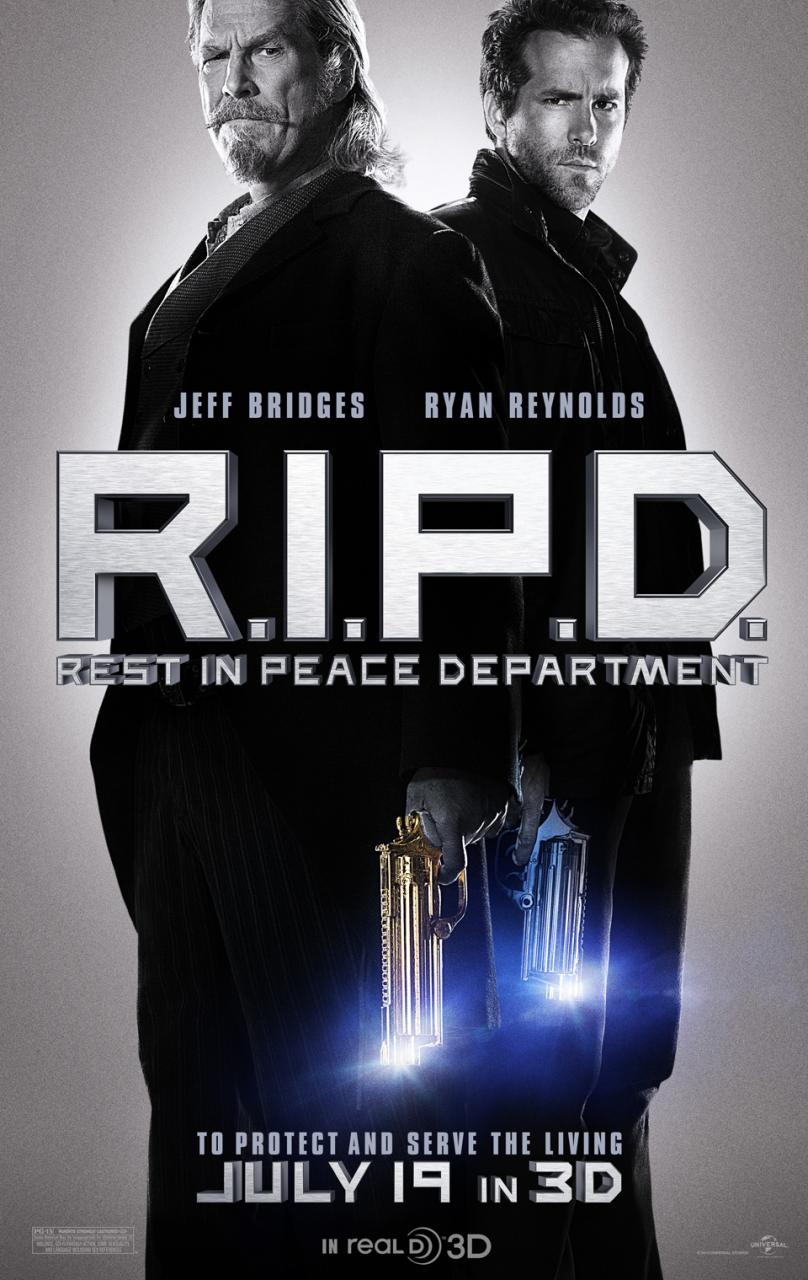
“RIPD”: “Men in Black” meets “Ghostbusters” meets lots of other things

RIPD (Rest in Peace Department) is where good cops go when they die. Their job? To track down escaped demons from Hell and return them or terminate them altogether. Ryan Reynolds plays Nick with one-note aplomb. His partner, Hayes (played by Kevin Bacon with similar gutsto), kills him over parts of a golden talisman they recover from bad guys. In the afterlife, Nick is drafted into the RIPD without ceremony and partnered with old west lawman Roy (Jeff Bridges) for training. On the first day out they happen upon the same case Nick was working when he was killed. They follow the trail to recover the rest of the talisman, failing to catch the demon when he is revealed. When the demon goes on a rampage in the city and Nick and Hayes are threatened with termination (which means meeting their final death), they take matters into their own hands.

I firmly believe there is nothing new under the sun; everybody works to put new spins on the same old archetypes. ABC’s Once Upon A Time, which puts a new spin on old fairy tales–especially on old Disney fairy tale properties–is case in point. The fun comes not in watching something new, but in watching a new spin on what must be an ages old concept. Many writers, I’m sure, set out to write something one of a kind and alternately cringe and scream when they see their original ideas manifested elsewhere (this was a regular occurrence while watching Fringe and working on Phase Shift). Other writers take someone else’s idea as a start and go from there (as is the case with every vampire property I’ve ever seen or read and The Revenant or The Time Traveler’s Wife and my untitled Alice piece).  RIPD has the typical old-timer-trains-newbie framework present in Men in Black or Lethal Weapon series. Unlike those movies, the old-timer is the strange-duck, while the newbie plays straight man.   Like Men in Black, the beings the cops hunt can hide in plain sight, appearing somewhat quirky, but for the most part normal. As is the case with Ghostbusters and television’s Reaper, RIPD detectives have a device to quickly dispatch the spirit back to the underworld before they wreak havoc on the living. Similar to Buffy the Vampire Slayer, there is a Hellmouth that is in danger of opening if the detectives don’t thwart the bad guys in time. Similar to Ghost, Nick’s love for his wife transcends death. Also similar to Ghost, his best friend/partner is the bad guy and his wife is ultimately put into jeopardy. Nick and his wife also have a brief reunion scene near the end, as do Sam and Molly at the end of Ghost.

RIPD is lots of fun. In addition to it being a police procedural, it is a love story, and involves superheroes of a sort. There is a lot of comic book violence as well as interesting villains. Jeff Bridges steals the scene in the role of talkative, cynical Roy, and much of the comedy comes from his deadpan responses and odd behaviour (such as driving the car facing sideways with his right leg up on the seat, or the way he is more concerned that he loses his hat than that he loses the demon). Though it borders on the cliché, RIPD is a light-hearted romp worth a look-see.

Did you see RIPD? Leave me a comment to let me know what you thought about it.

(Former) Archaeologist’s Lament Addendum

Excerpt from THE NEXT COMING RACE (as yet unpublished).

Pot hunters held rave-type, secretive, pic-nic-style parties, complete with bar-b-ques and beer, on little known or overlooked archaeological sites. They socialized, ate a good meal, and then broke out the shovels, leaving behind a landscape so littered and cratered you’d think you’d landed on a mock-up of the moon.
I suppose what happened next was my fault. Goaded by the wealth of my online data mining and the voracity with which we’d hatched the previous night’s plan, I emailed the others with my findings, urging them to follow through with our stratagem.
It got exciting two months later. One of the pot hunters suggested they get together and investigate an abandoned and soon to be demolished property south of Stouffville. They used SurveyMonkey to determine the best date and settled on having a tailgate-style dinner prior to the dig. Undaunted by the sheer gall of what the pot hunters had suggested, I emailed every one of the original archaeologists. None of us had the slightest clue as to how to proceed. We knew that prosecuting the buggers would be a difficult task—to date, there had been only one case of successful prosecution documented. The solution, we all agreed, was to be on hand to disperse the rave and then hightail it to the Ministry of Culture to register the site.
So we’d have some official capacity, we’d enlisted Michael’s assistance whose job it would be to flash his badge and look menacing, no grand feat for Michael who had the physique of a well-padded football player and the sombre, stoic gaze of a Terminator on a mission permanently tattooed onto his face.
On the date in question, we caught the looters with their metaphoric pants down, munching on ribs and chicken, guzzling beer and Coke by the cans-full. We drove up the dirt access road at dusk, circled them with our vehicles and parked with our brights on. Mesmerized to paralysis at first, the looters presently scrambled, Hibachis and shovels clanging as they were thrown into the beds of their pickups. One by one they snaked between our cars and drove away.
Our group had participated in no less than three such raids since.
To have that power, to be able to do something to protect our passion from marauders, was exhilarating, if not entirely legal. To that end, we swore each other to secrecy, vowing only ever to meet clandestinely, and only when dictated by the slightly lesser legal activities of our pot-hunting nemeses.
The ghost town of Ballycroy in the northern GTA was our first failure. I’d been monitoring online chatter for weeks, trying to pinpoint the message containing the exact date and time of the party. Once I’d found it, I’d marked it on my smart phone’s calendar. Busy at school, I hadn’t gone back to check for revisions. At some point between entering it into my calendar and the scheduled date, the pothunters had changed their meeting and I’d missed it.
After a few minutes of uncomfortable silence between us I said, “I fucked up big.”
“Come on, Moll,” Palmer said, “you had no way to know.”
“Hindsight is 20/20,” Michael said.
“Really, Michael?” I said. “Platitudes? Now?”
“Say, is there any cream?” Michael asked. He left the table and took his coffee with him.
“You need to calm down, Moll,” Palmer told me. “Stop beating yourself up.” I looked deep into his dark eyes and saw the calm I sought. How was he able to slough off what had happened so easily? Probably because he wasn’t on point for plan-making. “Crestwood means well, you know he does.” Palmer reached out and pried my hand from the near death-grip it had around the coffee cup, and squeezed.
When Michael returned to the table I apologized.
We agreed I would be the one to go to the Ministry office first thing the next day and register the site. Not that it would stop future looters from spoiling the archaeological record, but if we were ever going to see these guys prosecuted, it was the first step.
About the Author
Elise Abram, English teacher and former archaeologist, has been writing for as long as she can remember, but it wasn’t until she was asked to teach Writer’s Craft in 2001 that she began to write seriously. Her first novel, THE GUARDIAN was partially published as a Twitter novel a few summers back (and may be accessed at @RKLOGYprof). Nearly ten years after its inception Abram decided it was time to stop shopping around with traditional publication houses and publish PHASE SHIFT on her own


Behind Every Story is a Kernel of Truth

The desire to own a part of history is probably as old as man himself. Reality television is replete with shows—Canadian/American Pickers, Pawn Stars, American Restoration and the like—that attest to this. The Victorians were obsessed with all things Egyptian. It wasn’t uncommon for the wealthy to purchase and display mummies in their own homes or host mummy unwrapping parties (History), the craze for which continues and was documented in the short-lived television series Treasure Trader. Anything ancient, it seems, is worth collecting, even fossilized dinosaur feces, which was recently sold at auction on Auction Kings (discovery).

The problem with procuring artifacts such as these (though technically, the dinosaur poop cannot be called an artifact as it was not manufactured or modified by people—unless you call the turning of the fossil into a commodity a modification) is that it is regulated. There are laws in place regarding who may legally excavate these materials. And make no mistake about it, picking an artifact up from the ground knowing it is from a potential archaeological (or paleontological) site is considered excavation, even if it the item lay on the surface when you found it.

I can remember in the early days of the Internet finding a bottle collector’s website. Though he posted some amazing diagnostic tools, his site read, primarily, like a how-to for bottle hunters. As a practicing archaeologist, I engaged the man in a digital debate that I had no expectation of winning. Though I tried to educate him on the evil of his way, the man relied on his pot hunting to make a living. One has to look no further than SpikeTV’s American Digger to see how to do this for a living.

I was an archaeologist for about a decade of my life, and though I can say that in those ten years I never worked on a site that had been vandalized, I was sickened at the stories I heard from my colleagues. Most of my work was on public archaeological sites. This meant the sites were open to the public with the intent to educate them on the importance of the archaeological record. Unfortunately, most people didn’t get the lesson we were trying to teach. In PHASE SHIFT, the main character, archaeologist and university professor Molly McBride laments,

On archaeological sites someone always comes around and asks if you’ve found any gold yet.  It’s inevitable.  Tell me something, I’ve always been dying to say, when you move house how much gold do you leave behind?  Instead I smile, and try to educate them on the fact that archaeology is not about the money.  What’s more valuable is the information artifacts give us about what went on while the site was occupied all those years ago, regardless of their material of manufacture. 

An observation that’s altogether too true. When I worked on The Trinity Bellwoods/Gore Vale Site in downtown Toronto, almost once a day someone would come by and ask if I’d found anything valuable yet. My own grandfather used to tease me about this each and every time he saw me, something which exasperated me to no end. In case you’re wondering, I never did find any gold and any of the coins I found were too old and too damaged to have been worth much of anything.

The nugget for this blog was mined from an article published on the LiveScience website about a fossil dealer who was prosecuted for smuggling dinosaur remains. The article reminded me of the stories I’d heard regarding plundered Ontario archaeological sites and how powerless archaeologists felt to do anything about it but to hire round-the-clock security guards on an already stretched budget (something Molly does to protect the TTC site in the as yet unpublished THE NEXT COMING RACE). Prosecuting looters is a difficult task as it is tough to prove in court as it often happens under the cover of night and without witness. In 1985 the July/August issue of ArchNotes carried an article by William A. Fox documenting the first case of the successful prosecution of looters to a site, but that case involved witnesses and police involvement. Had the looting been carried out by a stranger rather than a neighbour of the property owner, the case might have ended differently.

When I read the LiveScience article, I thought of the first chapter of THE NEXT COMING RACE, the book to follow the recently published PHASE SHIFT.   In it, protagonist Dr. Molly McBride enlists local archaeologists to participate in cyber-stalking to determine when local bands of pot-hunters will loot abandoned sites in order to conduct raids to scare them off in an attempt to protect the archaeological record. As this is the first chapter in the novel, it sets into motion the main plot and the threads of two sub-plots that (I promise) eventually come together and make sense in the long run. The main plot supposes an archaeological site is found during the excavation for expansion of Toronto’s subway system. The sub-plots are the raids on the looters and Palmer’s involvement in a case of forensics with the police department. Please click on the link to read, and enjoy.

If you like Molly and Palmer, you can download PHASE SHIFT, my first published novel featuring these characters from my web site, eliseabram.com, for the price of a Facebook post or tweet. Molly and Palmer are also featured in two novellas available at KoboBooks.com or Amazon.com entitled THE MUMMY WORE COMBAT BOOTS (largely about Palmer and DC Michael Crestwood), and THROWAWAY CHILD(featuring Molly, Palmer and Michael). Happy reading.

Note for Once Upon A Time fans: I cast my characters when I write in order to help me imagine the scene as well as to keep my character descriptions consistent throughout a work. As you read this chapter from THE NEXT COMING RACE, try to imagine OUAT‘s Robert Carlyle in the role of Dr. Palmer Richardson and (not an OUAT alumni, but he played Lois Lane’s father on Smallville and has been a favourite Canadian actor of mine since the first V series) Michael Ironside in the role of DC Michael Crestwood.

Works Cited

Discovery. Auction Kings: Dino Poo. 2012. <http://dsc.discovery.com/tv-shows/auction-kings/videos/dino-poo.htm&gt;. 30 December 2012. (Video)

Fox, William A. The Freelton/Misner Site Looting and Prosecution. ArchNotes. July/August 1985. <http://www.ontarioarchaeology.on.ca/publications/AN/an85-4.pdf&gt;. 30 December 2012. (Newsletter)

History. Mummy Unwrapping Parties. 1996-2012. <http://www.history.com/videos/mummies-mummy-unwrapping-parties#mummies-mummy-unwrapping-parties&gt;. 30 December 2012. (Video)

Parry, Wynne. Dealer Pleads Guilty to Smuggling in Largest International Dino Case Ever. LiveScience. 29 December 2012. <http://www.livescience.com/25879-dealer-pleads-guilty-tarbosaur-smuggling.html&gt;. 30 December 2012. (eZine)

Flat and Round Characters

Colin O’Donoghue who plays Killian Jones aka Captain Hook in ABC’s Once Upon A Time is handsome, I’ll give him that. The blogosphere was abuzz with how Hook will give Rumple a run for his money, how he will be the biggest and baddest villain on the show. The problem with these theories is that Hook is flat whilst Rumple is rounded. Hook will be no match for Rumple due to Rumple’s multifoliate interior.

                Characters are of two types, flat and rounded. Flat characters are doomed to live their lives out in Flatland, the one-dimensional world created by Edwin A. Abbott and popularized by Sheldon Cooper in an early episode of The Big Bang Theory. That is to say, when looked at head on, they have shape and dimension, an appearance, names, a purpose, but when they turn sideways, they devolve into nothing more than flat lines, indistinguishable from one character to the next. Flat characters function as “phaser bait”, they serve a purpose, nothing more. They are the innocents Palmer and Michael (my characters) interview in their investigation that give up their information and then vanish, never to be seen or heard from again. They are Molly’s students who find an important artifact and then get about with their studying. They are the pirates who cheer on Hook in his bid to belittle Rumple and then fade into the background. They are the Milhas, the women who spur a duel between two characters, never to be heard from again. Last night’s Hook seems to have no motivation other than to kidnap women for the pleasure of he and his crew and then, later, to avenge Milha’s death. Or maybe it’s to get back at “The Crocodile” (a brilliant turn of events, nicknaming Rumple this) for taking his hand. OUAT’s Hook is narcissistic, and single-minded. Girls and wealth are his only motivator.

                Ever the round character, Rumple continues to amaze. All this time, the viewer was led to believe his sole motivation was to bring magic to Storybrooke so he could wield power over Regina, The Evil Queen. Now we learn his sole purpose is to overcome his cowardly past, to be reunited with those he loves and prove to them he is worthy. In a stroke of genius, the writers send Rumple to Belle to humble himself and apologize for his transgressions where she is concerned. He is a man who knows he is imperfect, someone who is capable of vengeful murder (Milha’s) and sweet gestures (giving Belle the key to the library), but at his core, he is a man whose sole desire is to be loved, and to love, but he doesn’t know how. Rumple looks upon people as possessions. He became The Dark One to keep Bae with him. He killed Milha (his wife) because he could not possess her. He imprisoned Belle in his dungeon because he feared she, like all those before her, would leave. Rumple’s motivation to bring back magic so he can leave Storybrooke and find his son is heart-achingly poignant and gives the character depth.

                Granted, Hook is a new character and we’ve only seen him in a single episode designed to facilitate getting Cora, Emma and Snow back to Storybrooke, and he will be fleshed out in the weeks to come. But so far, the simple fact that Hook was introduced to facilitate getting Cora, Emma and Snow back to Storybrooke supports my theory that he is a flat character. He has a purpose; he has no self-motivation to speak of thus far. Contrastingly, when we are first introduced to Rumple, he is already The Dark One, his origins a mystery cloaked in an impish exterior. He is jailed, he grants wishes, he is hated and revered by virtually everyone in Storybrooke. We know there is an age-old rivalry between he and Regina and we ache to find out what that is. Juxtapose that with Storybrooke’s Gold who may or may not remember his life before the curse, and Rumplegold is multi-dimensional from the start.

                Last night’s OUAT opened a multitude of possibilities for the season(s) to come. I like that, unlike while watching so much formulaic prime time tripe, I never know what to expect. And even when I intuit the formula, I am still satisfied with what I see. Kudos to OUATs writers and actors, but especially to Mr. Robert Carlyle who brings justice to the character of Rumplestiltskin, a tragic hero if ever one there was. 

Download PHASE SHIFT for the price of a tweet. Visit http://www.eliseabram.com, click on the button, tweet or Facebook about my novel and download it for FREE!

Graphic credit to http://hollywoodlife.com/2012/10/21/once-upon-a-time-captain-hook-rumpelstiltskin-kills-milah/

PHASE SHIFT – Prelude

Here is the Prelude, the first chapter of my  novel PHASE SHIFT.

Enjoy.

I am laying in the dark listening to my husband’s raspy almost-snore, unable to sleep.  To keep myself occupied, I try to remember when I first knew I wanted to be an archaeologist. 

After seeing the first Indiana Jones movie as a teenager, perhaps? No, Indy merely served to bolster my interest in the field.  The real turning point came while watching a documentary called “In Search of Noah’s Ark” when I was no more than twelve, back in the time before the super cinemas.  It was then, I knew.  Wood decomposed to nothing but dark shadows in the soil, aerial photographs of well-fed vegetation, and measurements approximating those in The Bible—I still shudder in awe at the thought of it. 

My first real taste of archaeology was in the middle of a conservation area  almost an hour’s drive north of the city: dark soil dampening trouser knees and buttocks, dirt rammed under fingernails, blowing out a peppering of dust mixed with snot on the Kleenex—man!  I was hooked. 

A few years later I was near graduation and looking toward grad school.  Dr. Richardson, the head of the Archaeology department, offered to be my faculty advisor and I accepted without hesitation. He assigned me a site, the remains of a carriage house behind a restored clapboard house, built nearly two centuries ago.  The planning, supervision, excavation and analysis of the site over two years’ time would earn me my Master’s degree. 

My assistants and I arrived at the house, to find Dr. Richardson sitting on the stoop reading Scientific American, anissue featuring an article about a cache of Peruvian mummies. Dr. Richardson is a forensic anthropologist. That means he gets off on dead people and figuring out how they died.  He works extensively with the police, to give them clues as to what decomposed bodies and skeletons might have looked like while they were still living and breathing. 

We approached the stoop and he stood to greet us.  I had to crane my neck and shield my eyes from the sun in order to meet his gaze.  He smiled at me, said hello and squeezed my shoulder.  My stomach lurched.  Dr. Richardson is what we used to call “a hunk”.  The first time my mother met him she called him “a dreamboat” and said she wouldn’t throw him out of her bed for eating crackers.  The way things turned out, that comment was so many different levels of wrong. 

The house was converted to a living museum sometime in the late eighties.  The side entrance, added on around the same time, smelled of new carpet and fresh paint.  Pictures of the house in various stages of disrepair and renovation hung on the walls like windows into the past.  Dr. Richardson gave us the grand tour:  men’s parlor, women’s sitting room, dining room, upstairs ballroom, and nurseries.  A narrow staircase took us up to the third floor servants’ quarters. 

Back downstairs, Dr. Richardson showed us the kitchen.  The walls were of unfinished wood made dark by soot.  At the centre of one wall was the original hearth, complete with bake ovens.  A single wooden table stood in the middle of the room, deeply scarred through use and over time, and in the far corner, the kitchen pantry, converted to a small storage-cum-utility closet after the restorations.  Near the ceiling Dr. Richardson pointed to a series of wallpaper layers.  He recited each occupation and era by rote and I was in awe of him. 

He finished his lecture and ushered us out of our cramped quarters.  I chanced a glance up at him and he smiled at me.  A perfect three-toed crow’s foot appeared to frame the outer edge of each of his eyes.  The solitary, unshaded light bulb that dimly lit the room shone in his dark eyes—a girl could get lost in those eyes.  I blushed, embarrassed at the lust I felt for him at that moment, chastising myself for falling for my faculty advisor.  But then I reminded myself that Dr. Richardson was a good sixteen years’ my senior, and everyone knew he was seeing Suzanne Pascoe, the Egyptologist.  Dr. Richardson was safe, like a movie star.  Like a movie star, he was unattainable, and consequently, not entirely real. I told myself the crush would pass, and it eventually did.


Palmer’s snoring again. I nudge him, tell him to roll over, then roll over myself, wedging one hand between his rib cage and the mattress and one foot arch-deep between his thighs. He doesn’t protest. 

Sleep has eluded me this evening.  Pretty soon my bedside alarm will begin to shriek at me, signifying the start of yet another day.  I need a drink.  Tea would go down good right about now.  Hot tea with honey and lemon. 

In the kitchen I fill the kettle and plug it in. While I wait for the water to boil, I stroll into the living room and take a peek out the front window.  Two black sedans are parked on the road, each facing opposite directions, waiting for me in case I decide to take it on the lam.  Inside each car sits a pair of officers—which officers are out there tonight is anybody’s guess. The possibilities read like a who’s who for law enforcement:  CIA, CSIS, OPP… It’s funny how quickly things spiral out of your control:  yesterday I was an archaeology professor considering earning my doctoral degree. Today I am the prime suspect in a murder investigation.

The kettle begins to boil.  I unplug it.  Sometime between eying the sedans and thinking about the death I may have expedited, I’ve lost my appetite for tea.

I return to bed, drawing my body close to Palmer’s, more for security than warmth.  I find solace in the fact I was right about one thing when I was struggling with that crush on my faculty advisor all those years ago:  Palmer Richardson is safe.