Tag Archives: once upon a time

Move Over Fonzie…OUAT may be along for the ride!

This blog entry was written last week, after Once Upon a Time‘s “Breaking Glass” episode. I was unable to post then, but I’m choosing to do so now because last night’s episode, “The Snow Queen,” echoed the sentiments expressed in it.

Though “The Snow Queen” drew even further connections between the characters we’ve grown to love (Rumple, Belle and Emma), it still focuses more on the Frozen theme than not, which poses a problem for me. And while I dig the role reversal between Rumple and Belle–with Belle as the headstrong and Rumple as vulnerable–Belle was too quick to rush to control Rumple and Rumple too forgiving with no indication of a desire to remedy the situation in the future. Of course, there’s always the possibility that it really wasn’t his dagger and he was just playing along. The thought of this intrigues me more than does any amount of Frozen business.

Move Over Fonzie…OUAT may be along for the ride!


I love (Love, LOVE) Once Upon A Time, but I’m afraid it’s jumped the shark.

I’m not digging the whole Frozen vibe.

[Last] week’s episode took a long time to give up few teasers: Emma’s previous relationship with Lily; Emma reaching out to Regina; the Snow Queen assembling her mirror. Elsa’s search for Anna, the “filler” in this episode, seemed belaboured and contrived.

That’s right. Even a storyline populated with fairy tale and Disney characters, [last] week seemed contrived.

I recently had the opportunity to re-watch OUAT’s first episode when I shared it with my students in a lesson on literary archetypes. I watched the whole episode, twice in a single day (the fourth and fifth time I’ve watched it in entirety) and loved every second of it. By contrast, I don’t think I could ever be persuaded to watch [last] week’s one again.

Maybe it’s because the Frozen episodes come after a rather strong season in Neverland followed by an interesting season in Oz. Maybe it’s because I never saw Frozen. Maybe it’s because this episode lacked the mesmerizing talent of Robert Carlyle.

Whatever the reason, I put my faith in the writers of the show to draw it out of its slump. I’m with you for the long haul, OUAT. Fonzie survived jumping the shark, my hope is that you, too, will emerge victorious for many seasons to come
.

Dracula is a page turner

Bram Stoker’s Dracula is the gothic horror story that put down roots for modern day vampire lore.

In Dracula, lawyer Jonathan Harker is sent to Transylvania to close a deal on the sale of a house for Count Dracula in England. Confined to a limited number of rooms in Dracula’s castle, Harker goes  exploring where he discovers siren-like creatures and Dracula’s dark nature. Harker eventually escapes, goes nearly mad, and convalesces in a hospital where fiance Mina Murray retrieves him and marries him. They return to England to find Mina’s friend, Lucy, mysteriously ill from blood loss. Harker and Dr. Seward enlist a retired Van Helsing for help. They replenish Lucy’s blood nightly to no avail. Eventually Lucy dies, her body claimed by Dracula. It’s not long before Mina falls prey to the same “illness,” with one strange symptom–she has a connection with Count Dracula. Harker, Seward and Van Helsing use this connection to ambush Dracula and kill him for good at last.

Fan of vampire stories that I am, I had always meant to read the original Dracula, but never got around to it. But after watching NBC’s Dracula, I needed to go back to the archetype to see which characters and events were borrowed from the original and which were new.

In NBC’s Dracula, the count assumes the name Alexander Greyson and pretends to be an American newly arrived in England on business. In a grand spectacle opening, Greyson holds a party at his mansion where he introduces his guests to free, wireless power which sends the oil magnates into a tizzy. At this gala is socialite Lucy Westenra who has invited her friend and medical student Mina Murray and Mina’s boyfriend, reporter Jonathan Harker. When Dracula sees Mina he sees his wife’s doppelganger and is determined to have her, but not by force. To that end, he hires Harker as his assistant, puts him up in a mansion and pays him enough to marry Mina and live happily ever after. The idea is to keep Mina close and gradually insinuate himself into her life. Pursued by the Order of the Dragon, an ancient organization whose members are involved in (among other things I can’t figure out) maintaining a power monopoly and killing vampires, Greyson’s goal is to punish members of the Order for their role in making him what he is today.

Other than character names and the time in which the story takes place, there is little comparison between the original book and the television show. In the book, Dracula has no alter ego and there is no mention of Mina the doppelganger. TV’s Renfield is Dracula’s manservant, a far cry from Stoker’s raving, bug-eating lunatic and Stoker’s Van Helsing is out to kill Dracula, not form an unholy alliance with him in order to seek revenge on the Order of the Dragon. Reading the book  also shed some light on other supernatural works, including  an explanation as to why the brothers on Supernatural bear the last name Winchester and the origin of the title “Vampire Diaries”, adopted because most of Stoker’s novel is told in journal or diary format.

The novel is a page turner at times, boring at others, but worth the time to read.

The series picks up pace midway through episode two and becomes the television version of a page turner. I binge watched the first three episodes and regret not watching the fourth as well (but Once Upon a Time was about to begin and priorities must be set).

Are you watching NBC’s Dracula? What do you think?

“Sleepy Hollow” builds rich mythology

Fox’s Sleepy Hollow premièred last week to rave reviews. Like its predecessors Grimm and Once Upon a Time, Sleepy Hollow offers an interesting spin on an archetypal story.

The town of Sleepy Hollow was a small valley in the settlement of Tarrytown, New York in 1820 when Washington Irving published his short story about a Revolutionary War soldier in search of his head, lost when it was taken by a cannonball. In Irving’s The Legend of Sleepy Hollow, which takes place in 1790, Ichabod Crane is a gangly schoolteacher in competition for the love of Katrina Van Tassel, the daughter of a wealthy farmer. His competition is the burly Abraham “Brom” Van Brunt, who sets Ichabod up as an object of ridicule. Katrina sees through Brom’s antics and appears content to give her heart to Ichabod when he meets the horseman and disappears. Katrina marries Brom instead. Other than his horse and a shattered pumpkin, there is no sign of Ichabod to be found. Ichabod considers the horseman might be Brom in disguise during the attack, but the description of the horseman, headless and awash in fire and brimstone, is too horrific to have been pulled off by Ichabod’s rival, given the technology at the time. When the horseman throws his head at him, Ichabod falls from his horse and is never seen again.

Irving’s Sleepy Hollow is a typical horror story. Its setting is a place reputed to have been bewitched by “an old Indian chief, the prophet or wizard of his tribe”. People believe it to be overrun by “haunted spots and twilight superstitions” where they “see strange sights and hear music and voices in the air.”  In this way, Sleepy Hollow is no different than Vampire Diaries‘s Mystic Falls or Buffy the Vampire Slayer‘s Sunnydale. Similar to these towns, witches, ghosts and evil supernatural entities abound. Irving’s Ichabod is the stereotypical geek, described as tall, lank, “narrow shoulders, long arms and legs,” small head, “huge ears, large green glassy eyes and a long snipe nose.” He is later described as scarecrow-like, hardly the physique one would expect from a leading man. The fact that he would have the girl in the end were it not for his disappearance, shows the advantage of brains over brawn, which may very well be the moral of the story. Also, don’t go out at night, particularly alone and on a path reputed to be haunted by a headless Hessian hefting a pumpkin head.

In the Fox series, Sleepy Hollow is a thriving town with a Starbucks on every corner. Abbie Mills (Nicole Beharie), a black, female police lieutenant finds a decidedly anti-gangly Ichabod Crane (Tom Mison) wandering around town and arrests him for a series of murders. People report sightings of a headless horseman and since Ichabod seems to know quite a bit on the topic, Mills enlists his help to try to stop the body count from rising even further. The backstory, we learn, is that during the Revolutionary War, a Hessian soldier mortally wounded Crane, and Crane beheaded him with his sword. They died together, their blood mixing in the field, forever linking their souls. When someone in 2013 resurrects the horseman–believed to be Death, one of the horsemen of the apocalypse–Ichabod is similarly resurrected. Mills convinces her colleagues to let Ichabod go free to help her stave off the supernatural and catch the horseman before the coming of the Apocalypse.

I love the Supernatural-slash-Fringe-slash-X-Files vibe of Sleepy Hollow. I was a little upset when Officer Andy Dunn (John Cho) and Sherriff Corbin (Clancy Brown) were killed off in the first episode, but delighted to see their return in the second. Cho plays a (literal) devil’s advocate with creepy excellence while Brown’s character’s ghost becomes Mills’s Yoda, giving her cryptic clues when she asks for help. Mison is more than competent as the handsome yet fearless hero-type, solving problems with ages old wisdom over technology. Subtle humour is hidden in Crane’s curiosity about the modern world, feeding much of the banter between he and Mills.  Unlike many of the new science fictiony shows of last season (Zero Hour, Do No Harm, Cult and 666 Park Avenue, to name a few), I think Sleepy Hollow can look forward to finishing out this season while building a rich mythology with the potential to move forward for many seasons to come.

Once Upon A Time is Coming!

In preparation for the new season of ABC’s Once Upon A Time, I took some time to go over some of the classics associated with the show. I re-read Alice’s Adventures in Wonderland and Through the Looking Glass, partially to “borrow” allusions and create symbols for my Alice Untitled story, but also in anticipation of the premiere of Once Upon A Time in Wonderland. I also went back to read up on Rumplestiltskin’s origins.

In the Grimms’  version, a miller boasts that his daughter can spin straw into gold. The greedy king of the realm locks the daughter up demanding she spin a roomful of straw into gold. The daughter cries and Rumplestiltskin, a plain-looking dwarf of a man, helps her in exchange for a necklace. The same thing happens the next day and, thanks to Rumplestiltskin, the daughter delivers. On the third day, the king promises that if she spins the gold he will make her his queen. Having nothing else to trade, the daughter promises Rumplestiltskin her first born. After the child is born and she decides she doesn’t want to give the child up, Rumplestilstkin tells her that if she guesses his name, she will be allowed to keep it. They hire someone to tail the dwarf and hear him singing his name as he gloats. The next day, the queen “guesses” his name and is allowed to keep the child.

OUAT’s version incorporates much of Rumple’s archetypal story in “The Miller’s Daughter”, and in snippets woven into other characters’ origin stories. OUAT’s Rumple starts out as the fearless trickster imp, granting favours in exchange for what each of the characters holds dear. The character is broadened by the writers to personify Belle’s Beast and Hook’s Croc. The Trickster, the Cowardly Lover and the Adversary are portrayed with most excellent skill by Robert Carlyle. The same goes for Gold, Rumple’s real-world counterpart.

In my search for an online version of Rumple’s origin story, I found “Rumpelstiltskin in Love“, a flash-fiction short story by KC Norton that tells the story of the dwarf as he raises a child. We learn Rumpel is not the child’s father. He has also raised other children, now grown and moved away. The child asks about his mother and Rumpel answers vaguely, hoping to spare the child the heartache of knowing his mother gave him up to save herself. This shows that in addition to being a trickster who is vain and greedy he is caring and lonely, someone who longs for human love, someone who cannot find a woman to love him because he is ugly, so he settles for the unconditional love of a succession of children, each of which winds up breaking his heart when they grow to maturity.

OUAT‘s Rumple embodies the characteristics of both tellings. As previously stated, he is a trickster, someone who makes deals with desperate people without compassion. But he also has a human side, one that is achingly lonely, and believes himself unlovable, in spite of–or maybe because of–his power. This Rumple has compassion, though begrudgingly so. He is a romantic who believes in his own happy ending in spite of himself.

I don’t know about you, but I can’t wait for OUAT season 3 to unfold as the crew travels to Neverland to rescue Henry and discover new facets to the characters, especially Rumplestiltskin. In the mean time, go to the Flash Fiction website and read “Rumpelstiltskin in Love” to tide you over. Let me know what you think about this poignant addition to the mythology.

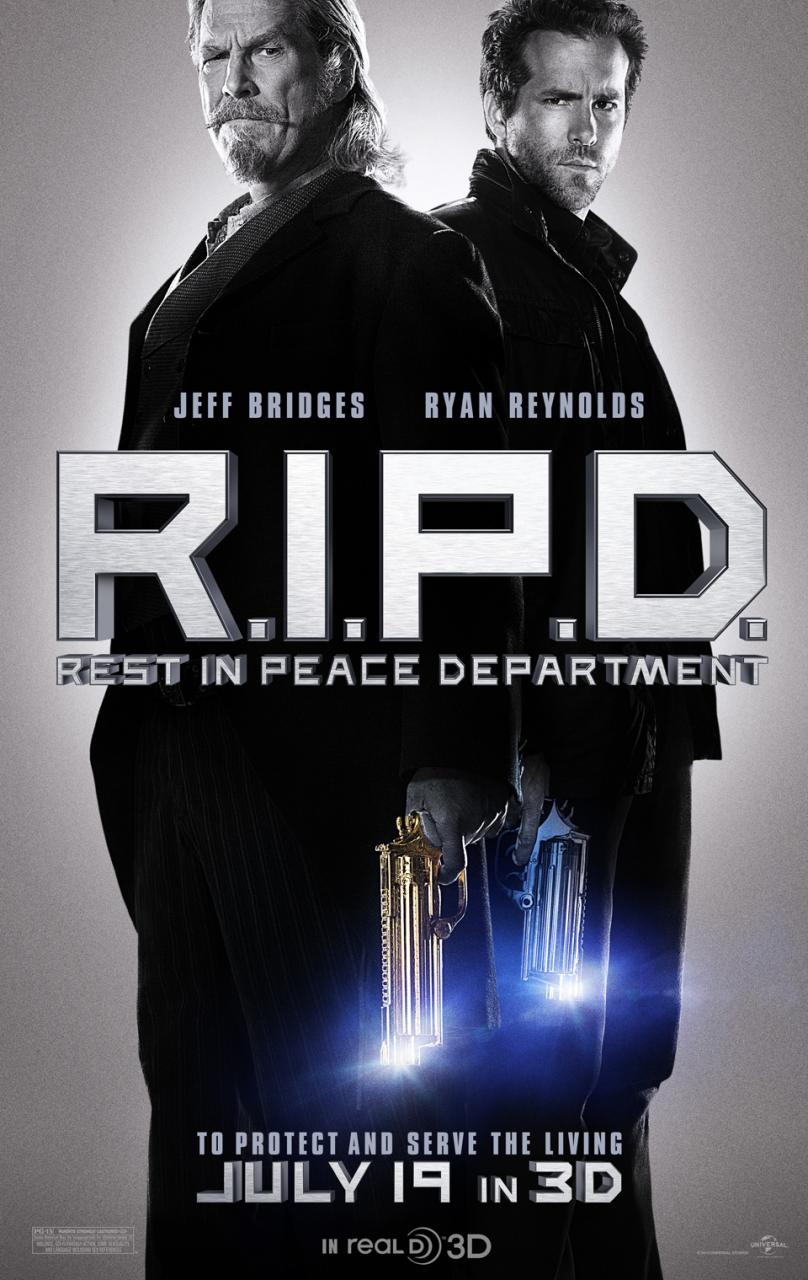
“RIPD”: “Men in Black” meets “Ghostbusters” meets lots of other things

RIPD (Rest in Peace Department) is where good cops go when they die. Their job? To track down escaped demons from Hell and return them or terminate them altogether. Ryan Reynolds plays Nick with one-note aplomb. His partner, Hayes (played by Kevin Bacon with similar gutsto), kills him over parts of a golden talisman they recover from bad guys. In the afterlife, Nick is drafted into the RIPD without ceremony and partnered with old west lawman Roy (Jeff Bridges) for training. On the first day out they happen upon the same case Nick was working when he was killed. They follow the trail to recover the rest of the talisman, failing to catch the demon when he is revealed. When the demon goes on a rampage in the city and Nick and Hayes are threatened with termination (which means meeting their final death), they take matters into their own hands.

I firmly believe there is nothing new under the sun; everybody works to put new spins on the same old archetypes. ABC’s Once Upon A Time, which puts a new spin on old fairy tales–especially on old Disney fairy tale properties–is case in point. The fun comes not in watching something new, but in watching a new spin on what must be an ages old concept. Many writers, I’m sure, set out to write something one of a kind and alternately cringe and scream when they see their original ideas manifested elsewhere (this was a regular occurrence while watching Fringe and working on Phase Shift). Other writers take someone else’s idea as a start and go from there (as is the case with every vampire property I’ve ever seen or read and The Revenant or The Time Traveler’s Wife and my untitled Alice piece).  RIPD has the typical old-timer-trains-newbie framework present in Men in Black or Lethal Weapon series. Unlike those movies, the old-timer is the strange-duck, while the newbie plays straight man.   Like Men in Black, the beings the cops hunt can hide in plain sight, appearing somewhat quirky, but for the most part normal. As is the case with Ghostbusters and television’s Reaper, RIPD detectives have a device to quickly dispatch the spirit back to the underworld before they wreak havoc on the living. Similar to Buffy the Vampire Slayer, there is a Hellmouth that is in danger of opening if the detectives don’t thwart the bad guys in time. Similar to Ghost, Nick’s love for his wife transcends death. Also similar to Ghost, his best friend/partner is the bad guy and his wife is ultimately put into jeopardy. Nick and his wife also have a brief reunion scene near the end, as do Sam and Molly at the end of Ghost.

RIPD is lots of fun. In addition to it being a police procedural, it is a love story, and involves superheroes of a sort. There is a lot of comic book violence as well as interesting villains. Jeff Bridges steals the scene in the role of talkative, cynical Roy, and much of the comedy comes from his deadpan responses and odd behaviour (such as driving the car facing sideways with his right leg up on the seat, or the way he is more concerned that he loses his hat than that he loses the demon). Though it borders on the cliché, RIPD is a light-hearted romp worth a look-see.

Did you see RIPD? Leave me a comment to let me know what you thought about it.

Rumplestiltskin is a Construct

All literature is a construct. This means it does not depict real life. Everything in literature has a secondary meaning that you, as the reader, are expected to interpret to unlock the author’s hidden message about society, human behaviour, and the human condition. Everything in literature has a significance, a reason for being there.

Take Once Upon A Time’s Rumplestiltskin, for example:

I, Rumplestiltskin am a construct. I am a symbol of how power can corrupt even the most humble of people. As for physical symbols, I have many. I own a pawn shop that holds objects symbolic of the weaknesses of the people in the town. A shawl represents a happier time for me when I had a family and was no more than a coward. I imbued this with magic to help me find my son. I own a dagger with my name on it that is the source and symbol of my power. I embody the theme of good vs. evil. My story is the internal conflict I suffer as I battle my desire to be good and surrounded by people who love me against the thrill using my magic brings. I live in Fairytale Land, a place where the true good is embodied in princesses, princes, fairies, dwarves and true evil is embodied in trolls, evil queens, witches, and giants and magic is real. I take my name from the Rumplestiltskin of fairy tale fame, and my origins are based in that story, but I am so much more than that. I am the trickster. I am the Godfather. I am the everyman, the poor peasant who found himself the most powerful creature in the land and allowed himself to be seduced by it. I have lost my family, and no one really likes me. I am the heartless landlord, the wealthy miser, the lonely curmudgeon, but I also have a human side, one that is lonely, has desires, and wants to belong. I speak in riddles, use certain phrases in my fairytale life that bleed into my every day one. I maintain an accent that hearkens back to my humble roots. I reveal little personal information when I speak as knowledge is power, and in spite of my character flaws, power is what I crave, in spite of myself. Everything about me is a construct, designed to serve a purpose. My legend is vast because my character is diverse (and my actor is so talented) that the authors use me to my potential, writing and re-writing my history whenever they see a reason to further plot, character or theme.

Graphic from http://io9.com/5887438/supercut-every-single-maniacal-laugh-from-once-upon-a-times-rumpelstiltskin

About the Author

Elise Abram, English teacher and former archaeologist, has been writing for as long as she can remember, but it wasn’t until she was asked to teach Writer’s Craft in 2001 that she began to write seriously. Her first novel, THE GUARDIAN was partially published as a Twitter novel a few summers back (and may be accessed at @RKLOGYprof). Nearly ten years after its inception Abram decided it was time to stop shopping around with traditional publication houses and publish PHASE SHIFT on her own.

Download PHASE SHIFT for the price of a tweet. Visit http://www.eliseabram.com, click on the button, tweet or Facebook about my novel and download it for FREE!

Inconsitencies I have known.

Consistency.

It’s something writers strive for in their work, especially with respect to setting and character descriptions. For many, an error in consistency can break the narrative flow, reminding the reader s/he is immersed in a construct of reality and not the real thing.

On film, errors in consistency are typically referred to as bloopers. And though they can be fun to spot, if you’re like me, and the gaffes are serious enough, they can also be maddening. Minor consistency problems are artifacts of the way television and movies are filmed, a result of the final product being an amalgam of various takes and camera angles.  This is the shirt that mysteriously buttons and unbuttons or the strand of hair that magically tucks and untucks itself from behind an actress’ ear as the scene plays out. In a recent episode of Cult, it was the level of water in Skye’s bottle that randomly rises and falls.

Errors like these are more amusing than annoying.  The inconsistencies prompting me to write this blog are much more serious than that. The ones I’m talking about are due to errors in the writing and/or interpretation of the script, errors that should have been caught and edited out long before production began. Take, for example, the Once Upon A Time episode in which Mr. Gold/Rumplestiltskin is led to believe August is his son. This correlates with an hour of my yelling at the screen that August couldn’t possibility be Baelfire because August has blue eyes and Bae has brown. And while it turned out August wasn’t Bae, I don’t know how I noticed this and the boy’s own father didn’t.

Another issue arose watching this week’s Hannibal.  The police assert that their murderer was killing girls of the same age, height, weight and with the same hair and eye colour as his daughter. They show a series of victim photos, and I swear the last girl has brown eyes. Trouble is, when they show the daughter in the next scene, her eyes are decidedly blue.

Perhaps the biggest gaffe I’ve noticed was in this week’s Orphan Black. I remember being told via subtitle in the premiere episode that the story takes place in New York. Wikipedia observes the police used NYPD coffee mugs and drove NYPD cars in that episode. But this week they drove to a building I recognize as being on the U of T campus driving cars with Ontario plates. To make matters worse, Sarah/Beth drove through Chinatown to get to a Kensington Avenue address and walked into The Waverly Hotel (it said so on the door as she entered). While I love that shows (like Rookie Blue or Bomb Girls) use Toronto as a backdrop for stories told in Toronto, I need a show to pick a location and stick to it so that I forget I’m watching a construct and not actual people’s lives.

In other words, do the viewers a favour and make the effort to remain consistent.

graphic from:http://escapepod.org/2013/04/02/tv-review-orphan-black/

About the Author

Elise Abram, English teacher and former archaeologist, has been writing for as long as she can remember, but it wasn’t until she was asked to teach Writer’s Craft in 2001 that she began to write seriously. Her first novel, THE GUARDIAN was partially published as a Twitter novel a few summers back (and may be accessed at @RKLOGYprof). Nearly ten years after its inception Abram decided it was time to stop shopping around with traditional publication houses and publish PHASE SHIFT on her own.

Download PHASE SHIFT for the price of a tweet. Visit http://www.eliseabram.com, click on the button, tweet or Facebook about my novel and download it for FREE!

Strong Women on Television

I love The Good Wife’s Alicia Florrick. At the start of the series, Alicia is a woman scorned. Her husband has cheated on her with colleagues and prostitutes, taking advantage of his position as DA, landing him in jail. Her relationship with her husband has changed over the years, from outright hate, to tolerance to friendship, but she remains strong. A strong female character makes sacrifices, and Alicia has sacrificed a sexy-hot relationship with Will Gardner for a sexy-hot no-ties sexual relationship with her husband, Peter, but she does so on her own terms. On her own, with neither Peter nor Will’s influence, she successfully wrangles a position as partner in her law firm after only 5 years’ employment. Alicia proves that being strong does not preclude being vulnerable. She proves a woman can be middle-aged and sexy, a care-giver, bread-winner, and mistress of her own sexual domain.

The kernel idea for this blog came while watching last week’s episode of Smash, which purports to weave together the lives of five strong woman, but falls short. Karen Cartwright begins the series as a mousy singer who is nearly willing to sacrifice her career for her fiancee’s, until he cheats on her with a Ivy. She follows director Derek around like a puppy on a leash (no offense, Katharine McPhee—you remain my favourite actor on the show in spite of this) and she is contemplating yet another relationship with her song-writer protoge, Jeremy, a drug user bent on self-destruction. Ivy Lynn nearly commits suicide over her affair with her director, Derek Wills. Julia Houston, the writer of Marilyn, loses her husband because she has an affair with a man she can’t resist and winds up losing them both. She will almost certainly fall for the “dramaturge” with whom she has been working the past few weeks. Veronica Moore is a teen Broadway sweetheart wanting to shed her little girl image and have the world recognize her as the woman she’s become, but is afraid to talk back to her mother who clings to Veronica’s little girl persona. Eileen Rand is the producer of Marilyn who battles with her ex-husband, Jerry, falls in love with a mobster who appears to have been hired by her ex to sleep with her and fund her project with illegal gains so she will have no choice but to hand the project over to Jerry (which happened last week). I’ll admit, I’m no Anjelica Houston fan, but she played what was perhaps the strongest female character on the Smash block up until last week which saw her plead to her boyfriend not to turn himself in to save her, a scene that was uncomfortable to watch as it came off as behaviour unbecoming to someone in Houston’s stage of life, bordering on simpering, which destroyed the remaining strong female character on the show.

Oddly enough, aside from Juliana Margulies’ Alica, the best examples of strong women on the tube these days are the “princesses” on ABC’s Once Upon a Time. Readers of my blog will know I am a diehard fan, but hear me out before you snort in derision at my claim. Cora, the miller’s daughter from the original Rumplestiltskin tale and Regina’s mother, tore out her own heart so she could follow through with her plan to rule the kingdom without being side-tracked by her love for the golden imp. Though Henry was born in prison because Emma fell prey to a man, she has grown into an independent woman that barely flinches when she learns Neal, Henry’s father, is engaged to another woman. She is too busy trying to cast spells to protect her family which, at this point in time, includes the dying Rumplestiltskin. Even Snow White steps up. Determined to protect her family at all costs, she curses Cora’s heart and manipulates Regina into placing it back into Cora’s body, thus killing her. Though many tweeted about how they hate Snow, I admire her for having the courage to sacrifice something of herself to protect those around her. Previously, Snow relied on Charming or Emma to protect her. Her sacrifice to meet Charming in the burning room was less altruistic than it seemed. Sure, she got him an important message that ultimately saved she and Emma, but the real reason she did it was to feed her lovesick heart and to see Charming again. Don’t get me wrong; I think casting Ginny Goodwin in the part of Snow White was a stroke of brilliance, but last night’s episode, which saw Snow make a decision that changed her innocent, child-like princess status to that of full-grown woman, finally rendered her character much more interesting than probably ever. Regina, the only other “strong” woman portrayed last night missed the mark this time, as strength does not equate with hatred, which has been the character’s drive for most of this season. Instead, her willingness to seek revenge has consumed her humanity, rendering her character much flatter than an actor the calibre of Lana Parilla should be tasked to portray. I hope the coming weeks see Regina gain more of the self-sacrifice of Alicia, the compassion of the old Snow, while echoing the pre-Rumple Cora, the woman with drive who fights against her vulnerability. If she is up to the task, Regina has the power to become one of the (if not THE) strongest female characters on television today.  

About the Author

Elise Abram, English teacher and former archaeologist, has been writing for as long as she can remember, but it wasn’t until she was asked to teach Writer’s Craft in 2001 that she began to write seriously. Her first novel, THE GUARDIAN was partially published as a Twitter novel a few summers back (and may be accessed at @RKLOGYprof). Nearly ten years after its inception Abram decided it was time to stop shopping around with traditional publication houses and publish PHASE SHIFT on her own.

Download PHASE SHIFT for the price of a tweet. Visit http://www.eliseabram.com, click on the button, tweet or Facebook about my novel and download it for FREE!

Graphic taken from http://www.empowernetwork.com

I don’t want realism. I want magic!

image

I listen to CBC Radio every morning on the drive to work. This morning I heard stories about how the number of home grown Al Qaida members is growing, the persistence of nuclear testing in North Korea,  the underfunding of aboriginal education in Canada, and (my personal favourite) a woman who says she can’t marry her beau of 15 years because the owners of a Spadina Avenue bridal boutique took off in the middle of the night with the store contents, her dress included.

That’s not what this blog is about. In the words of the immortal Blanche DuBois, this morning, “I don’t want realism. I want magic! Yes, yes, magic!”

Magic. What an apropos segue.

This morning I read Meredith Woerner’s post on io9 entitled Once Upon A Time might be the most frustrating TV show I’ve ever watched”. Damn! She beat me to the punch. I vow from this day forward never to procrastinate writing and/or posting to my blog again. As Macbeth would say, from now on, “the very firstlings of my heart shall be the firstlings of my hand.” As a result of her post, I must change tack on mine.

I thought I might explode waiting out the three long weeks between  OUAT episodes. On second watch, I even grew to sort of like the subplot of the last episode as it was high time Dr. Whale got his backstory, though I still don’t understand what Rumplestiltskin was doing in 1800s Europe or why he wanted Frankenstein’s experiments to succeed. And while I admit Ruby and Whale might make a cute couple, I would much rather have learned more about Mr. Mendell, as well as seeing more Rumbelle interaction.

This week’s episode makes the third (to quote Ms. Woerner) of the most frustrating episodes I’ve ever watched.  I liked George Garcia, both in Lost and Alcatraz, but his role as “Tiny” the Giant seems forced.  Why grow “magic” beans if you have no use for them? If the purpose of the story is to introduce the stalk cutting to grow more beans so a portal back to Fairytaleland may be opened, isn’t there a better way? Secreted away in Mr. Gold’s safe, for example? And why return to Fairytaleland when it’s already been established that the kingdom and much of its surroundings is no more than wasteland?

Then there’s the matter of Regina. What happened to living a better life to prove to Henry she’s worthy of his affection? The whole time I watched the scene I thought, “this can’t be Regina; it’s Cora in disguise again.” I liked watching her struggle with her former self in an effort to change, though I realize now she can’t ever change, seeing as she’s a fairy tale character, drawn to power and…well…evil by design. The beauty of fairytales is the clear distinction between good and evil, the battle between the two, and that good always triumphs in the end. So while Regina had gained some headway into the gray, she must ultimately lose her battle as she is inherently evil.

On a brighter note, Hook, though still quite one dimensional, provided quite a bit of comic relief, coming on to everyone without a penis. Charming’s reaction to Hook’s advances on Snow were funny but exaggerated—when will the men of Storybrooke learn that if there’s one thing the women of Storybrooke don’t need it’s protection by Storybooke’s men?

Last on the discussion agenda is the story of Rumple’s search for Bae. In an earlier post I wrote that Gold had adopted his limp as an affectation to deceive people into believing he is weaker than he appears. Going by the way he limped through the metal detector, I’m guessing I was off base with that theory. I’m still holding tight to the theory that Bae is Neal—how else might the look of recognition on Emma’s face in the preview be explained?

I like the fish-out-of-water vibe of Rumple at the airport and on the plane. In her post, Woerner asks, “Why not a road trip?” given that New York is probably no more than eight hours’ drive from Maine. When you consider that a plane ride might cut their travel time by half at least, they would save eight hours on a round-trip. That’s almost a day. A day less for Rumple to be away from Belle. A day less for Henry to be out of Storybrooke (though I don’t understand why he needed to go along on their quest). A day less for Emma to leave her parents (still naïve to the ways of the outside world) to deal with Mr. Mandell and Hook and Cora in her absence. 

Time to put on my English Teacher’s Hat now. The one thing this episode does is to seal the deal regarding Rumple as a tragic hero. In a previous post I explained how Rumple was an example of a tragic hero. He had everything in Fairytaleland—wealth, power, respect (disguised fear, really). In Storybrooke, his insistence that nothing has changed with respect to his power has slowly led to his downfall. He lost Belle (again). Power has shifted to Sheriff Emma and her parents. And now, he’s lost his magic, non-existent outside of Storybrooke, and his control. Sitting on the plane, we are reminded of Rumplestiltskin the coward, with one difference—this time, Robert Carlyle allows Rumple’s nobility to show through.

Next week should prove interesting. According to online spoilers, the flashbacks take us to early in Rumple and Milha’s relationship. In one picture, Rumple sits on a bed cradling baby Bae in his arms. One can only imagine the thoughts racing through the man’s head, his hopes for the child, but mostly his fears. Losing Bae’s mother to a pirate, nearly losing him to the Ogre Wars and then finally losing him to another dimension, his fear of the perils of Fairytaleland, mistaken for cowardice, prove warranted.

Works Cited

Woerner, Meredith. Once Upon A Time might be the most frustrating TV show I’ve ever watched. io9 TV Recap. 11 Feb 2013. <http://io9.com/5983580/once-upon-a-time-might-be-the-most-frustrating-tv-show-ive-ever-watched&gt;.13 Feb 2013.

Download PHASE SHIFT for the price of a tweet. Visit http://www.eliseabram.com, click on the button, tweet or Facebook about my novel and download it for FREE!

The Anti-hero

I love Dexter, be it reading Jeff Lindsay’s novels or watching the television series. It was weird at first, rooting for the bad guy, but the more I read/watched, the more I realized that “bad” had shades of grey. Lately, many shows feature protagonists who are more anti-hero than hero. Take ABC’s Once Upon a Time, for example. It’s no secret that my favourite character on that show is Rumplestiltskin/Mr. Gold, a man who killed his wife, chopped a man’s hand off, held a woman hostage, and beat an old man with his cane, twice. Through it all, I root for him. I feel the loss of his son, the anguish in his love affair with Belle, the plunging psyche as he picked up the remains of his prized possession, the chipped cup, from the hospital floor. Scandal is another example. Olivia and her team have murdered, stolen, and lied. Olivia herself is in an affair with a married man and was involved in rigging votes in the last presidential election. Is it wrong to want to see her and Fitz together? To want Fitz to remain blind to her conspiracy? To want Mellie to die in childbirth? To love Cyrus for calling off the gun for hire he’d paid to murder his own husband to keep the secret buried?

For two weeks now, I’ve been watching FX’s The Americans. The premise is intriguing: Russian spies carrying out covert missions while posing as the all American family. As I watched this week’s episode, I questioned my interest in the show. Talk about anti-heroes? Elizabeth and Phillip pose as heads of a nuclear family, living out the American Dream in their house in the suburbs with their son and daughter. Last week, they used their garage to store the spy that raped Elizabeth during her training in the trunk of their car. This week, Elizabeth poisoned an innocent college student and the two blackmailed his mother for the cure. Elizabeth played the nurse to the boy while Phillip beat up the uncle, broke his hand, strong-armed the mother, and nearly suffocated the boy to get what he wanted, which was for the mother to plant a bug in a politician’s office. As I watched, I thought, “How horrible. I don’t even think I like these characters.” Then Phillip sat in his car after suffocating the boy and nearly cried while Elizabeth consoled him. I won’t say I root for him as I do Dexter, but I think I watch to put together the glimpses of humanity. So long as the gruesome brutality is balanced with the humanity, I may continue to watch.

I am no stranger to television brutality. Shows like True Blood, Vampire Diaries, and Walking Dead are full of it, but the macabre is acceptable, almost expected, given that the characters are vampires and werewolves and hunters and zombies and just trying to survive. Shows like this don’t bother me much. What I find horrific is when the monsters are human, drawing blood for nothing more than the horror of it. Dexter, I understand. He witnessed his mother brutally murdered in front of him as a toddler. Dexter’s impulses are born of blood. He knows what he does is wrong. Unable to quash his compulsion, he has found a way to control it instead, killing only those who deserve to be killed. Not the same for Joe Carroll on Fox’s The Following, who gets others to kill for him a la Charles Manson. I can’t figure out why he does what he does other than the fact that he can. American Horror Story is another show that pushes the blood-soaked threshold, but it does so with a subtle irony and hidden horror stereotype allusions that elevate it from horrific bloodbath to interestingly compelling.

The line between good and evil has blurred for the traditional superhero types as well. Gone are the days in which the hero does good both in and out of their costumes, like Batman or Superman. Today’s heroes fall nothing short of human. This week’s Arrow, for example, showed Oliver brutalizing his own mother for answers. On Person of Interest, Detective Carter often bends and/or breaks the law to save Reese and Finch. Even the president of the United States is not exempt—this week’s Scandal saw Fitz murder Verna in her hospital bed to prevent the jury tampering secret from getting out. Gone are the days of good and evil, of black and white; welcome to the days of anti-heroism and shades of grey.  

Download PHASE SHIFT for the price of a tweet. Visit http://www.eliseabram.com, click on the button, tweet or Facebook about my novel and download it for FREE!