
Canadian television has changed by leaps and bounds since the days of The Trouble with Tracy. I remember enjoying Night Heat in the mid to late eighties, loving the fact that I could pinpoint Toronto landmarks like the downtown Greyhound station, simultaneously hating the fact that all destination points announced in the background at the station were American.
There is something about Canadian fictional television that uniquely portrays the Canadian experience, warts and all. Production values are comparable to those of American television, but the stories have that Canadian je ne sais quoi. This is particularly true of Family Law.
A Canadian Cast
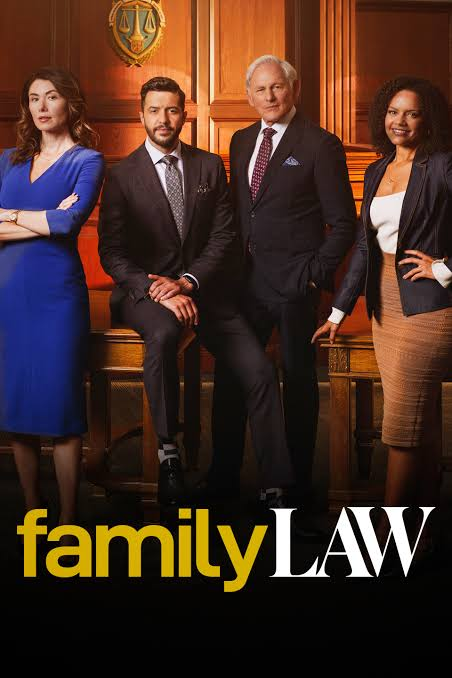
The first thing I loved about Family Law was its entirely Canadian cast, headed by Jewel Staite (whom I’ve followed since Stargate) and Victor Garber (of Alias and Legends of Tomorrow fame, not to mention countless others). As Abigail Bianchi, Jewel conveys volumes with a well-timed look at the camera, a sneer, or a roll of the eyes. Jewel and Victor are supported by Zach Smadu as Daniel, Abigail’s half-brother, Genelle Williams as Lucy, Abigail’s half-sister, and Bobbi Charlton as Jerri, Harry’s (Victor Garber’s) best friend and firm office manager. These actors, all familiar faces on Canadian television, are what made Family Law amazing.
Character Arcs
The best part of the series was the character arcs. All characters, no matter how minor, experienced satisfying character arcs over the course of the series. Abigail struggles with her sobriety. Her father employs her when no one else will. Over the years, Abigail grows up. She learns to put her needs aside for her children, forgives her father for abandoning her as a child, and forges a relationship with the half-siblings she has always resented. Through it all, she remains true to herself, never losing her sarcasm and sense of humour. But her true measure of growth is how she sacrifices her plans to open her own firm for her brother’s happiness and takes over Svensson and Svensson so her father can retire after re-marrying her mother.
A terrible philanderer for much of the series, Harry Svensson mellows over the years. He accepts responsibility for his failed marriages and his children’s resentment. He also realizes that you can’t think in black-and-white when dealing with people, and that everyone, including himself—and especially his children—is a shade of grey. In what is perhaps Harry’s finest moment, he sacrifices his firm’s merger for his relationship with Abigail. When told that the deal hinges on firing Abigail, he calls off the merger for his daughter’s sake, something he would not have considered four years prior.
Throughout the series, Lucy, the baby of the family, matures and stops accepting her father’s support. She opens her own practice, finds love, and co-parents her daughter from her first marriage. Self-centred Daniel learns to support his future “baby momma” and child. After revisiting his journal, he finds the courage to break free from Harry’s practice and open one of his own based on collaborative family law.
The End
All good things must come to an end, and so does Family Law with the fourth season. I’m not going to lie: I’m disappointed. But my disappointment is tempered with the beautiful send-off the writers gave the characters. All four Svenssons are messes at the start of the series. They come into their own by the end of the final season, but it’s not enough.
Ten episodes a season was also never enough.
And don’t even get me started on the final minute! I know it was meant to be a cutesy way to end the series, but I would pay to see Nathan Fillion join the cast. I don’t want it to end! Not now. Not ever!
RIP Family Law. You will be greatly missed.

