Author Archives: Admin

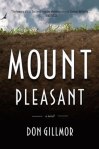
Review of Mount Pleasant by Don Gillmor

I first heard about Mount Pleasant by Don Gillmor on CBC Radio One. The reviewer said he couldn’t read the novel in public because he was embarrassed by the laugh-out-loud moments. I could use a good laugh, I thought to myself, and went home, downloaded and read the preview, and liked it enough to buy the ebook. The premise of Mount Pleasant is simple enough—a middle-aged man faces the realization that life is not what he’d expected.

When Harry Salter’s father dies leaving much less by way of inheritance than Harry thought, he hires a forensic accountant to find out what has happened to his father’s money. On the way he has an affair with his father’s younger second wife, learns his own wife had an affair decades earlier, comes to terms with his son’s new girlfriend, and his ailing mother. In his quest, Harry discovers his father was cheated out of his money by colleagues involved in a ponzi investment scheme. Now, in addition to the fact that he’s barely staying financially afloat, he must pay the forensic accountant for his services and convince his wife to sell the house in order to ease their financial burden. He must also come to grips with a sense of his own mortality after a colonoscopy yields a number of polyps.

Mount Pleasant—named after the cemetery in which Harry’s father is buried—is beautifully written. It is funny in a way, but the tone is more dark and ironic than laugh-out-loud funny.  The novel paints a detailed picture of Harry and his disenfranchisement from both his family and society. Though he teaches and still has contact with youth, there is the sense that the world has passed Harry by, and Harry doesn’t quite know what to make of it. While reading the novel, White Noise by Don DeLillo came to mind as both Gillmor and DeLillo write about coming to terms with a changing, postmodern society. In White Noise, fear of the future comes in the form of airborne toxins and invisible technological miasma. In Mount Pleasant, it is in the form of growing old alone (both literally and figuratively), and finding oneself unable to maintain accustomed lifestyles in a rapidly approaching retirement.

Mount Pleasant is worth the read. Gillmor’s prose is literary, his descriptions—whether on point or on tangent—superb. Gillmor’s storytelling is even paced, though anti-climactic. Mount Pleasant is a slice-of-life parable with which many aging baby boomers will identify.

About the Author

Elise Abram, English teacher and former archaeologist, has been writing for as long as she can remember, but it wasn’t until she was asked to teach Writer’s Craft in 2001 that she began to write seriously. Her first novel, THE GUARDIAN was partially published as a Twitter novel a few summers back (and may be accessed at @RKLOGYprof). Nearly ten years after its inception Abram decided it was time to stop shopping around with traditional publication houses and publish PHASE SHIFT on her own.

Download PHASE SHIFT for the price of a tweet. Visit http://www.eliseabram.com, click on the button, tweet or Facebook about my novel and download it for FREE!


Graphic from: http://www.dongillmor.ca/

Rob Ford needs a speech writer

I was never one to go out for politics. As a young adult, I never voted, primarily because I had no idea what was going on. Politics were boring and I never cared to pay attention. Politics—Canadian politics in particular—w ere, quite frankly, never worth following.

Until recently.

Before I continue, it must be said that I don’t live in Toronto. As a citizen of Vaughan—and by extension, Ontario—and as Toronto is the capital of Ontario, Toronto politics nevertheless affect me. In addition, all of the local media I monitor is Toronto based. And the Toronto-based media (as well as some American-based) has recently been abuzz with the antics of Toronto mayor Rob Ford. Has, in fact, been saturated with it this past week.

For those of you who are unaware, Rob Ford has been the centre of much controversy in the past year, with accusations ranging from misappropriating a Toronto Transit Commission bus on the city dollar to shelter the high school football team he coached, to inappropriate use of funds in his campaign, to appearing in public drunk and disorderly, making inappropriate and unwanted sexual passes at partygoers. As the icing on this week’s cake, a video has surfaced, purporting to document Mr. Ford smoking crack cocaine with drug dealers. The owners of the video want $200,000 for the file. They showed it to The Toronto Star who declined to purchase it as they do not pay for news stories. The gossip tabloid website Gawker.com is currently in the process of raising the money for the purchase.

After spending a week in which he remained mum to the media, Mr. Ford finally spoke today in a forty-some-odd second speech in which he made the following statements: “I do not use crack cocaine, nor am I an addict of crack cocaine…I cannot comment on a video that I have never seen or that does not exist. It is most unfortunate, very unfortunate, that my colleagues and the great people of this city have been exposed to the fact that I have been judged by the media without evidence” (Gillis).

Within a half an hour after broadcasting Mayor Ford’s speech on CBC Radio One, a spokesperson from Gawker was interviewed in which he argued that Mr. Ford did not deny any of the allegations. He accused him of pussyfooting around the accusations. His reasoning goes something like this:

1.       “I do not use crack cocaine” means he does not currently use crack cocaine. It does not address his use of the substance in the past six months.

2.       “nor am I an addict of crack cocaine” means he is not currently an addict because  he does not currently use it. Heavy emphasis on the word “currently”.

3.       “I cannot comment on a video that I have never seen” does not refute the existence of such a video.

4.       “or that does not exist” leaves the possibility open that a video may exist, but not one that Mr. Ford has ever seen.

The spokesperson went on to insist both he and two Toronto Star reporters confirmed the identification of Mr. Ford as the subject of the video.

I did some research on Mr. Ford. Wikipedia reports he completed one year of post-secondary education at Carleton University (Rob). Because I know there is a question about the validity of Wikipedia, I searched other sources as well. The Star reports he quit two credits short of a degree (Rider). Macleans reports the only thing known for sure about Mr. Ford’s post-secondary education is that he attended Carleton between 1989 and 1990 and later attended York University, taking  courses through distance education from 1990 to 1991 (Jerema). The implication in all online sources is that he listed his years in attendance at a post-secondary institution on his mayoral application as if to gloss over the fact that he didn’t graduate.  

I mention this because I don’t think Mayor Ford’s speech today was a way for him to dance around the subject of whether or not he had a drug problem, or whether, as his recently fired chief of staff, Mark Towhey apparently suggested, he needed to “go away and get help” (Strashin). I think his speech was a denial of accusations written by a man under a great deal of stress who, pressed by the media and his staff to make a statement, neglected to hire himself a proof-reader before reading his statement.

Speaking as a teacher of English who just came from a half-hour discussion in which she tried to explain to a student the nuances between explaining evidence and giving its significance, many people, untrained in writing a series of cohesive paragraphs, neglect to proofread to ensure a connection is made between the point they are trying to prove and their thesis. Consider the following statements:

1.       “I do not use crack cocaine nor am I an addict of crack cocaine” – how can you be an addict of crack cocaine if you do not use crack cocaine? This statement suffers from redundant phrases bordering on circular reasoning. “I am not an addict of crack cocaine, nor have I ever used crack cocaine” would put an immediate end to the speculation.

2.       “I cannot comment on a video that I have never seen or that does not exist” should have been worded “I cannot comment on a video that I have never seen and that does not exist.” The use of “or” instead of “and”, confusion of conjunctions, is a common mistake in writers who have not studied the English language.

3.       “It is most unfortunate, very unfortunate, that my colleagues and the great people of this city have been exposed to the fact that I have been judged by the media without evidence.” This, to me, is further proof that the only thing Mr. Ford is guilty of is scribbling out his assignment the night before it is due without leaving himself enough time to proofread it. What he means, I think, is “It is most unfortunate that my colleagues and the people of this great city have been forced to endure my being judged in the media, considering the media’s lack of evidence.”

Mr. Ford is not trying to hem and haw his way through this accusation as the media contends he did when reporting his educational background. Instead, he rushed his speech, writing it himself without stopping to give it to a professional for editing, and wound up striking the blow that broke the lock on his personal Pandora’s box.

Works Cited

Jerema, Carson. Rob Ford dropped out of university. How dare he? Macleans On Campus. 22 December 2010. <oncampus.macleans.ca/education/2010/12/22/rob-ford-dropped-out-of-university-how-dare-he/> 24 May 2013.

Rider, David. Rob Ford’s confusing university life. The Star. 21 December 2010. <www.thestar.com/news/city_hall/2010/12/21/rob_fords_confusing_university_life.html> 24 May 2013.

Rob Ford. Wikipedia. 22 May 2013. <en.m.wikipedia.org/wiki/Rob_Ford> 24 May 2013.

Strashin, Jamie. Rob Ford fired chief of staff for telling mayor to ‘get help’. CBC News: Toronto. 23 May 2013. <www.cbc.ca/news/canada/toronto/story/2013/05/23/toronto-ford-towhey.html> 24 May 2013.

Gillis, Wendy, Paul Moloney, Daniel Dale. Rob Ford’s video scandal: ‘I do not use crack cocaine,’ mayor says. 24 May 2013. <read.thestar/#!/article/519f793e8e492dd36c1a1-rob-ford-s-video-scandal-i-do-not-use-crack-cocaine-mayor-says> 24 May 2013.

Graphic from http://hcp2010.physics.utoronto.ca/toronto_night_skyline.jpg

About the Author

Elise Abram, English teacher and former archaeologist, has been writing for as long as she can remember, but it wasn’t until she was asked to teach Writer’s Craft in 2001 that she began to write seriously. Her first novel, THE GUARDIAN was partially published as a Twitter novel a few summers back (and may be accessed at @RKLOGYprof). Nearly ten years after its inception Abram decided it was time to stop shopping around with traditional publication houses and publish PHASE SHIFT on her own.

Download PHASE SHIFT for the price of a tweet. Visit http://www.eliseabram.com, click on the button, tweet or Facebook about my novel and download it for FREE!

Critique of “Star Trek: Into Darkness”

Critique of Star Trek: Into Darkness

Warning: Spoilers follow.

I’ve been a Star Trek fan for as long as I can remember, so devout a fan, in fact, that the first time I heard of the JJ Abrams re-boot, I thought it was sacrilege. And then I watched it. In light of the cancellation of Deep Space Nine and the failure of Enterprise, 2009’s Star Trek brought a breath of fresh air to the franchise.

After the vacuum in which there was no new Trek after the original series ended, I looked forward to the first Trek movie with anticipation. After watching it, I didn’t know what to make of it. Any new Trek is good Trek, I argued, but I loathed calling the new Trek good Trek. Then the second movie premiered and I went, in spite of the first, and was blown away. The Wrath of Khan was the best epic epi of Star Trek ever. I think I must’ve seen it a dozen times or more in the emptiness between it and The Search for Spock, only to be disappointed once more. The third movie in the franchise was too short and too proscribed. A mistake had been made in killing Spock and the purpose of The Search for Spock was an ends to a means—to put the canon right.

By contrast, The Voyage Home shined because it was a return to the two things Trek does best—the buddy relationship between Kirk and Spock (made better by Spock’s newfound struggle with humanity/vulcanry) and time travel. After movie number four, the original flavour of Trek would not return until movie seven, Final Contact. This movie, capitalizing on the popularity of The Next Generation series, was a winner as it was as good as TNG’s best television episodes. The movies that followed never, in my opinion, recaptured the camaraderie and adventure that made the series such a hit.

On the heels of TNG movies came a slew of television series linked to the Trek franchise. Deep Space Nine played out in mediocrity alongside a bland Final Contact and lacklustre Andromeda, followed by a struggling Enterprise, and it seemed like the franchise—and Gene Roddenbery’s future ideal—had petered out.

Then came the 2009 re-boot, followed by 2013’s Into Darkness. I went to see it because, like all other Trek movies, it was Star Trek. The reviews were mixed, everything from amazing and that it was a must see to nothing special, and that it recycled several episodes of the original Trek. While the movie does recycle many original Trek ideas, such as the characters of Khan, and Carol Marcus, as well as a conveniently placed zombie tribble, Into Darkness is amazingly fun. In it, the crew is sent to kill the character we later learn is Khan Noonian Singh in a deserted area on Kronos, the Klingon home world, without starting a war. Talked out of the hit by Spock, Kirk and crew are targeted by Marcus’ father as a part of a cover-up to hide the fact that Khan had been working with The Federation to develop a type of photon torpedo. It turns out the torpedoes disguise stasis pods for Khan’s eugenically engineered mates, and Kirk and his gang emerge victorious, thwarting the evil Marcus senior, and securing Khan and group back in their stasis pods, ready to be set afloat on the SS Botany Bay where they will be found by Kirk et al in the original Trek timeline.

I enjoyed the re-invention of the Khan character, seeing the start of Kirk’s relationship with Carol Marcus, and the cameos by both the tribble and Leonard Nimoy as the elder Spock. It is interesting how the roles of Kirk and Spock are switched for the retake of Wrath’s critical warp core scene. This time it is Kirk who asks about the status of the ship and Spock who answers “Out of danger,” as well as shouting “Khan!” with more emotion than you’d think a Vulcan could ever muster. I know Kirk is supposed to be the star of the series, but the Spock character, pioneered by Leonard Nimoy and wonderfully interpreted by Zachary Quinto, in my mind, has become my favourite and most important Trek character by far. I love the chemistry between Spock and Uhura as well. Though Kirk still has a lot of growing up to do, this movie helps the character travel down that road by miles from where he was at the end of the first movie.

Into Darkness is a fine addition to the popular Trek canon. I look forward to seeing it again when it comes out on DVD as well as where JJ Abrams will “boldly go” with the franchise in the next movie.

Graphic from http://collider.com/star-trek-into-darkness-app-image/

About the Author

Elise Abram, English teacher and former archaeologist, has been writing for as long as she can remember, but it wasn’t until she was asked to teach Writer’s Craft in 2001 that she began to write seriously. Her first novel, THE GUARDIAN was partially published as a Twitter novel a few summers back (and may be accessed at @RKLOGYprof). Nearly ten years after its inception Abram decided it was time to stop shopping around with traditional publication houses and publish PHASE SHIFT on her own.

Download PHASE SHIFT for the price of a tweet. Visit http://www.eliseabram.com, click on the button, tweet or Facebook about my novel and download it for FREE!

Guest Blog Post Announcement – 20 May 2013

I am proud to announce the publication of a guest blog post on TheWritePractice.com website.

Showing, not telling, is the mantra I use with my students in the first months of teaching Writer’s Craft. I tell them they must paint a word picture, using sensory information from all five senses. The trick is in finding balance between when to show and when to tell.

The post’s direct link is http://thewritepractice.com/word-pictures/. Please feel free to visit the site and post in the comments. I will make every effort to get back to you within 24 hours of posting.

Variations Under Domestication

I love Orphan Black. (I’ve gotten past the inconsistency issue I blogged about earlier.) “Variations Under Domestication,” last night’s episode, was a brilliant comedy of errors, in which Sarah’s, Allison’s and Beth’s lives come together in “Scarberia”, aka Scarborough.

When subplots collide, there can only be two kinds of results – explosive or comedic. “Variations Under Domestication” followed the latter with genius results. Suspecting all clones—or genetic identicals—have watchers, soccer mom Allison is convinced it is her husband. She knocks him out with a golf club to the head and then ties him up in her craft room and tortures him by dropping hot glue onto his chest. Sarah comes to the rescue, switching places with a drunken and self-medicated Allison. She calls Felix in to bartend. If that weren’t bad enough, who should show up but Vic and Paul. The comedy ensues watching Paul brutalize Vic and seeing Sarah try to keep the neighbours—at Allison’s for a block party—out of the basement where Allison is unconscious and Donny is tied up, eyes covered with a pink sleeping mask and pink fuzzy earmuffs. With Allison’s neighbours convinced she is having an affair with Paul, Sarah and Paul sneak out to the garage where Vic has taken a nail through the hand. Sarah gets rid of Vic and she’s left to deal with Paul, who seems to be as in the dark as Sarah and her duplicates. Canadian Eric Johnson (whom I miss from his prior Rookie Blue gig), plays a randy neighbourhood husband. Hilarity, some slapstick (as in the torturing of Donny), some darker (as in what poor—yes, poor—Vic has gone through  with respect to the loss of fingers, beatings and now nailings, since the start of the series.

In the mean time, Cosima is at university, getting to know a blonde woman whom she suspects is her watcher. The blonde has ties to a scientist who preaches taking control of your own, personal evolution (played with gusto by Matt Frewer) and you just know he figures into the story behind Sarah and her “sisters’” cloning.

The episode begs the question of whether the clones really do have assigned watchers. If Paul was Beth’s watcher, Allison suspects Donny of being hers, and Cosima suspects her new friend of being hers, who is Sarah’s watcher? Maybe it’s Vic and that’s why he refuses to leave her alone. I’m voting for Felix in the role. Think about it…they’ve known each other since they were kids and he knows exactly what’s going on. Felix’s primary role is as Sarah’s confidant and fixer, but other than that, he’s comedic relief on his own. Aside from fencing stolen drugs and prostituting himself, Felix has to have a larger role. Wouldn’t it be great if he were simply playing the fool when instead he was the mastermind of the whole affair, or at least in league with the masterminds?

One more thought occurs. Allison adopted her kids because she couldn’t have any on her own. All of the sisters were surprised that Kira was Sarah’s natural-born child. What if that’s because Kira is another clone? Sarah could carry her to term because Kira’s DNA would have been genetically identical to her own. Keep in mind that other than the fact that Kira’s father isn’t Vic, we have no idea who the father really is. What if that’s because there is no father because Kira is yet another Sarah clone?

Time will tell, I guess, and we have a lot of that, considering that it’s been reported Orphan Black has been renewed for another season.

Graphic from thunderclam.wordpress.com

About the Author

Elise Abram, English teacher and former archaeologist, has been writing for as long as she can remember, but it wasn’t until she was asked to teach Writer’s Craft in 2001 that she began to write seriously. Her first novel, THE GUARDIAN was partially published as a Twitter novel a few summers back (and may be accessed at @RKLOGYprof). Nearly ten years after its inception Abram decided it was time to stop shopping around with traditional publication houses and publish PHASE SHIFT on her own.

Download PHASE SHIFT for the price of a tweet. Visit http://www.eliseabram.com, click on the button, tweet or Facebook about my novel and download it for FREE!

I am proud to announce the publication of my first guest blog post on the WriteToDone.com website.

Modelling expert text is something I learned about in teachers’ college and have used many times over the years, both as a tool with which to develop my own writing voice (as I discuss in the article) as well as with my students as a writing exercise.

The post’s direct link is http://writetodone.com/2013/05/02/develo-your-narrative-voice-by-stealing-from-bestselling-authors/. Please feel free to visit the site and post in the comments. I will make every effort to get back to you within 24 hours of posting.

Above is the Twitter announcement for the post:

Critique – “The Imposter Bride” by Nancy Richler

The Imposter Bride

The Imposter Bride by Nancy Richter documents the life of a young Polish woman who steals a dead woman’s ID during the Second World War and uses it to come to Canada as a mail-order bride of sorts. In Montreal, Lily marries her betrothed’s brother, has a child and flees, leaving the child behind. As fate would have it, she meets Lily’s real cousin, whose daughter marries the man Lily was originally supposed to marry. The story is primarily told from two points of view, that of Lily and of her daughter Ruth. Lily’s story reveals a woman who feels guilty for having stolen a dead woman’s identity and who is so scared of being found out as an imposter she must flee. Ruth grows from a child to a woman with children of her own as the book unfolds, wondering the whole time why her mother left.

Nominated for the Scotiabank Giller Prize, The Imposter Bride is told from third person omniscient point of view, which I found confusing. Chapters either tell Lily’s tale or Ruth’s and I would have a better feel for each of these potentially amazing women if their stories were exclusively told. In one paragraph I’m given Ruth’s thoughts, in the next, her grandmother’s, and I felt jarred at the shift, having to re-read sections as a result. The climax is told, rather than shown, quickly wrapping up most character’s lives in a single chapter and with little emotion. Maybe this is why I found it hard to identify with any of the characters.

At times, the writing is amazing. I feel the tension between strangers Lily and Nathan, especially on their wedding day, and the mystery of imposter Lily’s life drives the reader forward. Though I didn’t like the objective telling of the climax, I found this and the prologue the best parts of the novel as well as the most satisfying, but as I’ve said, lacking the emotion that helps me care when someone dies or achieves the closure for which she’s searched her entire life.

Richler overextends the plot as well, telling the story of Lily—both the real one and the imposter—and Nathan, his brother Sol and his wife, Elka, and children, Ruth and her friends and husband and children, and of grandparents Bella and Ida. There is a journal belonging to the real Lily, with which Ruth is nearly obsessed that haunts her childhood because it’s written in Yiddish and no one is willing to read it to her, and the stones that her mother randomly sends her on birthdays and the meaning Ruth makes of them. Richler also tells about Lily’s life after she leaves Nathan and Ruth, leaving the reader with too little information about too much and no specific detail about any of the characters and what motivates them beyond Ida’s exposing Lily for the fraud she is and Ruth’s obsession with the minutia—either real or perceived—of her mother’s life.  

Though Jewish, I tend to stay away from novels simply for their Jewish content as there is no guarantee a connection will be made between reader and protagonist beyond religious upbringing. I made an exception this time because of the first chapter which so poignantly sets up the relationships between Lily and Nathan and his brother Sol and the diamond-cutter’s daughter, Elka, but came close to closing it for good so many times for lack of that connection.

The Imposter Bride is well-written and has the potential for a great story behind the premise and wonderful voice, but something is lost in the telling of it, as the story jumps back and forth in time and in and out of too many characters’ minds.

About the Author

Elise Abram, English teacher and former archaeologist, has been writing for as long as she can remember, but it wasn’t until she was asked to teach Writer’s Craft in 2001 that she began to write seriously. Her first novel, THE GUARDIAN was partially published as a Twitter novel a few summers back (and may be accessed at @RKLOGYprof). Nearly ten years after its inception Abram decided it was time to stop shopping around with traditional publication houses and publish PHASE SHIFT on her own.

Download PHASE SHIFT for the price of a tweet. Visit http://www.eliseabram.com, click on the button, tweet or Facebook about my novel and download it for FREE!

Inconsitencies I have known.

Consistency.

It’s something writers strive for in their work, especially with respect to setting and character descriptions. For many, an error in consistency can break the narrative flow, reminding the reader s/he is immersed in a construct of reality and not the real thing.

On film, errors in consistency are typically referred to as bloopers. And though they can be fun to spot, if you’re like me, and the gaffes are serious enough, they can also be maddening. Minor consistency problems are artifacts of the way television and movies are filmed, a result of the final product being an amalgam of various takes and camera angles.  This is the shirt that mysteriously buttons and unbuttons or the strand of hair that magically tucks and untucks itself from behind an actress’ ear as the scene plays out. In a recent episode of Cult, it was the level of water in Skye’s bottle that randomly rises and falls.

Errors like these are more amusing than annoying.  The inconsistencies prompting me to write this blog are much more serious than that. The ones I’m talking about are due to errors in the writing and/or interpretation of the script, errors that should have been caught and edited out long before production began. Take, for example, the Once Upon A Time episode in which Mr. Gold/Rumplestiltskin is led to believe August is his son. This correlates with an hour of my yelling at the screen that August couldn’t possibility be Baelfire because August has blue eyes and Bae has brown. And while it turned out August wasn’t Bae, I don’t know how I noticed this and the boy’s own father didn’t.

Another issue arose watching this week’s Hannibal.  The police assert that their murderer was killing girls of the same age, height, weight and with the same hair and eye colour as his daughter. They show a series of victim photos, and I swear the last girl has brown eyes. Trouble is, when they show the daughter in the next scene, her eyes are decidedly blue.

Perhaps the biggest gaffe I’ve noticed was in this week’s Orphan Black. I remember being told via subtitle in the premiere episode that the story takes place in New York. Wikipedia observes the police used NYPD coffee mugs and drove NYPD cars in that episode. But this week they drove to a building I recognize as being on the U of T campus driving cars with Ontario plates. To make matters worse, Sarah/Beth drove through Chinatown to get to a Kensington Avenue address and walked into The Waverly Hotel (it said so on the door as she entered). While I love that shows (like Rookie Blue or Bomb Girls) use Toronto as a backdrop for stories told in Toronto, I need a show to pick a location and stick to it so that I forget I’m watching a construct and not actual people’s lives.

In other words, do the viewers a favour and make the effort to remain consistent.

graphic from:http://escapepod.org/2013/04/02/tv-review-orphan-black/

About the Author

Elise Abram, English teacher and former archaeologist, has been writing for as long as she can remember, but it wasn’t until she was asked to teach Writer’s Craft in 2001 that she began to write seriously. Her first novel, THE GUARDIAN was partially published as a Twitter novel a few summers back (and may be accessed at @RKLOGYprof). Nearly ten years after its inception Abram decided it was time to stop shopping around with traditional publication houses and publish PHASE SHIFT on her own.

Download PHASE SHIFT for the price of a tweet. Visit http://www.eliseabram.com, click on the button, tweet or Facebook about my novel and download it for FREE!
Can “Defiance” Defy the Odds?

Defiance is a combination of both a TV show and a video game

Defiance premiered on Showcase Monday night, to lukewarm reviews. I, on the other hand, rather liked the show, and will be watching further episodes. Defiance takes place 33 years after Earth is invaded by an alien ship, called The Ark, transporting seven different types of sentient beings from the same solar system. They arrive on Earth, terraform it to their liking, and now the aliens and humans are trying to co-exist in the dystopia. Defiance is the town that rose up from the ashes of St. Louis.

Julie Benz is terrific as Mayor Amanda Rosewater. She plays her with a maturity that haven’t yet seen in her other roles. Grant Bowler is Joshua Nolan, a scavenger who makes his living collecting and selling the remains of The Ark as they fall to Earth (a phenomenon known as Arkfall). He arrives in Defiance and gets into trouble defending a boy accused of murder. He gets out of trouble by agreeing to find the real murderer and winds up staying on as sheriff of the town.

Defiance may suffer from a case of trying to do too much too soon. I don’t think I’ll ever learn all of the alien species (collectively known as The Voltans), and the soap-opera style subplots pile up until the last minutes of the two hour episode. In spite of the premise’s predictability (for example, I knew Nolan would become sheriff the moment the current sheriff is killed), and inconsistencies (Why terraform a planet to rid it of its greenery when it is the greenery of the planet that makes it desireable?) I enjoyed the show due to its nod to Shakespearean archetypes. I loved the Romeo and Juliet vibe going on between the son of the Tarr family and daughter of the McCawley clan. Just as entertaining is the scene between Datak and Stahma Tarr in the tub. Upset that his son will marry a human, Datak rants that his wife will spoil his bath if she continues to talk about his son’s choice for a mate. That’s when Stahma channels her inner Lady Macbeth and convinces Datak that if the children marry and something were to happen to the girl’s father and brother, then their family would stand to inherit the McCawley business and eventually control most industry in the town. The implication is that Datak will have something to do with the death of the male McCawleys. Later, when Datak is disgusted by his son’s conformation to the human custom of giving the McCawley girl a ring as a promise to wed, Stahma calms him by suggesting the mere fact the children are engaged will be enough to prompt Papa McCawley’s demise.

Defiance is unique in that quite a bit of money and planning has went into the simultaneous release of the show and video game and (according to online sources) the hope is that watching the series will unlock hints for the game and playing the game will further endear viewers to the characters. While I won’t be playing the game any time soon (that’s just not my thing), I am looking forward to next Monday’s episode, especially in light of the cliff-hanger posed by the episode’s final moments in which former Mayor Nicky Riordan, played with sinister flare by Finnoula Flanagan, hints that there is something subversive about to happen in the near future that will change life on the planet as they know it.

I will definitely be watching; will you?

graphic from:http://www.slashgear.com/defiance-is-both-a-tv-show-and-a-video-game-08276908/#entrycontent

About the Author

Elise Abram, English teacher and former archaeologist, has been writing for as long as she can remember, but it wasn’t until she was asked to teach Writer’s Craft in 2001 that she began to write seriously. Her first novel, THE GUARDIAN was partially published as a Twitter novel a few summers back (and may be accessed at @RKLOGYprof). Nearly ten years after its inception Abram decided it was time to stop shopping around with traditional publication houses and publish PHASE SHIFT on her own.

Download PHASE SHIFT for the price of a tweet. Visit http://www.eliseabram.com, click on the button, tweet or Facebook about my novel and download it for FREE!