Author Archives: Admin

Literary Devices from A to Z – Brought to you by the letter F


is for Foil


Foils are characters that have opposing character traits and motivations.

An example of foils from classical literature are Macbeth and Macduff from William Shakespeare’s Macbeth. In this example, Macbeth is driven by ambition to suit his own, selfish needs, while Macduff’s only ambition is altruistic in nature, to put the kingdom back to rights. Macduff and his wife’s relationship is a loving one, while Macbeth and Lady Macbeth’s is adversarial. Macduff has a child while Macbeth has none. Macduff is allied with Malcolm while Macbeth is his enemy. These and other traits set Macbeth and Macduff up as near polar opposites in character and desire, establishing them as foils.

In The Revenant, Morgan and his brother Malchus are constructed as opposites. Morgan is the naughty child, Malchus the good one. Morgan tends his family’s farm fields while Malchus is apprenticed to the local doctor. Morgan has the gift of foresight, something he wishes would go away while Malchus actively seeks out and embraces his power in the Dark Arts. Malchus raises Zulu from the grave for nefarious means; Morgan saves him. Morgan finds a life of purpose embracing the good while Malchus loses himself in evil. For these and other reasons, the brothers are set up as having opposing personalities, desires and motivations, rendering them foils.

Can you think of any other foils in literature or television? Post your ideas in the comments below.


Literary Devices from A to Z – Brought to you by the letter E


is for Equivocation


Equivocation occurs when someone uses ambiguous or unclear language with the intent to mislead or deceive (full definition). One example of this I like is from Macbeth by William Shakespeare in act 1 scene 6 when Lady Macbeth says to King Duncan upon his arrival to her castle:

All our service In every point twice done and then done double Were poor and single business to contend Against those honours deep and broad wherewith Your majesty loads our house.

Lady Macbeth equivocates here. On the surface, it may seem as if she is pandering to Duncan, telling him if they could do everything in their power double and then double again, it wouldn’t be enough to repay him for honouring their house with his visit. Alternately, she could be saying this sarcastically. All that Duncan has done for them at this point, besides honouring Macbeth with the thane of Cawdor title, is appoint Malcolm instead of Macbeth as his successor, something for which both Macbeth and Lady Macbeth deeply resent him. In the short story “A Grave Situation“, protagonist Sam Roeper mourns his wife after she’s left him, tending his garden to help pass the time. Toward the end of the story he lets his neighbour in on his gardening secret when he says,

“It’s all in your choice of fertilizer. Take the one I use, for example. Works like a charm. I have it on good authority its the same fertilizer they use at the graveyard.”

Here, Roeper deceives  his neighbour to believe he, too, could have the same green thumb if he purchases the same fertilizer used by the local cemetery. He equivocates because the one fertilizer the graveyard has in abundance is decomposing human flesh, hinting that Roeper’s wife isn’t missing; he knows exactly where she is: buried in his garden feeding the flowers planted there. Can you think of any examples of equivocation in literature, television or in the movies? Did you get the subtext behind it? Post your examples in the comments section below.

Literary Devices from A to Z – Brought to you by the letter D


is for Doppelganger


A doppelganger is a character’s double. The two characters have identical looks but different personalities and agendas.

Both The Talisman and it’s sequel, Bleak House, by Stephen King, feature doppelgangers. In The Talisman, a boy discovers his parents are doppelgangers of the king and queen in another universe. Mistaken for the prince, he is drawn into a life or death adventure to restore order to the duplicate world. In Bleak House, the boy, now a man, must once more return to the other universe to impersonate the prince and put things right in the doppelganger universe.

The notion of duplicate universes is also used in Phase Shift. In Phase Shift,  Molly McBride, an archaeologist, discovers an artifact which is the key to the other world. In this scene, Molly meets with Reyes Prefect and she realizes she’s actually traveled to a doppelganger Earth:

“And where exactly is ‘here’?”

He looks confused. “Why, Theran Prefecture, of course.”

That’s not what I meant. “I mean where, geographically?”

“Theran Prefecture resides on the mass of Selene.”

I continue to look at him, trying to process this information.

“On the planet of Gaia,” he offers.

It’s nothing new, nothing I haven’t already read in Prescott’s memoirs, nothing I wasn’t anticipating in the event our experiment worked. Still, I can’t help but wonder: is this actually happening? Am I really to believe I’m on another world?

“You said you were expecting me.”

“Not you, precisely.” He picks at the upholstery on the padding of his chair. “Perhaps someone like you.” He looks up at me. “We knew it was only a matter of time before someone discovered how to bridge the gap from the other side.”

“The gap? I don’t understand.”

“Between our world and yours.”

I must still look confused because he takes it upon himself to explain further: “Every living thing, from the smallest insect to the largest animal, has a life force that sustains it through its existence. It is the phase pitch at which a life force resonates that binds it to its earth.

“And this ‘gap’ you speak of?”

“Our clerisy posits at some point in time, a cataclysmic event ensued on our planet, forcing a shift in the phase of all living things.

“History tells us at the time of the cataclysmic event our world spawned a doppelganger, an exact duplicate. Your world.” Reyes’s explanation was a lot like chocolate: it tasted good, but did nothing to sate the appetite.

“So the ‘gap’ refers to the difference in our…broadcast frequencies?”

“In the pitch of our phase resonances, yes. Your world and mine co-exist, occupying the same space-time, only slightly out of phase. Here, yet not here.

“We have known of your world for some time now, known how to travel between the two worlds as well. In the interest of science, this technology has been banned until your world could discover our existence, learning how to bridge the gap on your own accord. Our clarists posited the coming of this day.”

What doppelgangers have you read about in fiction? Watched on television? Did the trope work? Post your comments and observations about doppelgangers in literature below.

Literary Devices from A to Z – Brought to you by the letter C


 is for Conflict


Conflict is what drives the plot forward. It also supports character development. Without conflict there is no story, end of story.

There are generally 3 main types of conflict authors use, person vs. self, person vs. person, and person vs. society. There are other sub-types, such as person vs. machine/technology (which could be lumped into person vs. society), person vs. the Gods (which is a type of person vs. person conflict), to name a few.

Person vs. Self

Internal monologue is a hallmark of person vs. self conflict, in which a person struggles over a decision. Quite often, the character weighs the pros and cons of his/her situation in an effort to gain control of a predicament.

He brushed away a blood-soaked lock of hair from her forehead. It left behind a copper trail. Her skin was pale, her lips and cheeks inordinately red where her makeup had clung in spite of the blood that had left her. Nigel cursed himself for the situation in which he was in. Maybe if he’d let her know how he felt, things might’ve been different. If she’d only known it was he who truly loved her, not the thug that had fired the bullet that ended her life. If she’d have known, perhaps she would have declined to follow Posner to this room because she’d worry for him and what he’d think.

Chicken or Egg: A Love Story

In this example, Nigel berates himself for not expressing his love for Paula while she was alive, a mistake he vows to correct when he travels back to a time before her death.

Person vs. Person

This type of conflict occurs when a character finds him/herself in opposition to another character. The conflict can manifest itself through dialogue, online communication, or action sequence:

He swung at her. She ducked; he clipped her on the shoulder sending her reeling. She shrugged her shoulder twice in an effort to gauge how hurt she was; seemed fine.

“We don’t have to do this, you know,” he told her.

“You should have thought of that before you threw the first punch,” she replied. She took a step forward and swung at the underside of his jaw with all the force she could muster. He intercepted the swing by grabbing her wrist. He twisted her around until he had her in a bear hug, her arms pretzeled around her midsection.

–Chicken or Egg: A Love Story

Person vs. Society

In a person vs. society conflict, a person challenges the accepted social mores of society. This frequently happens if the protagonist is an anti-hero (like Dexter Morgan of Jeff Lindsay’s Dexter series) or dystopian fiction. In “Hope Floats”, the unnamed preteen protagonist goes against society when he leaves the confines of his underground community in search of food, something only “paws”, adult males, do:

I climbed out from the rubble to feel sunshine on my face for the first time in a while, I don’t remember how long. I know how to keep time, that’s not the problem. It’s just that these days we tend to rely on the maws and paws to keep track for us. It’s their responsibility to tell us when we’ve had too much of anything. Too much sleep. Too much fun. As if I’m not old enough to figure that out on my own.

Leave your comments below. Describe a memorable conflict. What kind was it? What genre was it?

Literary Devices from A to Z – Brought to you by the letter B


is for Bias


Bias occurs when an author incorporates his or her own beliefs into a piece of writing. Incorporating elements of a person’s social, political, religious and life experience, bias can be as explicit as arguing a single side of a conflict or as implicit as omitting evidence that doesn’t conform to an author’s worldview.

Many years ago, I engaged with a self-described bottle-hunter online. I wrote a totally unsolicited email to him chastising for what I considered looting behaviours–“recovering” artifacts from known archaeological sites for their resale value. An active archaeologist at the time, my bias was toward preserving the archaeological record, admiring cultural remains for their intrinsic and historic value,  and fostering the same respect in others. My newly discovered nemesis insisted that, since most of the bottles he collected were from backwoods and beaches that were not parts of the existing record and therefore had no provenance, the bottles were okay to collect. I argued that the only reason there was no provenance was because people like him picked up and sold the artifacts rather than reporting them to the proper authorities. In the end, both of us were so mired in our personal, political, social and educational bias, no amount of back and forth was about to change either of our minds and we eventually gave up the fight.

I’m still fighting the good fight, trying to persuade others to see things clearly (that’s my way, in case you’re wondering) via my writing. The following excerpt imagines how one might feel after arriving on site after pot hunters have finished with it. It’s from an unfinished manuscript tentatively called The Next Coming Race:

We’d arrived on site too late.

I surveyed the marred landscape, barely able to breathe, mired in the horror of it, unable to look away. Craters the size of meteorites; random piles of dirt peppered the grass like shrapnel. A gentle hand on my shoulder broke the trance. “Oh, Moll,” Palmer, my husband, said, barely above a whisper. “I’m sorry.” He squeezed my shoulder. Numb, immobile, unable to manage even the slightest nod, I said nothing.

“You okay?” he asked. I felt the warmth of his breath on the back of my neck, imagined his words edged with a fine cloud of mist hanging in the air between us. He placed his other hand on my other shoulder, and attempted to draw me near. Though I longed for solace in the shelter of his embrace, the shock of the potential archaeological site, ruined, kept hold.

One by one the members of our failed rescue attempt muttered their goodbyes until there were only Palmer, Michael and myself left.

I turned to face Palmer. He smiled. Those were his scruffy years. Clean shaven and hair close cropped since I’d met him, he’d taken to wearing his beard grown, but marginally so. His hair had grown in salt and pepper, and wavy. He kept it long, just this side of needing a cut. I’m not complaining, mind you; I’ve always liked a man in a beard. Combine that look with his dark, watery eyes, add a billowy shirt, and Palmer’d be at home on the cover of any romance novel, I used to think. I worried the look was a sign he was in the throes of a mid-life crisis, but God-forbid I’d ever say that to him—at more than fifteen years’ my senior, Palmer was a little touchy about his age.

That night he wore a dark pea coat, the collar hiked up around his neck as if about to head asea. He shoved his hands into his pockets, shoulders raised nearly to his ears, and asked, “Timmy’s?” Michael, Detective Constable Michael Crestwood of the Metropolitan Toronto Police Department, nodded his assent.

“I need something with more caffeine,” I said. “Second Cup anyone?”

What would you do if you found an abandoned artifact washed up by the side of a cottage country lake? Would you notify the local archaeological association, or cultivate it for your own collection? Post your thoughts or opinions in the comments section below.

Literary Devices from A to Z – Brought to you by the letter A


is for Allusion


An allusion is a reference to a person, place or thing outside of the current text. It is assumed that the reader or viewer will recognize the reference and draw a deeper connection with the text.

Different types of allusions require different levels of critical thought in order to form connections. A simple allusion might be a casual reference to something from popular culture:

The plan was simple enough–bring the girls to the ancient Victorian, that Addams Family knock-off, scare the pants off them, be all “there, there” when the time was right, and then literally take the pants off them.

-from The Revenant

In this example, “Addams Family knock-off” connotes a dilapidated mansion with mansard-style roofs, quite possibly haunted, with a belfry, bats included.

A more complex allusion might be an extended metaphor that, when taken as a whole, paints a picture for the reader:

Zulu heard his watch mark off the time: tick…tick…tick. He fancied himself Captain Hook on the deck of the Jolly Roger, hearing the clock in the belly of the crock that took his hand. He stood upright, hands on hips, right foot on an overturned trash can. For a moment he was Hook. “He tasks me,” he whispered. “He tasks me and I shall have him.”

Wait, he thought. Wrong movie.

-from The Revenant

This allusion relies, not only on the reader’s knowledge of J.M. Barrie’s Peter Pan, but also “Star Trek II: The Wrath of Khan.” While the reference to Pan is more of an explicit allusion as it identifies characters in the text, the reference to “Khan” is more subtle in that it doesn’t. Here the author is hoping her target audience has seen the movie, recognizes the quote, and makes the connection.

I leave you with one final allusion I wrote, just because I’m proud of it, from my I am, Was, Will be Alice YA novel:

“I’m not sick.”

“Paralyzing fear is a kind of sickness,” she says and just like that, we’re replaying the scene from The Big Bang Theory, the one where Sheldon is locked out of his house and spending the night at Penny’s, but he can’t sleep and Sheldon says he’s not sick and Penny says, “Homesickness is a kind of sickness.” Mom doesn’t disappoint–she asks if I want her to sing “Soft Kitty” to me. Or maybe she does disappoint, I mean, here I am, scared to frozen that if I go to school I will one day dematerialize in front of people in an imperceptible poof of air leaving behind nothing but my clothes (including my underwear) or even worse, rematerialize in front of the entire ninth grade population in the altogether, my privates on display, and all she can do is play out a corny scene from a stupid television show. I know she means well, to ease the tension in the room, but come on!

Feel free to share any allusions you’ve written or comments you have below.

Yawping My Verse

Yawp your verse!

Yawp your verse!

I’m teaching poetry to my 11C students and the way I began the lesson was with watching “Dead Poet’s Society.” In the movie, Robin Williams’s character has the boys “yawp” to assert their power. He reads them a poem by Walt Whitman that was later used in a MacAir commercial. I showed them the commercial and put the words “The powerful play goes on and you may contribute a verse!” on the board. As an exemplar, I stood on a chair and yawped my verse. Here it is.

I’m going to be published.

I’m going to be published.

After all these years

–all these years–

It’s finally happening.

I’m going to be published.

I’m going to be published.

I’ll sell a thousand…

Ten thousand…

A million books…

Be on every best seller list.

I’m going to be published.

I’ll be interviewed for the papers–

The CBC…

Jimmy Fallon…

I could be famous!

I’m going to be published

And the world will read

–the whole wide world!–

What I’ve written

…oh my God!

I can’t believe I’m going to be published!

What’s your verse?

Look for The Revenant to be released on 10 July 2014!


Literary Devices from A to Z

First there was NaNoWriMo – write an entire novel in 30 days during the month of November. Now there’s the A to Z Challenge – post 26 blogs in the month of April (Sundays not included), each blog on a different topic, each featuring a different letter of the alphabet.

Piece of cake, no?

Announcing my first attempt at the A to Z Challenge (drumroll, please?): Literary Devices from A to Z, a device a day for your literary pleasure.

To help illustrate each device, I’ll be relying heavily on my own reading and (especially) writing experience. The whole point of this exercise is to be read and make connections with my fellow blog-writers, so participants are asked to visit at least 5 participant blogs a day in addition to posting. I’m including the Linky list with the other theme listings with this post and every other Challenge post, in case you’re interested.

Wish me luck!

The Lure of the Vampire, or Why We Fantasize about Dead People

Vampire lore owes its popularity to Bram Stoker and the release of Dracula in 1897 at the height of the Victorian Era. At that time there were strict rules for how men and women should act in public, such as women never appearing in public or found alone with someone who wasn’t their father, brother or husband. Women’s clothing was generally quite restrictive with high necklines, bustles (to accentuate the behind) and corsets (to cinch the waistline). Necks and ankles were considered “sexy”, only because they were, for the most part, hidden from view.

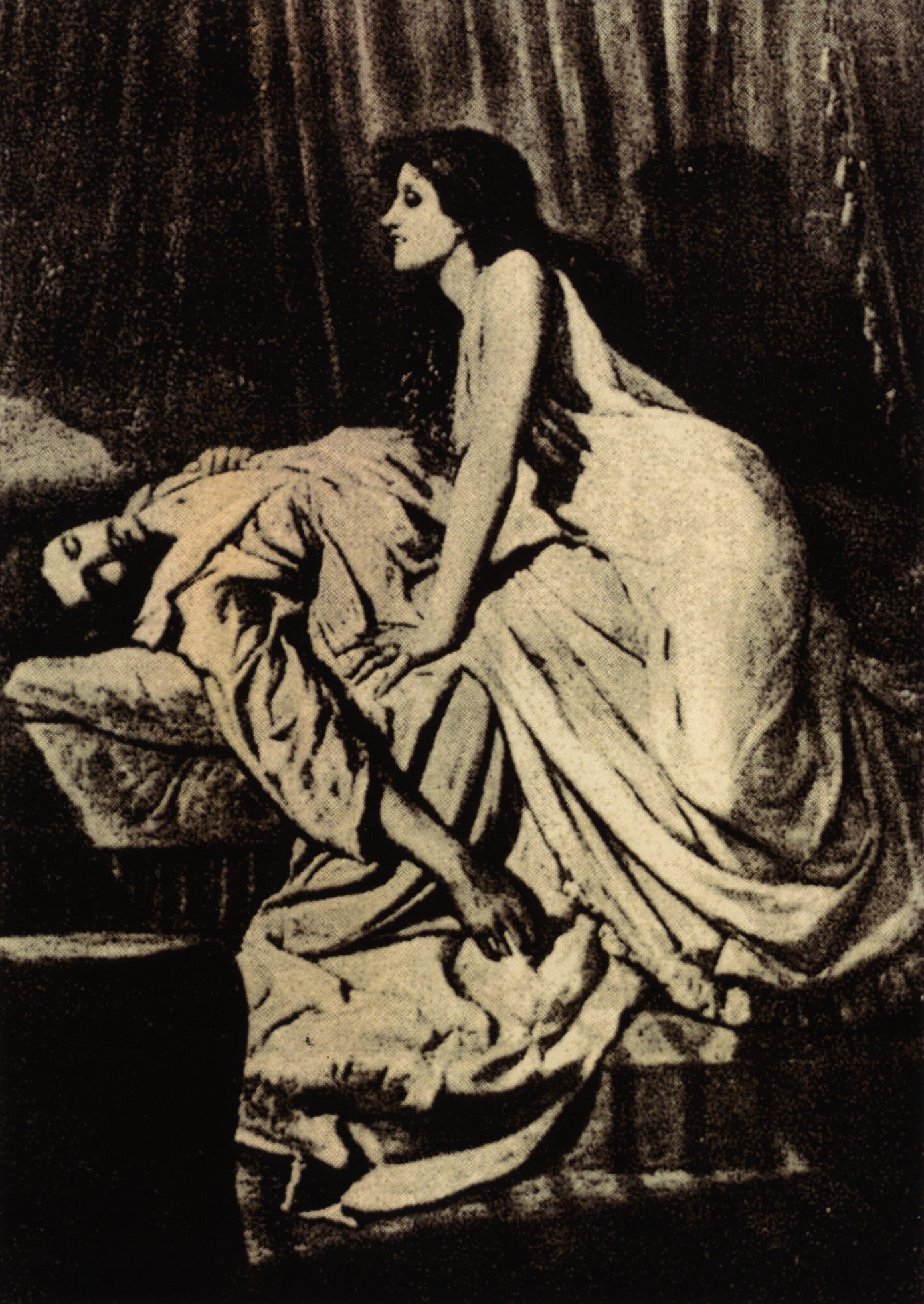
In the novel, Dracula creeps into both Lucy and Mina’s rooms whilst they sleep to bite each of them on the neck. This challenged a number of social values including men and women being alone without chaperones and men seeing women in anything other than full dress. Women were expected to restrain their desires, yet the female characters in Dracula welcome his penetration (pun intended). The titillation factor was high as a result, which might account for the popularity of the novel in the long term.

Symbolically, blood and the drawing of it have sensual connotations. Blood signifies a woman’s coming of reproductive age. It is associated with the loss of her virginity and subsequent sexual awakening. It is also spilled with childbirth (Kella), all topics that were not discussed in polite company, yet implicitly referenced in vampire lore.

The main thing that’s changed since Dracula’s heyday on the literary stage is the degree of vampiric humanity. Most vampires are young and attractive. They are driven by their appetite for blood, their lust, and their emotions. Many male vampires (think Aidan from Being Human and Damon from Vampire Diaries) epitomize the leather-clad bad-boy popularized by James Dean in the fifties and which a number of ladies still find appealing.

Modern vampires are tragic figures who, lives cut short and often sired against their will, evoke pathos in their struggle against what they’ve become and what they’ve had to do to survive the ages. They are portrayed as broken brooders in search of the one person on earth who is able to fix them. Though they sometimes mate with their peers, they often desire human companionship. Even then they are forever doomed to play Romeo to a still human Juliet, taking star-crossed lover after star-crossed lover only to watch them grow old, perish and die unless he turns her.

In spite of the myriad books, movies and television shows, vampires are still hot, the object of fear and fantasy for so many of us.

Which vampire or vampire story is your favourite? What was it that attracted you to it? Share your thoughts in the comments below.

“Saving Hope” from an Identity Crisis


In “Saving Hope”, Charlie (Michael Shanks) is in a car accident leaving him in a coma for most of the first season. While in the coma, his spirit roams the hospital interacting with other dead or nearly dead patients, helping them solve their dilemmas, watching his fiancée, Alex (Erica Durance), and  ex-wife, Dawn (Michelle Nolden), fight over whether or not to pull the plug. When Charlie finally awakens, he is left with the “gift” of seeing dead and nearly dead spirits in the hospital. He reluctantly makes the effort to help them with their problems, afraid he may be going insane. He finally lets hospital psychiatrist, Gavin (Kristopher Turner) know he may be hallucinating and is prescribed medication, but his ability doesn’t go away. After a near overdose, he decides to let Alex know. She doesn’t take it well and Charlie decides the best thing to do is to take a break from the relationship while he sorts out his situation. This serves to complicate matters, as free of Charlie, Alex finds herself drawn to colleague and ex-boyfriend Joel (Daniel Gillies).

I love “Saving Hope”. I like the characters and would be as happy seeing Alex with Charlie as I would with Joel. It’s filmed locally, right here in Toronto, Ontario, Canada, which is a bonus as–like with “Rookie Blue” and “Orphan Black“–it doesn’t try to hide or disguise the city. The stories are every bit as compelling as “Grey’s Anatomy” and sometimes as cringe-worthy as the most gross “Grey’s” emergency case or “Bones” opening segment. I like that it’s a guy who sees ghosts, and that he does so reluctantly. Charlie’s a good guy who means well, but he’s also worried for his career and social life and we get to see his internal struggle. Unlike “Ghost Whisperer”, Charlie has yet to experience catharsis into acceptance of his ability, and Shanks does an excellent job portraying this.

Where “Saving Hope” fails, is deciding if it’s a supernatural show or a hospital drama. This week’s episode was a prime example of that indecision, as there wasn’t a single ghostly encounter in the entire show. The odd thing is, as a pure medical drama, it worked. Maybe the confusion is not on the part of the writers, but on me. The show has potential as a supernatural-slash-medical drama. It works as a purely medical drama. The question is would it work as a purely supernatural one? If they took the action outside of the hospital, perhaps, but then you’d be taking away Charlie’s source of spirit. People die in the hospital. As a doctor, Charlie is in a position to be their first welcome into the afterlife. Without the medicine, “Saving Hope” would be nothing more than “Ghost  Whisperer: the early years”–assuming Charlie eventually comes to terms with his ability and whether he ultimately decides it is more a blessing than a curse.

Did you watch this week’s “Saving Hope”? What did you think? Were you disappointed there were no ghosts? Let’s talk in the comments below.